Fix the gate before you touch the latch
A gate that slams or won't catch is almost never a latch problem. Here's how to find the real cause and fix it in about an hour.
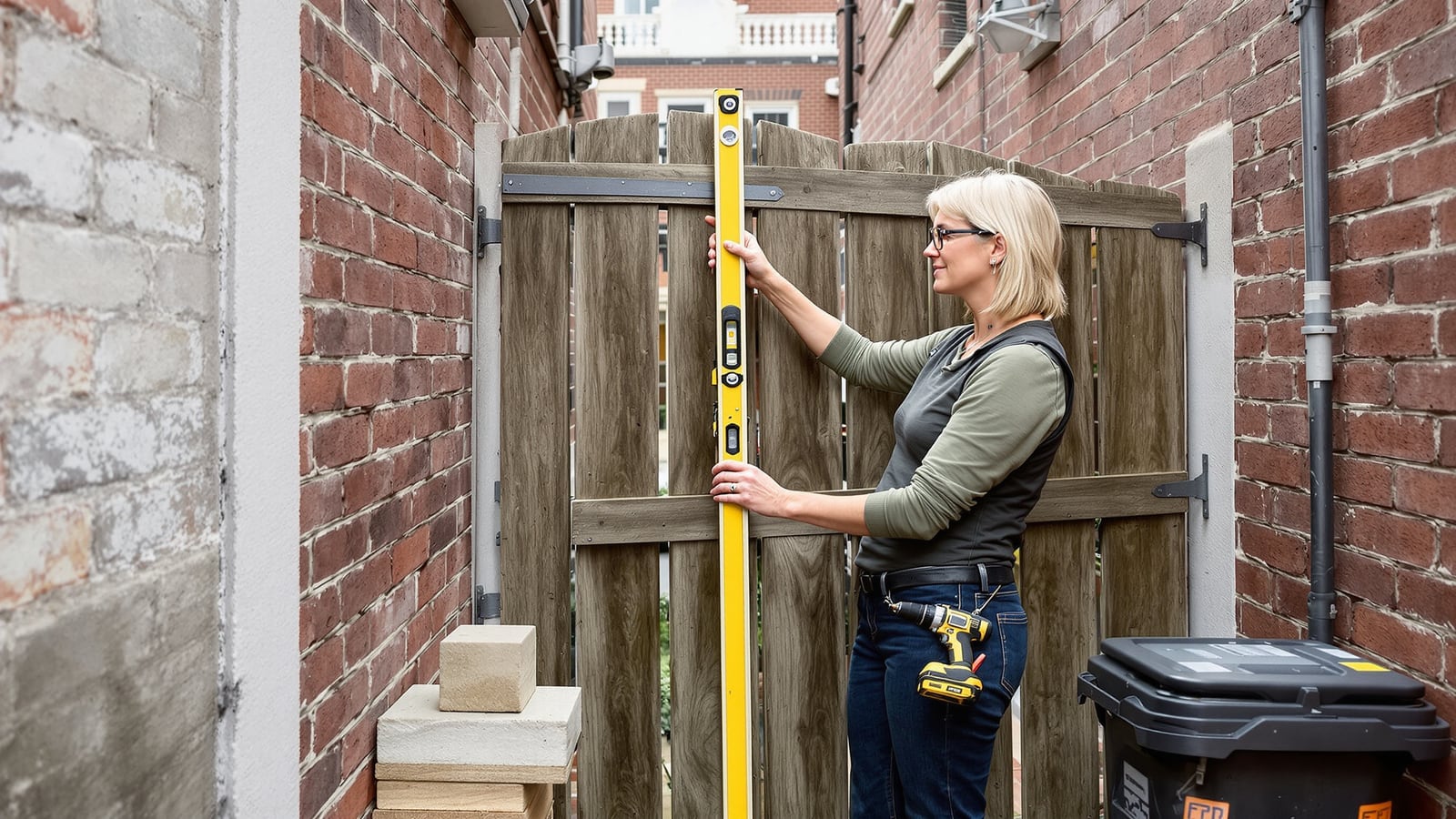
Quick answer: Tighten the hinges and check for sag first. Then move the latch strike until the bar clears it by about an eighth of an inch. Then slow the gate down with a hinge spring, a closer, or a rubber-faced stop. Most people start at step two and wonder why it never stays fixed.
You'll need a cordless drill, a screwdriver, a 2-foot level, a tape measure, a pencil, wood glue, a few toothpicks or a short length of dowel, and a handful of 2½-inch exterior screws. A rubber bumper or a strip of 1x2 for a stop is optional. Total cost is under ten dollars if you already own the tools.
Stay out of the pinch point
Gates are heavier than they look, and the gap between the gate and the post is where fingers get hurt. Wear safety glasses when you drill or drive screws. Work with the gate propped open, and never test the swing with your hand on the latch side of the post.
If the gate is heavy or tall, put a brick or a block of wood under the latch end so it's supported while you loosen anything. A gate that drops two inches on your foot ruins the afternoon.
Watch it before you wrench it
Open the gate and let it close three ways: a slow push, a normal swing, and a hard shove. Watch three things.
- Does the latch bar hit the strike too high, too low, or too far to one side?
- Does the bottom corner scrape the ground or the latch corner droop?
- Does it close because it's pushed, or because a spring is yanking it?
Write down what you saw. The answer tells you where to start. A bar that hits low means the gate is sagging. A gate that slams means too much closing force and nothing to catch it. A gate that bounces back open means the bar is missing the strike by a hair.
Fix the sag first
Look at the hinge side. Screws loosen over a few seasons, and the gate pivots on the loosest one until the latch end drops.
Tighten every hinge screw. If one just spins, the hole is stripped. Dip a toothpick or a piece of dowel in wood glue, push it into the hole, let it set for a few minutes, snap it off flush, and drive the screw back in. For a really chewed-up hole, use a longer screw that bites fresh wood in the post. Three inches is typical.
Now check the post with your level. If the post leans toward the gate, no latch adjustment will hold, and you've got a bigger job: resetting or bracing the post. If it's plumb, check the gate itself. Measure both diagonals of the frame, corner to corner. If they differ by more than a quarter inch, the gate has racked out of square.
Wood gates fix with a diagonal brace or an inexpensive cable-and-turnbuckle kit. The brace runs from the bottom corner on the hinge side up to the top corner on the latch side. Run it the other way and it does nothing. Tighten the turnbuckle a little at a time until the latch end lifts back to level.
Set the strike
Now the latch. Close the gate gently and see where the bar meets the strike. The bar should drop into the catch with roughly an eighth of an inch to spare, not bind in it and not scrape the plate.
Most strike plates have slotted or oversized holes for this reason. Loosen the screws, slide the plate toward where the bar lands, and snug the screws. Close the gate again. Repeat until the bar drops in without a lift or a shove.
If the plate has no slack, mark the new position with a pencil, fill the old holes with glued toothpicks, let them dry, drill new pilot holes slightly narrower than your screws, and mount it there.
Check the gap between gate and post too. A thumb-latch gate usually wants about a half inch to three-quarters. Too tight and it binds in humid weather. Too loose and the bar can't reach.
Wood moves with the seasons. A gate that latches perfectly in January may bind in August. Set it in the middle of the range and you'll touch it less.
Stop the slam
Slamming is speed. Something is pulling the gate shut harder than the latch can absorb, and nothing is slowing it.
If you've got spring hinges, there's an adjustment point on the coil, usually a hole for a hex key or a pin. Give it a quarter turn toward less tension and test again. A little too weak is better than a little too strong, because a gate that doesn't quite latch is a quick fix and a gate that slams leaves marks.
If you've got a hydraulic closer, look for a small speed screw. Turn it a quarter turn at a time. Most have a separate adjustment for the final few inches, which is where you get a soft click instead of a bang.
If you've got neither, add a stop. Nail or screw a 1x2 to the latch-side post so the gate lands against it, and stick a strip of rubber or adhesive weatherstripping on the face. The gate comes to rest against something soft, and the latch has time to catch. A rubber bumper on the strike side works for the same reason.
If the gate has an electric opener, that's a different job, and the wiring side is worth reading about first. See the wiring jobs worth doing yourself and the ones that aren't.
Test it like a kid would
Close the gate at all three speeds again. Then walk through it with your arms full, the way you do on a Saturday with a bag of mulch or a basket of laundry. If you need a free hand to coax it shut, it isn't done.
Test it in the wind if you can. A gate that latches on a still day and flaps open in a breeze needs a bit more strike depth or a stronger catch.
If this gate guards a pool, a play yard, or anywhere small children could wander, don't defeat the latch to make it easier. Many local codes require pool gates to be self-closing and self-latching, often with the latch mounted high. Check your local rules before you adjust anything, and test the gate every month. A gate that stays open because someone propped it with a rock isn't a gate.
If you need to tie it shut for a day while a part is on order, a rope hitch will do. Six knots, and the order to learn them in covers one that holds and still comes undone.
Finish the job
Put a drop of oil on the latch bar and the hinge pins. Wipe off what drips. Sweep up the toothpick ends and the wood chips. Take the empty screw box and the brick back to the garage.
And if it's a neighbor's gate you fixed because you got tired of hearing it, don't mention it. Let them wonder why the morning got quieter.
Wes Dunbar
Country & Skills
Grew up on an acreage and never quite left. Covers trucks, trades, land, and how to do the thing yourself.

Watch
Worth an hour of your evening
More from Skills.
From channels we rate. Plays on YouTube.
Read next