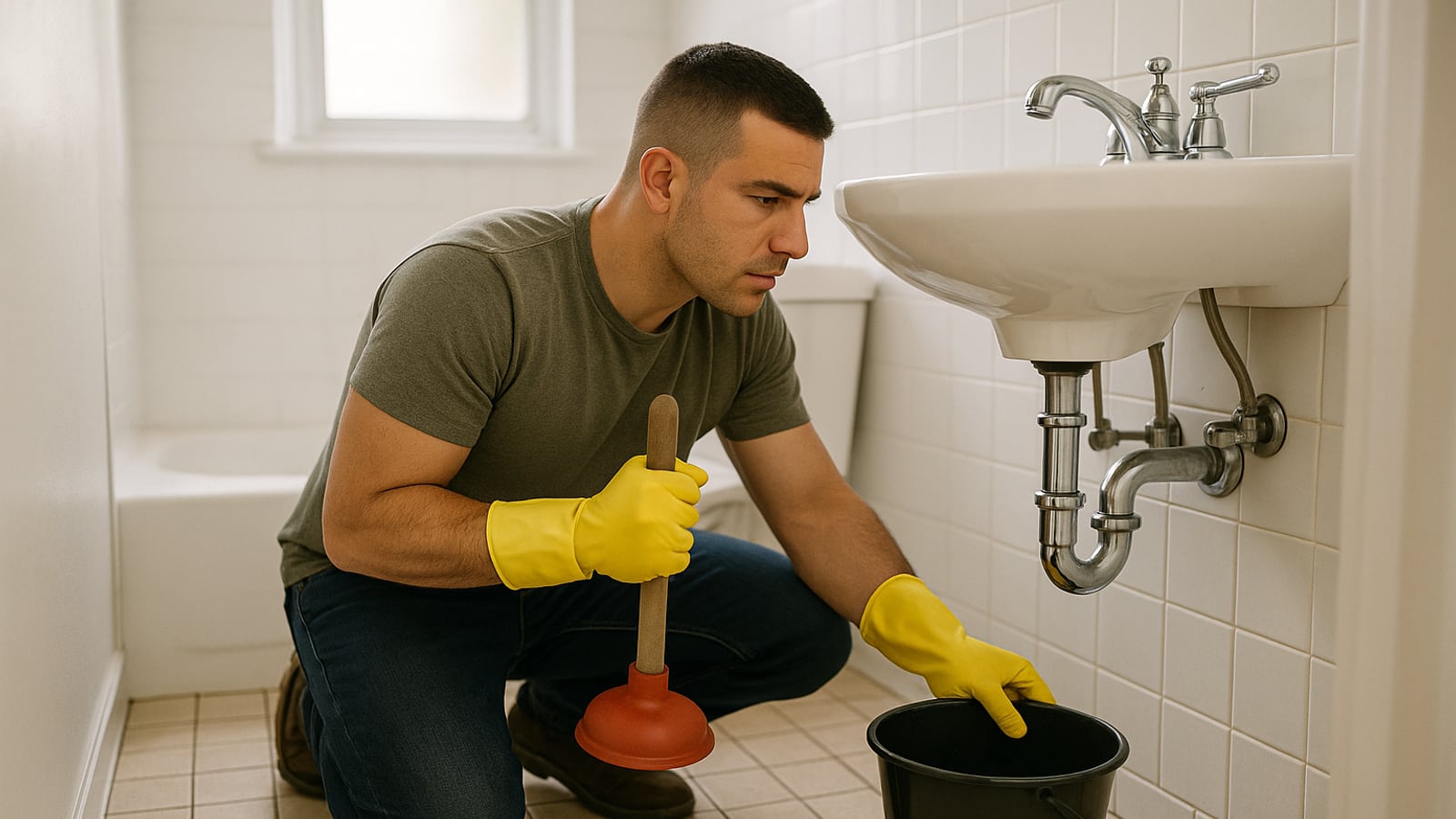
Before you touch anything, run the taps in every room and flush the toilet. You're answering one question: is it one fixture or all of them?
One slow sink means the blockage is local. It's almost certainly in the trap or the short run of pipe behind it, and you can clear it yourself. Multiple fixtures backing up — or a toilet that gurgles when the washing machine drains — means the problem is further down the line, shared between them, and your plunger isn't going to reach it. Knowing which of those you've got saves you an hour of pointless effort.
Safety, and the one thing that makes this dangerous
Waste water isn't clean. Wear rubber gloves, keep your hands away from your face, and wash properly afterwards — not a rinse, a proper scrub with soap.
Wear eye protection when you plunge. It feels like overkill right up until the moment something comes back at you.
The genuine hazard is chemical drain cleaner. If somebody has already poured a bottle of caustic cleaner down that drain and it hasn't worked, you now have a pipe full of standing water laced with something that burns skin. Do not plunge it — you'll splash it. Don't open the trap underneath either. And never, ever pour a second product in on top of the first. Bleach and acidic cleaners together produce chlorine gas in a confined space like a bathroom, and people have been hospitalised for exactly that.
If chemicals are already in there, your options are to bail the standing water out carefully into a bucket with gloves and goggles on, flush the fixture with a lot of cold water, and only then start work. Or call someone and tell them exactly what went down there.
Clear the obvious first
Take the strainer or plug out. In a bathroom sink, that often means unscrewing a pop-up waste or twisting the grate free.
Get a torch and look. Then get a bent piece of stiff wire — a coat hanger with a small hook bent into the end works — and fish. In bathroom sinks and showers, the culprit is nearly always a mat of hair and soap sitting six inches down, wrapped around the waste fitting. Pull it out. Have a carrier bag ready, because it's genuinely unpleasant and you don't want to be carrying it through the house on a hook.
A cheap plastic drain-cleaning strip — the flat barbed one that costs less than a coffee — does this better than a coat hanger and is worth keeping in the cupboard. Push it down, twist, pull slowly.
In a kitchen sink, the blockage is usually congealed fat and food rather than hair, and it's usually a bit further along. Skip to the plunger.
Hot water and washing-up liquid
For kitchen grease, heat does a lot of the work.
Squeeze a good amount of washing-up liquid into the plughole. Follow it with hot water from the tap, as hot as it runs, and leave it five minutes so the detergent can get at the fat.
Use hot tap water, not a kettle of boiling water. Boiling water can soften plastic waste pipes and loosen glued joints, and poured into a cold ceramic sink or a WC pan it can crack it. Hot tap water is hot enough for grease and won't cost you a basin.
Run the tap. If it's draining slowly rather than not at all, repeat twice. Slow drains often give up at this stage.
Plunge it properly
Most people plunge badly, then conclude the plunger doesn't work.
Block the overflow. Every basin and bath has one — that little hole near the rim. If it's open, you're just pushing air around in a circle. Jam a damp cloth into it and hold it there, or get someone to hold it.
Make sure there's water in the bowl, two or three inches, enough to cover the rubber cup completely. Plungers move water, not air. Water doesn't compress, so the pressure goes straight down the pipe.
Seat the cup flat and get a seal. Then push and pull steadily, fifteen or twenty strokes, keeping the seal the whole time. Don't lift off between strokes. The pull is doing as much as the push — you're trying to rock the blockage loose from both sides, not hammer it tighter.
On the last stroke, break the seal sharply and see whether the water goes.
For a double kitchen sink, block the second plughole with a wet cloth and something heavy. Otherwise all your pressure comes straight back up through it.
A toilet needs a flange plunger — the sort with the extra rubber sleeve that folds out of the cup. The flat cup meant for sinks won't seal on a WC pan. And if the pan is already full to the brim, bail some out first, or you'll flood the floor.
Open the trap
If plunging fails on a sink, the trap comes off. This is easier than it looks and it's where the blockage usually is.
Put a bucket underneath — a washing-up bowl is better in a tight cupboard. There will be more water than you expect.
Modern plastic traps have two big slip nuts you loosen by hand. Turn them anticlockwise from underneath. If they're tight, use a pair of water pump pliers gently, wrapping a cloth around the nut so you don't chew up the plastic. Old brass or chrome traps are stiffer and easier to damage, so go slowly.
Take the trap off, empty it into the bucket outside, and rinse it. Check the rubber washers are still in place and the right way round before you refit — the tapered edge faces into the joint. Hand-tighten only. Overtightening cracks the nut.
Then run the tap with the bucket still underneath and watch the joints for drips.
If the trap was clear, the blockage is in the pipe behind it. Feed a hand-turned drain auger into the open pipe, turn the handle clockwise as you push, and keep turning as you draw it back so the debris comes with it.
Outside
Go and look at the drain in the garden, the one with the grate that the kitchen waste pipe runs into.
If that gully is full of standing water and leaves, that's your blockage, and it's a bucket-and-gloves job. Scoop it out. There's often a build-up of silt and fat in the bend beneath. Clear it, then flush the gully with a hose.
Lift the manhole cover if you have one and can do it safely — they're heavy and the edges catch fingers. If the chamber is running clear, the problem is between the house and there. If it's full, the problem is downstream and it may not even be yours.
When to stop
Stop and call a professional if more than one fixture is affected, if there's water or sewage coming up through a shower tray or ground-floor toilet, if the manhole is full, if you can smell sewage inside the house, or if you've spent an hour and got nowhere. In the UK, blockages in shared drains beyond your boundary are usually the water company's responsibility, and they'll often come out for free — worth a phone call before you pay anyone.
Keep a plunger, a plastic drain strip and a pair of long gloves under the sink. Tip the fat from the roasting tin into a jar, not the plughole.
The people who never have this problem aren't luckier. They just stopped pouring the chicken fat down the sink about ten years ago.
Wes Dunbar
Country & Skills
Grew up on an acreage and never quite left. Covers trucks, trades, land, and how to do the thing yourself.

Watch
Worth an hour of your evening
More from Skills.
From channels we rate. Plays on YouTube.
Read next