Build a whole wardrobe for two thousand dollars in twelve months
Take the tailoring money off the top, buy coats in February, and stop shopping for clothes you already own.
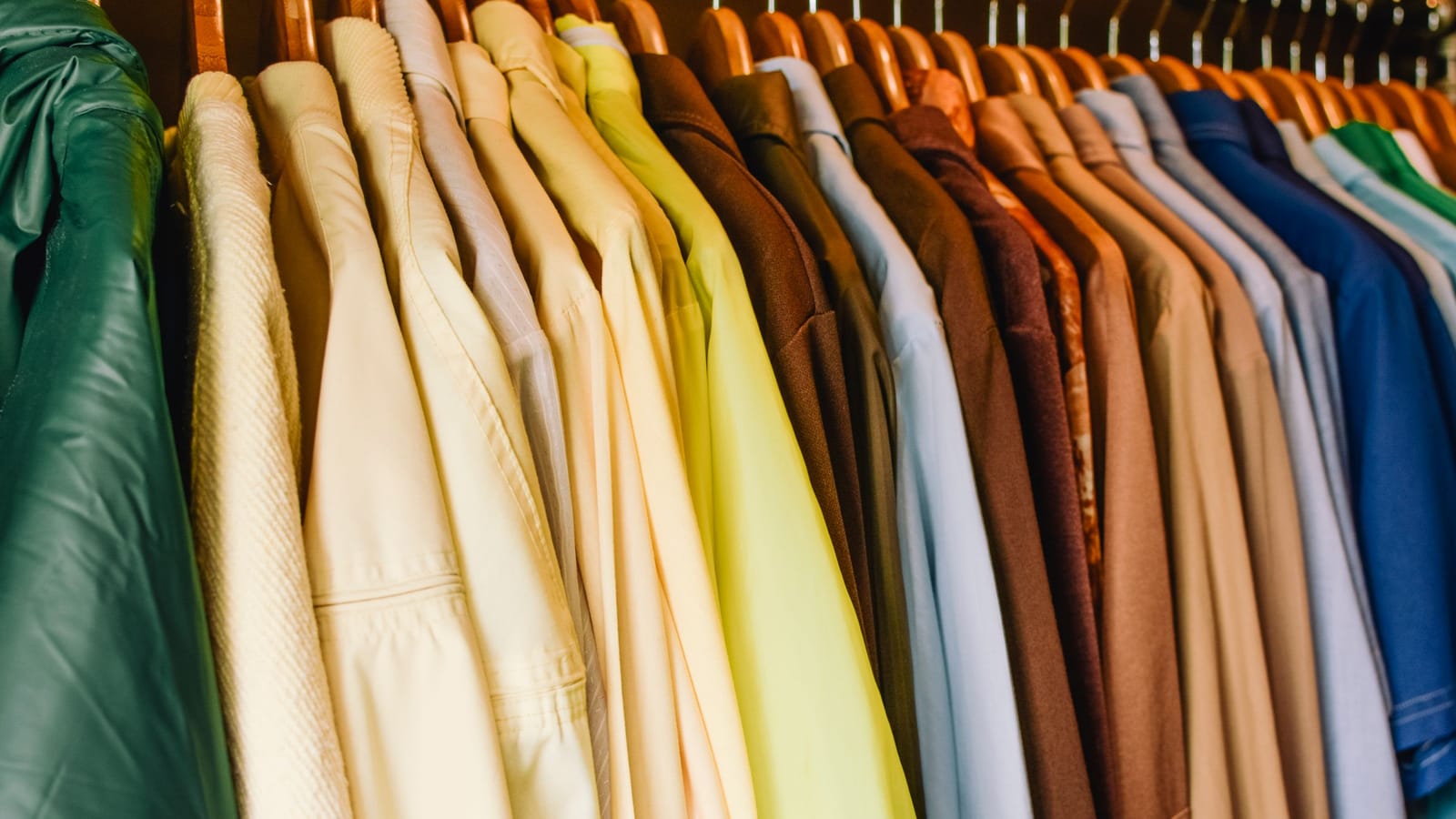
Take $250 off the top and don't spend it on clothes. That's your tailoring money, and it's the difference between a closet full of stuff and a closet that works. Hemming a pair of trousers runs somewhere around $15 to $25. Tapering a leg, maybe $20 to $30. Taking in the sides of a shirt so it stops ballooning over your belt, usually in the same neighborhood. Shortening jacket sleeves costs more, often $35 to $50, and it's still the best money in the whole plan.
That leaves $1,750 for garments. Over twelve months, that's about $146 a month. Which sounds thin until you realize you're not buying a wardrobe. You're buying eleven or twelve things, spaced out, at the right time of year, with a tape measure in your head.
Why a year beats a weekend
Two thousand dollars spent in one Saturday buys you a wardrobe that all fits the same mood. You'll come home with three shirts in slightly different blues and no coat. Ask me how I know.
Spread across a year, three things happen. You hit two full clearance cycles instead of zero. You learn what you actually reach for, because you're living in the clothes while you build. And your tailor gets to know you, which matters more than any brand on any label.
The sale calendar isn't complicated. Late January and February is when winter outerwear collapses in price, because stores need the floor space and nobody's buying a wool coat in March. Late July and August does the same thing to warm-weather clothes and, oddly, to a lot of leather sneakers. Boots go on sale around Thanksgiving. Everything else drifts down at the end of each season and back up at the start of the next.
Write the gap list first
Before you spend a dollar, wear what you already own for two weeks and keep a note on your phone. Every morning, write down what you put on and what you wished you had instead. Not what you think you should own. What you actually needed at 7 a.m. on a Tuesday.
Most men find the same holes. No jacket that isn't athletic or a suit coat. Trousers that are either sweatpants or dress pants with nothing between. Shoes that are either sneakers or the ones from a funeral in 2019.
That list is your buy order. Fill the hole that annoys you most first.
The allocation
Here's the split that works, and yes, footwear eats the biggest slice. It should. You wear them every day and they're the hardest thing to fake.
- Footwear, $600. Clean leather sneakers around $120. Dark brown leather dress shoes, $280. Boots, $200.
- Trousers, $340. Two pairs of chinos, about $70 each. Dark, plain denim, $80. One pair of wool or wool-blend dress trousers, $120.
- Shirts, $300. Three oxford cloth button-downs at roughly $50. Two proper dress shirts, around $55 each. Two heavyweight plain tees, $20 each.
- Knitwear, $180. A merino crewneck around $100. A cotton knit polo or lighter sweater, $80.
- Outerwear, $330. A winter coat for $180 on clearance. A shoulder-season jacket for $150.
- Tailoring, $250.
Twelve months, twelve or thirteen garments, plus the alterations. That's the whole thing.
Month by month
February. Buy the winter coat. A charcoal or navy topcoat, or a dark insulated jacket if your life is more parking lot than office. Full price these run well past $300. In the second week of February they don't. Buy it a year ahead of when you need it and hang it up.
March and April. Trousers. Two chinos in stone and olive, one dark denim, one wool trouser. Then take all four to the tailor in one trip, which is your first real bite out of the alterations fund, probably $70 to $100. Get the hem right. A puddle of fabric on your shoe ruins a $400 pair of pants and a break that's clean makes a $50 pair look intentional.
May. Oxford cloth button-downs, three of them. White, light blue, and a university stripe if you want one piece of pattern in your life. These are the workhorse. They go under the sweater, under the jacket, with the chinos, with the denim, tucked or not.
June. The sneakers. Plain leather, low profile, minimal branding, in white or a muted tone. You'll replace these before anything else on the list, so this isn't the place to stretch.
August. Shoulder-season jacket, off the end-of-summer rack. An unstructured cotton or linen-blend sport coat, a chore coat, a harrington. Whichever one matches how you actually live. If it's a sport coat, budget $50 of the tailoring money for the sleeves, because sleeve length is the single loudest tell on a jacket.
September and October. Dress shoes and dress shirts together, so you can see them as an outfit. Dark brown leather, because it does more work than black and forgives more. Two shirts with a collar that stands up on its own.
November. The merino crewneck and the knit polo, both of which are cheaper the week of Black Friday. Boots if the sale is genuinely good.
December. The tees, and whatever the gap list says you still don't have. Spend the rest of the tailoring fund fixing the things you already bought and have since decided you'd wear more if the sleeves were shorter.
What goes wrong
You buy the fun thing first. The jacket with the texture, the boots with the contrast sole. Then you're eight months in with nothing to wear under any of it.
You buy to a number instead of to the list. If you're sitting on $58 in September and there's a sweater for $58, that's not a reason.
You buy the second version of something you already own. Everyone does this. You find a shirt you like, so you buy the shirt you like again in a slightly different color. Two olive chinos isn't a wardrobe, it's a uniform with an understudy.
And you skip the tailor because the garment "basically fits." Basically fitting is what everyone in the room is doing. Fitting is what people notice without knowing why.
Fit, then fabric, then the label
A $45 oxford that sits right on your shoulders beats a $180 one that doesn't, every day of the year. The shoulder seam is the one thing a tailor can't fix cheaply, so that's the one you check hardest. After fit, read the tag. Look for cotton you can feel weight in, wool that isn't mostly polyester, leather that's whole rather than corrected-grain sprayed shiny.
The name on the label is the last thing to worry about, and honestly, nobody who matters is reading it. Half of what's on this list can come from a store you already drive past. Some of it should come from a thrift rack if you've got the patience.
By next February you'll have a coat you didn't panic-buy, shoes that got resoled instead of replaced, and a tailor who knows your inseam without asking. That's the whole trick, and it costs about the same as one weekend of doing it wrong.
Dean Shaw
Gear & Garage
Reads the warranty, the parts list and the long-term owner reviews before anything else. Trucks, tools, watches, and the cheap version that costs more.

Watch
Watch how it's done
Picked for this article.
From channels we rate. Plays on YouTube.
Loya the Fashion Queen
How to Build a Capsule Wardrobe on a Budget | What to Buy + Prices & Outfit Ideas
GAINSBYBRAINS
I Got Rid of Everything and Built a Minimalist Capsule Wardrobe
Read next