

Can you walk out on it? Settle that before you wrap it
A rolled ankle three miles from the truck is a decision before it's a bandage. Here's how to make that call, wrap it right, and know when to stop walking.
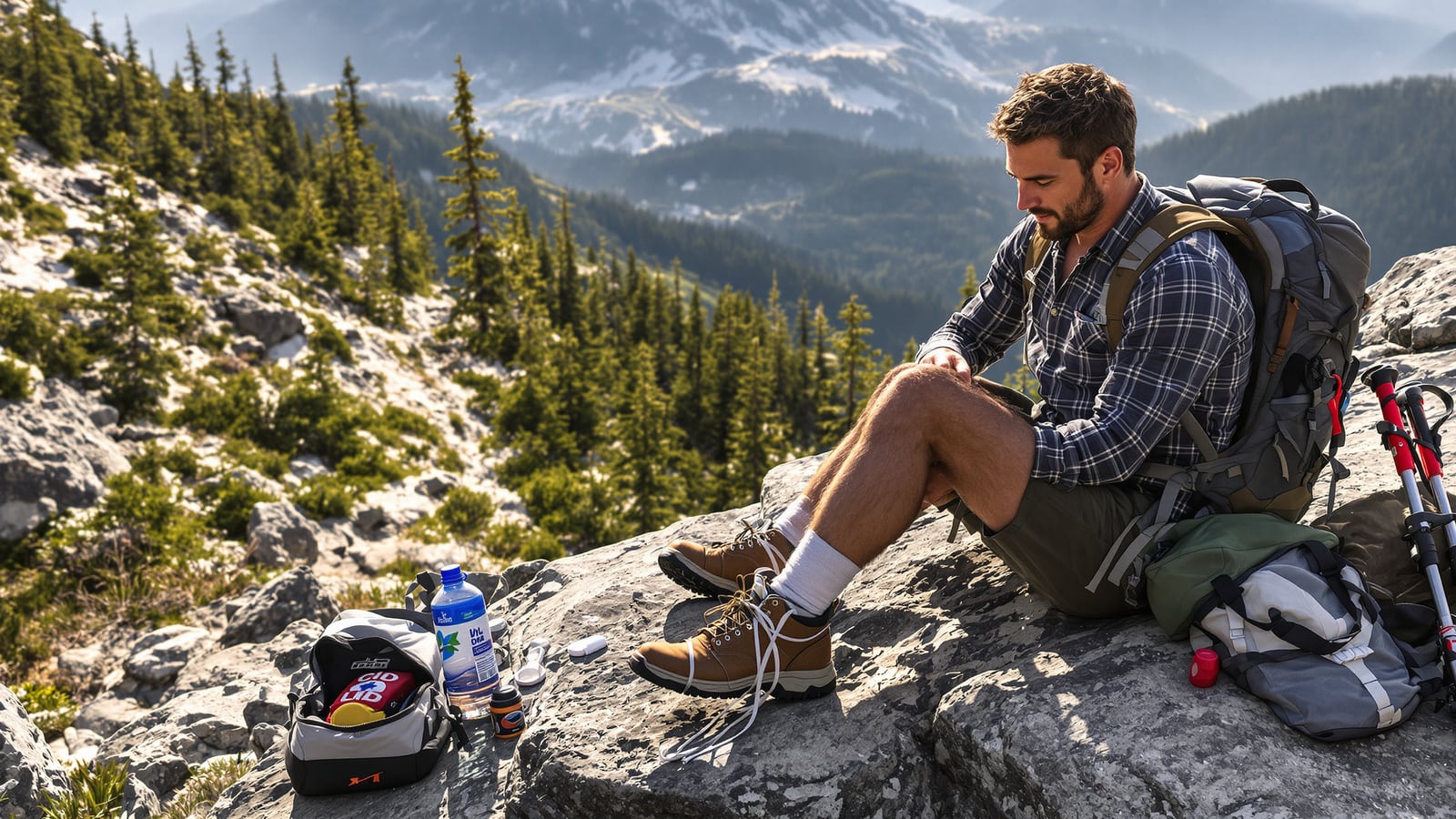
Quick answer: Sit down and wait five minutes before you test it. If you can take four steps on it and nothing is deformed or numb, wrap it over the boot and walk out slowly, with a pole. If you can't, you're staying put and sending for help.
You're three and a half miles from the truck on a descent. A rock rolls, your foot goes one way, and you hear or feel a pop. You're sitting on the trail before you decided to sit.
The next ten minutes matter more than the wrap.
Sit, breathe, and don't test it yet
Pain peaks in the first minute and settles. If you stand up right away to "walk it off," you learn nothing except how much it hurts at its worst.
Get out of the middle of the trail. Drink some water and eat something. Look around: how much daylight is left, what the sky is doing, who's with you. Leave the boot on. A laced high-top is the best splint you own, and once an ankle swells, a boot that came off often won't go back on.
If you're with a group, say how it really feels. Don't shave it down so nobody's schedule gets hurt. A friend would rather lose an hour than carry you.
The four-step test
After five minutes, stand and take four steps, even if they're ugly. Clinics use a version of this, called the Ottawa ankle rules, to decide who needs an X-ray. Two things raise the flag:
- You can't take four steps without the pain stopping you.
- Pressing on the bony knob on either side of the ankle, or along the back edge of it, hurts sharply. Soft, achy tenderness in the squishy parts is a different thing.
It's a screening tool, not a diagnosis, and you're not a radiologist. But it gives you a straight answer when your pride wants a different one.
Treat any of these as a stop sign:
- A foot that looks bent or out of line.
- Numbness, tingling, or a cold, pale or bluish foot.
- Pain that climbs instead of settling.
- A pop or snap followed by an ankle that feels loose.
How to wrap it
You need a 3-inch or 4-inch elastic bandage. It costs about $5 to $8, weighs next to nothing, and belongs in every pack.
- Start at the ball of the foot, just behind the toes. Leave the toes bare so you can check them.
- Spiral up and back, each turn covering about half of the last one. Firm, not tight.
- Make two or three figure-eights around the heel and ankle. That's what actually holds the joint.
- Finish a few inches above the ankle bone and secure it.
- If you're walking out, wrap over the boot or sock and lace the boot snug on top.
Check your toes every fifteen minutes. Look at color, warmth and feeling. If they tingle, go numb or turn dusky, unwrap and redo it looser right away.
Swelling keeps coming for hours. A wrap that felt right at noon will pinch by two.
For more stiffness, add athletic tape (a 1.5-inch roll runs $5 to $8). Run a strip from the inside of the lower leg, under the heel, and up the outside, two or three times. This is the "stirrup," and it's worth practicing on your own foot in the living room, not on the trail.
What to carry, and what it costs
- Elastic bandage and athletic tape: about $10 to $15 together.
- A SAM-style foam splint: roughly $15 to $20. Mold it into a U under the heel and up both sides of the calf, and hold it with the wrap. It earns its place the moment you're not walking.
- Trekking poles: about $50 to $150 a pair. On a bad ankle, one pole is a crutch and two are a way out. A sturdy branch works in a pinch, but a branch is also a good way to turn one injury into two.
- A way to send for help: a satellite messenger runs roughly $300 to $400 plus a monthly plan. A personal locator beacon costs about the same with no subscription. Phones lose signal in the places ankles get hurt.
Pain relievers are a question for your doctor or pharmacist before the trip, not something to improvise out there.
The walk-out math
This is where people go wrong. Don't ask "can I walk?" Ask "can I walk all of it before dark and in this weather?"
Work out the clock. Take the miles to the truck and assume you'll move at well under half your normal pace, slower on descents. Subtract that from your daylight. If the answer is close, it isn't close. You lose.
Walk out if all of these hold:
- You passed the four-step test, and the foot is warm, pink and feeling normal.
- The route is mostly gentle. Steep scree and stream crossings change the math.
- You have comfortable margin before dark.
- The weather is holding.
- You're not alone, or someone knows exactly where you are and when to worry.
Stay put if any of these are true:
- You failed the test, or the foot looks wrong.
- Dark or cold, wet weather is coming before you can finish.
- You're alone and far out with a route you can't do on one good leg.
Stopping isn't failure. It's the decision that keeps a sprain from becoming a night out with a fractured ankle and no jacket.
If you're staying
Get warm and dry first, since the ankle will keep. Put on every layer you've got and get off the ground onto a pack or pad. Raise the foot on your pack. Cool water from a stream on the wrap can ease swelling. Then send for help with your messenger and keep making yourself easy to find. Bright clothing laid out in the open and a whistle, three blasts at a time, help searchers. The same calm approach applies as in what to do in the first hour you're lost in the woods.
If you have no way to send a message, someone should already know your plan. Leave it before every trip: the trailhead, the route, the car, and the hour at which they should contact local police or the ranger district if you haven't checked in. Without that, you're depending on luck.
If you're carrying a sidearm
Legal carry on the trail is a right, and an injury is when habits slip. You're off balance, leaning on a pole, maybe falling. Keep the firearm holstered with the trigger covered and treat the four rules as non-negotiable: muzzle in a safe direction, finger off the trigger, treat it as loaded, know your target and what's beyond it. Don't take it out to "get it out of the way" while you wrap your ankle. Once you're home, it goes back into locked storage away from children. Carry and transport laws vary by state, province and county, and none of this is legal advice. Check local law or ask a qualified instructor or attorney.
Take a class
Reading a piece like this is a start. A hands-on class makes it stick, the same way your first firearms class does for shooting. A wilderness first aid course usually runs about 16 hours and costs a couple hundred dollars. A longer wilderness first responder course takes about a week and costs several hundred more. A qualified instructor will make you wrap a real ankle and splint a real leg while somebody watches your hands.
An injured ankle is rarely the emergency. Bad decisions around it are. Be the one in the group who stops, checks the clock, speaks plainly and leaves the trail better than he found it, with the wrapper in his pocket.
Wes Dunbar
Country & Skills
Grew up on an acreage and never quite left. Covers trucks, trades, land, and how to do the thing yourself.

Watch
Worth an hour of your evening
More from Survival & Self-Defense.
From channels we rate. Plays on YouTube.
Read next