
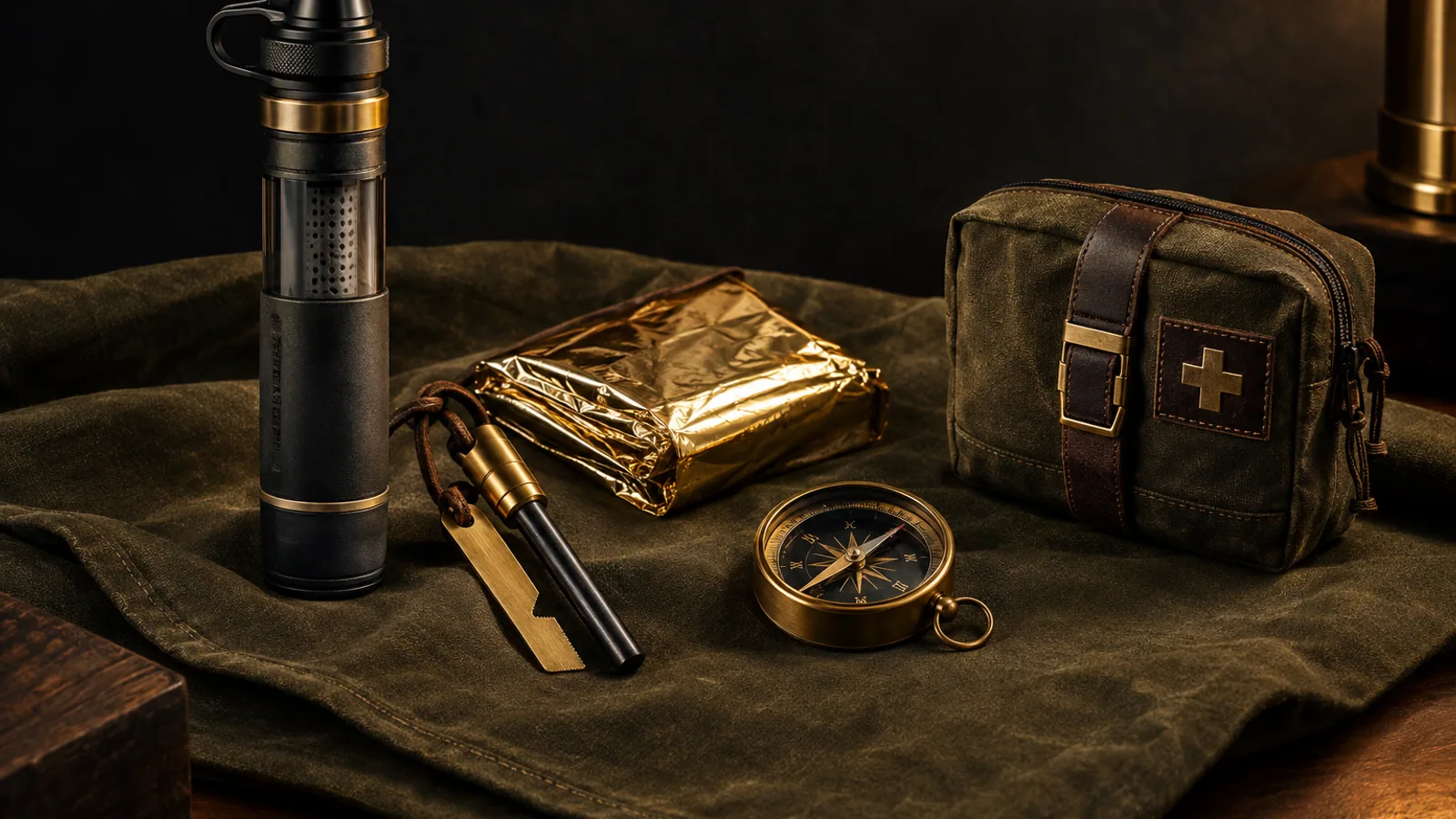
Quick answer: If the injury involves the neck, back, head, chest or belly, don't move the person unless the spot itself will hurt them. Call, insulate and wait. If it's a lower-leg injury, you've got four or more able bodies, and the trailhead is close, a jacket-and-pole stretcher works.
It's 4 p.m. Your buddy's ankle just folded on loose rock, and the trailhead is two miles away. Two miles is a lunch break. Two miles with a 190-pound man in your arms is a different trip altogether.
Most people's instinct is to pick him up and go. That instinct comes from a good place, and it's how one injured hiker becomes three. The carriers are the next ones to turn an ankle, wrench a back or run out of daylight.
Decide before you lift
Don't move the patient, except to get away from immediate danger, if any of these are true:
- Neck or back pain after a fall or a hard impact
- A head injury with confusion, repeated vomiting or a drowsy, off-kilter look
- Numbness, tingling or trouble moving the legs
- Chest or belly pain
- Bleeding you haven't gotten under control
Real danger changes that. Lightning, rising water, rockfall and a slope that's still shedding are all reasons to move. Even then, you're moving him to the nearest safe spot. You're not hauling him to the car.
Everything past this point assumes a lower-leg or similar injury, a patient who's alert and stable, and a short, passable route out. If you can't say yes to all three, stop reading and start calling.
Can he walk with help?
Often, yes. And it beats any stretcher.
Splint the ankle. A SAM splint runs about $15 and weighs next to nothing. Leave the boot on if it'll stay on, since it's a decent splint already. Pull it off only if the foot is going numb or turning blue. Hand him a trekking pole or a stout branch. Put one person under his arm on the injured side, and let the other walk ahead and pick the line.
Slow is fine. Slow is the whole plan.
Count your people first
A stretcher needs four carriers at minimum. Six is better, because they rotate. Two people can't carry a stretcher over rough ground. Don't try.
If there are only two of you, your options shrink to the assisted walk, a short drag on smooth ground, or waiting. That's not a failure of nerve. It's arithmetic.
The jacket stretcher
It's old, it works, and you probably already own the parts.
- Cut or find two straight poles, about 8 feet long and 2 to 3 inches thick. Green wood bends and dead wood snaps. Test each one by leaning your full weight on it.
- Take two or three sturdy jackets, zip them up and turn them inside out so the sleeves tuck into the body.
- Slide the poles through the sleeves. The jackets become the bed.
- Or skip the jackets. Roll a tarp or blanket around the poles, folding the edges over at least twice so his weight pins the fold.
- Pad the bed with a sleeping pad or spare clothing. Poles through nylon get ugly after twenty minutes.
- Lay him on and secure him with webbing or cord across the chest and thighs. A loose patient on a slope is a second injury waiting.
Test it before you trust it. Put the heaviest healthy person on it, lift to knee height and walk ten steps. If anything sags, slips or creaks, fix it while it's cheap.
Then plan the carry. Keep him as level as the ground allows. Call out every obstacle, every root and every step. Swap carriers often, long before anyone says they're tired, because by the time someone says it, they're already stumbling. Expect a mile to take far longer than a mile should.
The drag and the seat
A sleeping pad or tarp can drag a person a short way over grass, snow or smooth dirt. It's brutal on rock and roots, and it's no way to cover distance.
The two-person hand seat, where each carrier grips their own wrist and the other's, works for a conscious patient over maybe a hundred yards. Past that your forearms quit. It's for getting around a bad spot, not for the trail home.
When to wait
Waiting is usually the better call, and it's the one people feel guilty about. Wait when:
- You've reached 911 or someone has your itinerary and expects you back
- Anything on the don't-move list applies
- You've got fewer than four carriers
- It's getting dark and the route has drop-offs, creeks or loose footing
- The distance is more than a short haul
Waiting isn't sitting there. Insulate him from the ground first, because the ground steals heat faster than the air. A pad, a pack, a tarp, whatever you've got. Add a shell, a hat, a bivy if you carry one. Get water into him if he's alert and not suspected of internal injury. Write down the time, the GPS coordinates, the injury and what you've done. The rescuers will want it, and your memory will be worse by midnight.
Phones reach 911 from more places than people expect, and a text can sometimes get through where a call won't. Many recent phones can also send an SOS over satellite. Test yours before the trip, not during it. If you hike beyond coverage, a Garmin inReach Mini runs about $350 to $450 plus a monthly plan, and a personal locator beacon runs roughly $300 to $400 with no subscription. Either one can be the difference between a two-hour wait and a long night.
If you have to send someone for help, send two. Nobody walks out alone, and nobody leaves the patient alone unless there's truly no other choice. Hand the messengers the written note. If you've gotten turned around getting there, the first hour matters most, and the same calm applies.
What to carry
None of it is expensive:
- A SAM splint, about $15
- 100 feet of 550 paracord, $15 to $20
- An 8 by 10 tarp, $20 to $30
- An emergency bivy or space blanket, $20 to $50 for something that'll survive more than one use
- Webbing straps, a few dollars each
- A whistle, because three blasts carry farther than a shout
None of it helps if you've never touched it. Rig the stretcher in your backyard on a Saturday. You'll learn more in twenty minutes than from any article, this one included.
Get the real training
Everything above is general education, not medical advice, and no article can teach you to judge a spine injury. A Wilderness First Aid course runs roughly 16 hours and about $200 to $300. Wilderness First Responder is a much deeper course and costs somewhere around $700 to $1,000 or more. Outfits like NOLS Wilderness Medicine and the Red Cross teach them, and the hands-on practice is the point.
Same rule as any other skill you hope never to use: the training is the part that works when your hands are shaking.
The best carry-out is the one you never make. You kept him warm, you kept your head, and you let the people with the litter and the radios do what they're built for.
Cal Brennan
Fitness
Strength coach. Trains fathers, tradesmen and desk workers, which means programmes that survive a bad week.

Watch
Worth an hour of your evening
More from Survival & Self-Defense.
From channels we rate. Plays on YouTube.
Read next