

Make the walk-out call before the ankle swells
A rolled ankle two miles from the truck is a decision problem first and a wrapping problem second. Make the call in ten minutes, while it's still easy.
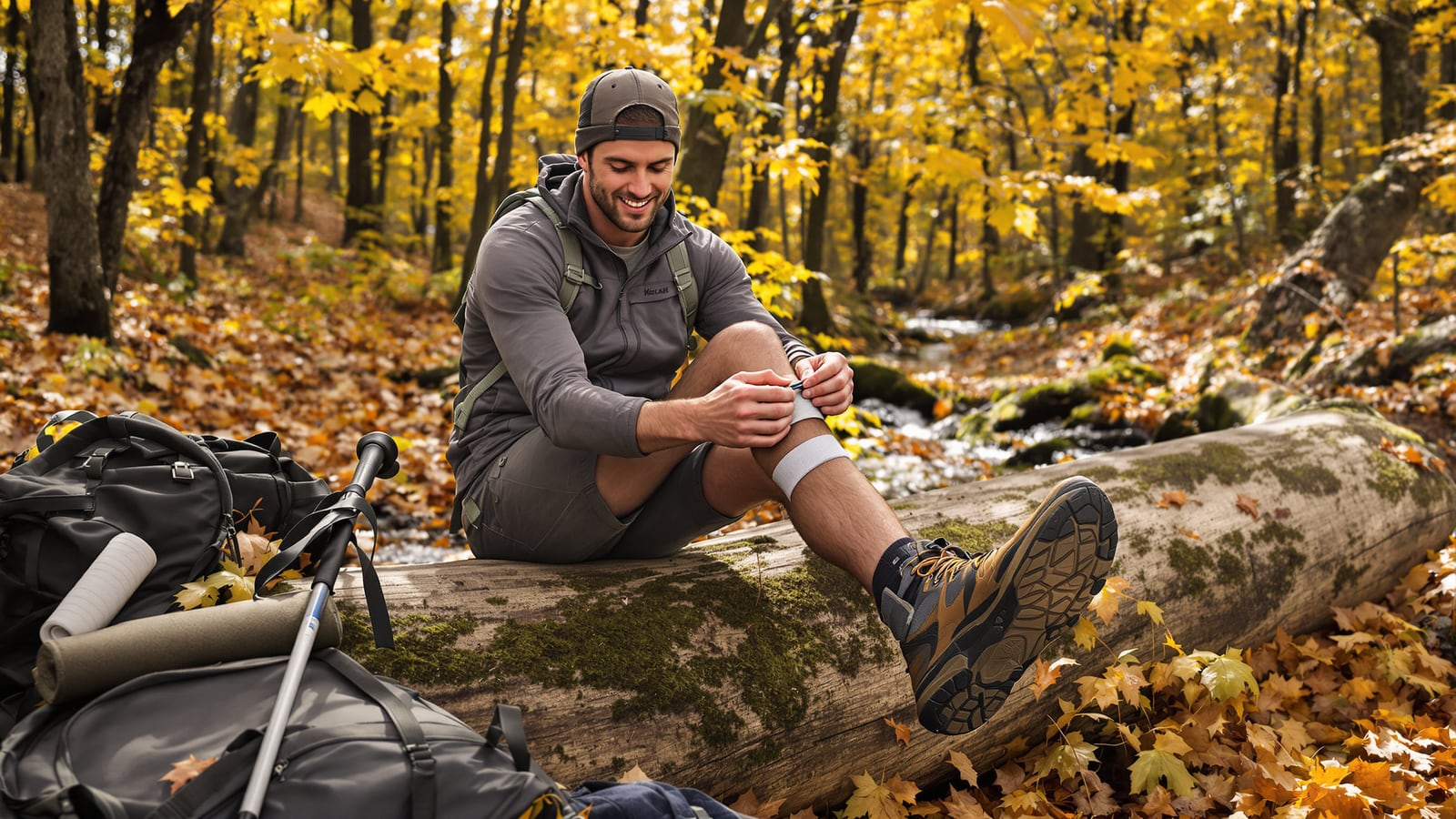
Quick answer: Sit down and leave the boot on. Test whether you can take four steps, and check for the red flags below. If you pass, wrap or tape it and walk out slowly with a pole or a stick. If you fail, splint it, get warm and dry, and send people for help rather than hopping.
It's four in the afternoon in October. You're two and a half miles from the truck, you just stepped on a wet rock at a creek crossing, and your ankle rolled with a pop you felt more than heard. Your first instinct is to stand up and see if it works.
Don't. Sit down first. The next ten minutes decide the whole afternoon, and most people spend them on the wrong thing.
Decide first, wrap second
The common mistake is reaching for the tape. Tape is a tool for walking out. It isn't a decision about whether you should.
Get off the foot and out of the water. Take a breath. Ask yourself what the injury felt like. A roll with a sharp ache that fades over a minute or two is one kind of problem. A crack, a grinding feeling, or a foot that went numb is another.
Keep the boot on for now. A laced boot is the best splint you own, and it controls swelling better than anything in your pack. An ankle can swell enough in half an hour that the boot won't go back on. Loosen the laces a little so the boot isn't a tourniquet, but keep it on your foot until you've decided if you're walking out or staying put.
The four-step test and the red flags
Stand up with help from a tree or a partner and take four steps. They don't have to be pretty. They just have to be steps with your weight on that foot. Limping is fine. Being unable to put weight on it at all is not.
Now look for the things that make this more than a sprain:
- Pressing on the bony bump on either side of the ankle, or on the outer edge of the midfoot, makes you flinch hard. Soft tissue hurts when pressed. Bone hurts sharply.
- The foot or ankle looks bent, lumpy or wrong compared to the other side.
- Numbness, tingling, or toes that are pale, bluish or cold.
- You heard or felt a snap, and it won't bear weight.
- A knee that locks, gives way, or swelled fast, within the first hour.
Any one of these means you treat it as a possible fracture or serious ligament injury. That means no walking on it if you can avoid it. Be honest with yourself here. The point of the test is to catch the injury your pride wants to ignore.
If it passes, you've most likely got a sprain, and you can plan a walk-out. Nobody can diagnose it for certain in the woods, and that's why the rest of this is conservative.
What goes in the pack, and what it costs
You don't need a hospital. You need about thirty dollars of supplies that weigh less than a sandwich.
- A 3-inch elastic bandage, five to eight dollars. Carry two if you hike with kids.
- Rigid athletic tape, 1.5 inch, five to eight dollars. Pull some off the roll and wrap it around a water bottle so you aren't hauling the whole spool.
- A moldable aluminum-foam splint such as a SAM splint, around fifteen to twenty-five dollars. It rolls flat and weighs next to nothing.
- Two triangular bandages, a few dollars each. They make slings, ties and padding.
- One or two instant cold packs, a few dollars. Fine for the first stretch, but they're no substitute for a creek.
- A trekking pole, sixty to a hundred and fifty dollars for a good one. Poles turn a bad ankle into a walkable one, and half the time they'd have prevented the roll to begin with.
Over-the-counter pain relievers are your call and your doctor's. Follow the label, and ask a professional if you take other medications.
Wrapping and taping so it actually helps
For a stable sprain you plan to walk on, the goal is support and compression without cutting off circulation.
With the elastic bandage, start at the base of the toes and wrap up the foot in overlapping turns, each covering about half the last one. Run a figure eight around the heel and ankle. Finish a few inches above the ankle bone. Snug is right. Tight is wrong.
For tape over the boot or a sock, anchor a strip above the ankle, run a stirrup from the inside of the lower leg under the heel and up the outside, then lock it with a figure eight. Tape on bare skin tears hair and skin when it comes off, so lay it over a thin sock if you can.
Be honest about what it does. Tape and wrap limit the bad movements, mostly rolling the ankle inward again. They don't heal a torn ligament, and they loosen as they get wet and sweaty. Check them at every rest.
Check the wrap every fifteen minutes or so. Press a toenail until it blanches and watch the color come back. Ask about numbness and tingling. If the foot is cold, discolored or going numb, loosen it immediately.
The walk-out decision
Weigh these together:
- Weight-bearing. Can you walk with a pole and keep the pain manageable? If you're gritting your teeth every step, your gait changes, and that's how a bad ankle becomes a bad knee or hip.
- Distance and terrain. Two flat miles on a groomed trail is a different problem than a mile of loose scree and a river crossing.
- Daylight and weather. An hour of light and falling temperatures usually argues for stopping, not pushing. Dark and cold turn a sprain into a night out.
- Company. With a partner, one can go for help while the other stays put. Alone, the margin is thinner, so be more conservative, and tell someone your route before you leave. That one's not optional.
If you walk, go slowly, rest every fifteen minutes, and keep the foot up when you stop. If you can't walk, or you're unsure, stay. Splint the leg with the SAM splint and padding, keep the boot on if the foot's circulation is fine, get insulated from the ground, and get warm. Send two people if you can, with exact location and condition. Don't send someone alone in the dark.
If you do end up in the woods overnight, read what to do in the first hour you're lost in the woods before you need it.
If you're carrying a firearm
An injury doesn't change the four rules: treat every gun as loaded, keep the muzzle pointed in a safe direction, keep your finger off the trigger until you're ready to shoot, and know your target and what's beyond it. It makes them easier to forget. People crowd around an injured hiker, hands everywhere, and a holstered gun gets bumped.
Keep it holstered and under your control. Don't hand it off, and don't fiddle with it while you're hurting and rattled. If you're being carried or helped, tell the people helping you where it is and to leave it alone. Rules on carrying in parks, on trails and across jurisdictions vary by state, province and city, and nothing here is legal advice. Check local law with a qualified attorney or instructor, and see your first firearms class isn't a test you can fail if you haven't taken one.
Take the class
Everything above is general education. It isn't medical advice for your injury, and it's no replacement for training.
A Wilderness First Aid course, usually about sixteen hours over a weekend and a couple hundred dollars, teaches you to do this with your hands under an instructor who watches you do it wrong first. If you guide, lead groups or hike far from help, step up to a Wilderness First Responder course. It's much longer and costs more, and it's worth it. A medical professional can tell you whether that ankle needs an X-ray. Go get it looked at, even if it felt better by Tuesday.
The best wrap in the world is worth less than the call you made in the first ten minutes. Make that one slowly.
Wes Dunbar
Country & Skills
Grew up on an acreage and never quite left. Covers trucks, trades, land, and how to do the thing yourself.

Watch
Worth an hour of your evening
More from Survival & Self-Defense.
From channels we rate. Plays on YouTube.
Read next