

When the headache starts at 10,000 feet, stop climbing
Mild altitude sickness is common and fixable. Here's how to spot the point where it turns serious, and the one move that fixes almost all of it.
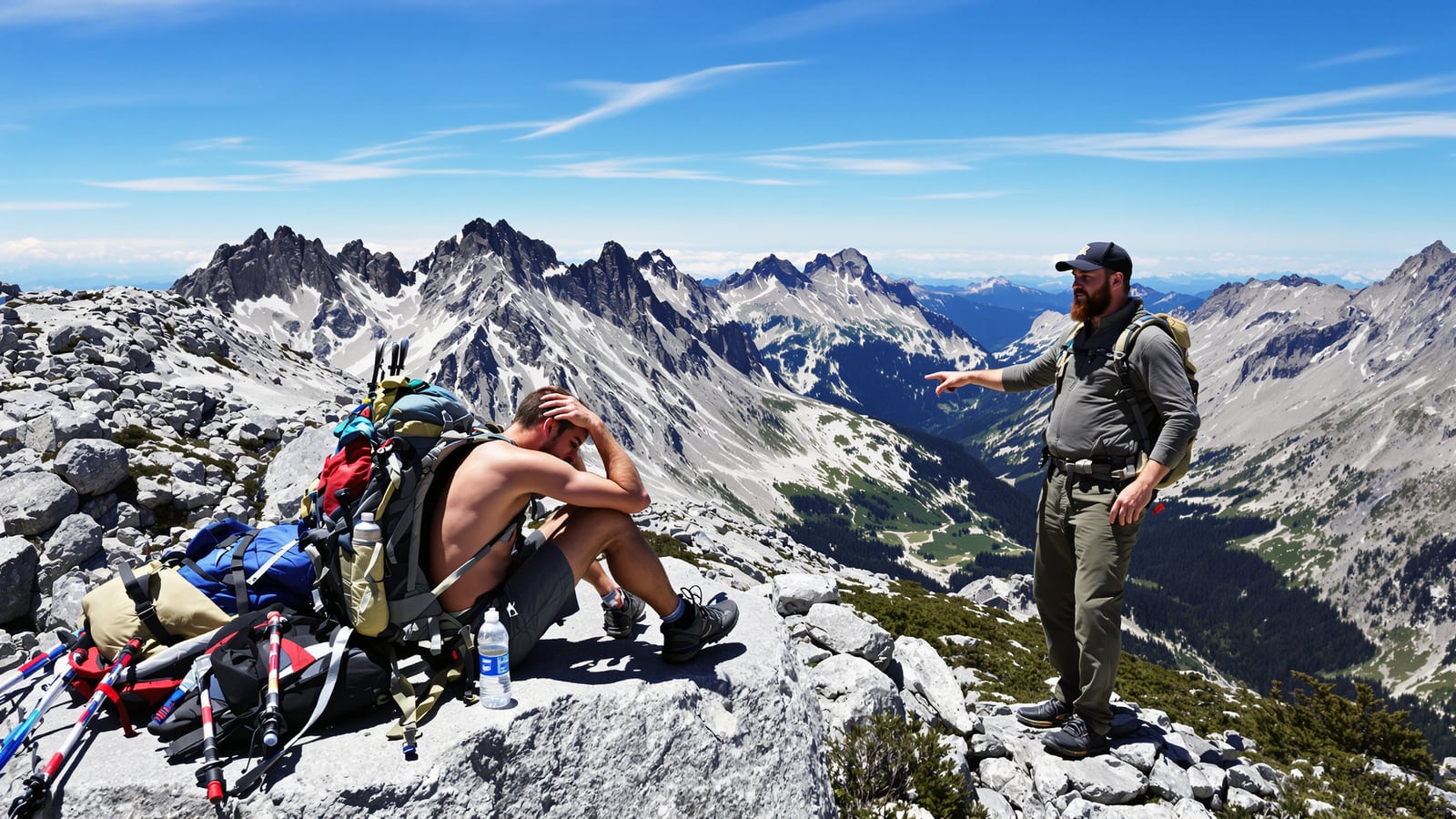
Quick answer: A headache plus nausea, dizziness or poor sleep above 8,000 feet is altitude sickness. Stop going up and rest. If you can't walk a straight line, you're confused, you're short of breath sitting still, or you're coughing up fluid, go down immediately. Don't wait for morning. Nothing else works as fast as losing elevation.
The guy who drove up from Texas
Say you left Dallas on Thursday. You're at a trailhead at 9,500 feet by Friday noon. You're strong and you run three miles a day, and you've got a pack with everything in it. You hike four hours, camp at 10,800, and wake at 3 a.m. with a headache that feels like a rubber band around your skull. Your stomach is off and the stew tastes like cardboard.
Most guys in this spot do the same thing. They decide it's dehydration, drink a liter, take two ibuprofen and climb anyway, because the summit is the reason they came.
Don't do that.
Fitness doesn't protect you from altitude. If anything, it hurts the fit guy, because he has the legs to climb faster than his body can adjust. Your lungs and blood need days to adapt. Your quads don't factor in.
What mild looks like
Acute mountain sickness usually shows up six to twelve hours after you arrive or gain elevation. It's most common above 8,000 feet, though some people feel it lower. The signature is a headache, plus at least one of these:
- Nausea or no appetite
- Unusual tiredness or weakness
- Dizziness or lightheadedness
- Bad sleep, waking up repeatedly
That's the mild version, and it's common. Plenty of sensible people get it. It isn't a character flaw, and it doesn't mean the trip is over.
It does mean one rule applies right now: don't go higher with symptoms. Stay where you are. Rest, drink water, eat what you can. Ibuprofen or acetaminophen is a reasonable move for the headache. Check again in several hours. If you feel better, you can continue slowly. If you feel the same, stay put another night. If you feel worse, you go down.
The signs that mean go down now
Mild sickness can progress into two serious conditions. Both are rare compared to the mild kind, and both can become life-threatening. When you see them, the debate is over.
Swelling of the brain (high-altitude cerebral edema):
- Stumbling, clumsiness, or trouble with the simplest balance
- Confusion, strange behavior, or irritability that's out of character
- Heavy drowsiness, hard to wake or hard to keep awake
- A headache that gets worse despite rest and pain relievers
Fluid in the lungs (high-altitude pulmonary edema):
- Breathlessness while resting, not just while climbing
- A cough that starts dry and turns wet, sometimes with pink or frothy spit
- A crackly or gurgling sound in the chest
- Tight chest, unusual weakness, blue or gray lips
Either one means descend now. Not at sunrise. Not after one more nap. Headlamps exist for a reason.
The test that takes thirty seconds
Confused people are bad at noticing they're confused. They'll tell you they're fine, and they'll mean it.
So test them. Mark a straight line about fifteen feet long on flat ground with a trekking pole or a strip of tape. Have the person walk it heel to toe, like a roadside sobriety test. If they wobble, step off the line or can't do it, treat it as the brain-swelling warning and start down. Then ask a few plain questions: What day is it? Where are we going? What did we eat last night?
This matters for you, too. If you're the one with the headache, ask your partner to check you.
How to go down
The fix is elevation. Dropping 1,000 to 3,000 feet resolves mild cases for many people. With the serious signs, keep descending until the person clearly improves, and get them to medical care.
A few rules:
- Nobody descends alone. A confused person can wander off the trail. Someone goes with them, and stays.
- Use the vehicle if there is one. A truck at the trailhead beats six hours of walking.
- Carry weight for them. Take the pack. Let them save their breath.
- Send for rescue help if you can't get them down safely. A satellite messenger or a hiker with signal can bring in trained people. Say what's wrong, where you are and how many are in the group.
If the descent goes sideways and you're turned around in the dark, work through the steps in what to do in the first hour you're lost in the woods.
Prevention that actually works
Most altitude trouble is a scheduling mistake.
Above 9,000 feet, the common guideline is to raise the elevation where you sleep by no more than about 1,600 feet per night, and to take a rest day every three or four days. You can climb high in the daytime and sleep lower. That's the old rule: climb high, sleep low.
Other basics:
- Arrive a day early if you're coming from sea level. Spend a night at 5,000 to 7,000 feet first.
- Skip alcohol the first night or two. It disrupts sleep and breathing.
- Drink steadily. The air is dry, and you lose more water than you notice.
- Keep a log. If you've had altitude sickness before, you're more likely to get it again. Plan slower.
- Ask your doctor about prescription options like acetaminophen alternatives and altitude medication such as acetazolamide before a big trip, especially if you've had trouble before. That's a conversation for a physician who knows your history. Don't borrow a buddy's pills.
Gear, with rough costs
- Fingertip pulse oximeter: $25 to $50. It's a useful data point, but cold fingers give bad readings, and a good number doesn't cancel bad symptoms. Believe the symptoms.
- Headlamp with spare batteries: $30 to $60. The nighttime descent is where it earns its keep.
- Ibuprofen and acetaminophen: a few dollars. Know what's in your kit.
- Satellite messenger: a few hundred dollars plus a monthly plan. For remote trips, this is how you ask for help when you have no signal.
- Wilderness first aid course: often a couple hundred dollars for a weekend. Take it from a qualified instructor. Reading about the heel-to-toe test is not the same as watching a tired friend fail it in front of you.
- Portable pressure chamber: these exist, they run into the thousands, and they're for guided expeditions. Don't buy one in place of descending.
If you're carrying a rifle
Elk country sits at 9,000 to 11,000 feet, and plenty of hunters live a lot lower. A tired, headachy, short-of-breath man is slower on every decision. A confused one shouldn't be handling a firearm at all.
The four rules don't get a day off. Treat every gun as loaded, keep the muzzle pointed somewhere safe, keep your finger off the trigger until you're on target, and know your target and what's beyond it. When you're carrying a sick partner's pack down a dark slope, unload and sling the rifle first. Rushed, worn-out people are exactly who break those rules.
Nothing here is medical advice for your situation. Altitude illness affects people differently, and conditions like heart or lung disease change the picture. Talk to your doctor before you go, and take a hands-on wilderness first aid class.
The hard call
The hardest part of altitude sickness isn't medical. It's the moment a friend says "I'm fine" and you both know he isn't.
Put him first. Hold the line. Tell him you're going down, and that you'll go down with him. The mountain will still be there next year. Make sure he is too.
Wes Dunbar
Country & Skills
Grew up on an acreage and never quite left. Covers trucks, trades, land, and how to do the thing yourself.

Watch
Worth an hour of your evening
More from Survival & Self-Defense.
From channels we rate. Plays on YouTube.
Read next