The Garage Power Setup That Won't Cook Your Tools
Most garages run on one orange 16-gauge cord and a ten-dollar power strip. Here's what to buy instead, what it costs, and what to never plug in.
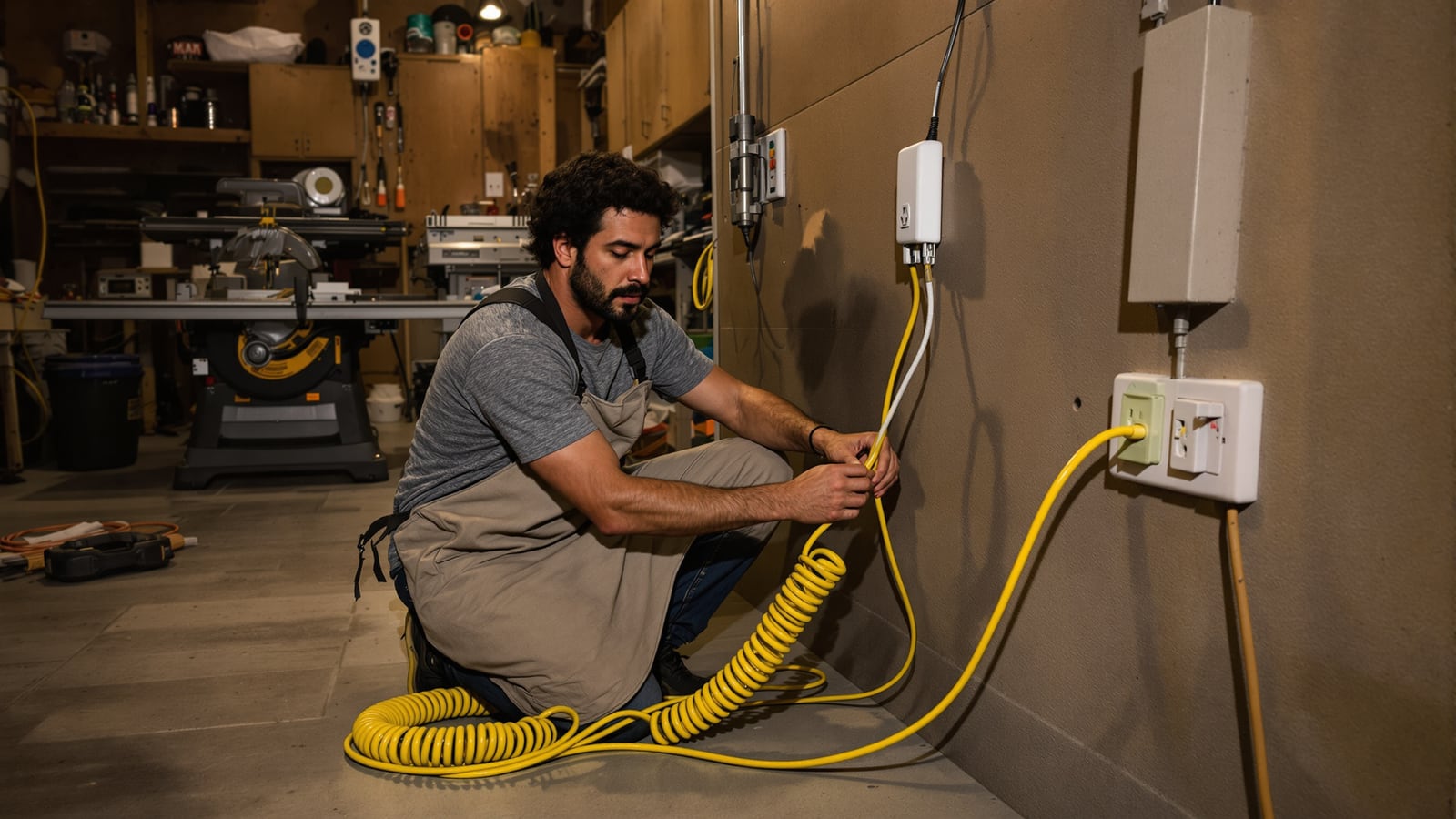
Quick answer: Buy one 12-gauge, 50-foot outdoor cord for tools, one 14-gauge, 25-foot cord for everything else, and one metal-cased surge strip for electronics. Plug heavy motors into the wall or the 12-gauge cord, never a strip. Skip the 100-foot cord until a job proves you need it.
The cord in your garage is probably too thin
Look at the jacket on your longest cord. Somewhere along it, printed in tiny letters, is a number followed by "AWG" or "GA," maybe 16/3. That's the wire gauge, and lower means thicker. Sixteen is the lightweight cord that comes in the bright orange twin-pack from the home center for around twenty dollars.
It's fine for a work light or a string of holiday lights. It's a bad match for a circular saw, a compressor or a table saw.
A thin cord fighting a hungry motor drops voltage along the way. The motor runs hot, the cord runs warm, and the saw bogs down in the cut when you least want it to. Long runs make it worse. A cord that's fine at 25 feet can be marginal at 100 with the same tool on the end.
The rough rule most electricians and tool makers agree on:
- 16 gauge: lights, fans, battery chargers, short runs only
- 14 gauge: most corded hand tools up to about 50 feet
- 12 gauge: saws, compressors, heavy sanders, long runs
- 10 gauge: 100-foot runs with big loads, and generators
Check the tool's nameplate. It lists amps. If the tool draws 12 or more and the run is longer than a few steps, reach for the 12-gauge.
Read the jacket letters
Those letters printed on the cord matter too. A "W" means rated for outdoor use. "SJTW" is a common light-duty outdoor cord. "SOOW" is the tough, rubber-jacketed kind that stays flexible in the cold and shrugs off oil and being run over by a truck tire.
You'll pay roughly forty to eighty dollars for a good 50-foot 12-gauge cord from Southwire, Woods or Iron Forge, and more for a rubber SOOW. The cheap 16-gauge cord costs a third of that, and what it gets right is price and weight. It's easy to coil and easy to carry. What it gets wrong is everything else under load.
Pick the lit-end plug if you can. A cord with a light in the female end tells you at a glance that it's live, which saves a lot of walking back and forth.
Power strips and surge protectors aren't the same thing
A plain power strip is a switch and some extra outlets. It protects nothing. A surge protector adds a component that diverts a spike to the ground wire. Buy one that says UL 1449 on the package. That's the safety standard for surge protection, and it's the only label that matters.
Two numbers help you compare:
- Joules: how much surge energy it can absorb before it gives out. Higher is better. For a bench full of chargers and a radio, 1,000 to 2,000 is plenty.
- Clamping voltage (the "voltage protection rating"): the voltage at which it starts diverting. Lower is better. Look for 400 volts or under.
A decent metal-cased strip from Tripp Lite, Belkin or APC typically runs fifteen to forty dollars. The cheap plastic ones in a bin at the register run five to ten. What they get right is more outlets for no money. What they get wrong is the protection, which tends to be thin or nonexistent.
Look for the "protected" light on the strip. When it goes out, the surge-absorbing part is spent and you're holding a plain power strip. Replace it. Replace it after any big storm too, since a strip that took a hit may look fine while doing nothing.
What never goes on a strip
A strip is for low-draw things. Phone chargers, battery chargers, a radio, a shop light, a laptop.
Don't plug these into one:
- Air compressors
- Table saws, miter saws and other big motors
- Space heaters
- A chest freezer or garage refrigerator
- Welders
A standard household circuit is 15 or 20 amps, and the strip's own switch and cord are often rated lower than the circuit behind them. Plug a heater and a compressor into the same strip and you've built a heating element out of the strip. Heaters especially belong in the wall by themselves.
And don't daisy-chain. A strip plugged into a strip plugged into a cord is how garage fires start.
When the answer is a new outlet, not a longer cord
If you run a cord across the floor to the same spot every time, you've got an electrical problem that a cord is covering for. A licensed electrician can add an outlet or a dedicated circuit, and for a typical garage that's often a few hundred dollars. It's money better spent than a fourth cord.
The same goes for a compressor or table saw that keeps tripping the breaker. Don't swap in a bigger breaker. The wire behind the wall is sized for the breaker, and that's the part that can overheat. Ask an electrician.
Garage outlets are also supposed to be GFCI-protected, and they usually are on newer homes. Press the test button on yours. If it doesn't trip, or there isn't one, a plug-in portable GFCI adapter runs about fifteen to thirty dollars and is worth owning for outdoor work anyway.
Surge protection for the whole house
A strip protects what's plugged into it. A whole-panel surge device, installed at your breaker box, protects everything on the circuits, including the garage door opener, the freezer and the charger station. Square D, Eaton, Siemens and Leviton all make them, and the device itself usually runs somewhere around one hundred to three hundred dollars before the electrician. Don't install it yourself. Work inside a live panel is one job where hiring someone is the right call.
It won't stop a direct lightning strike. It will take the edge off the smaller surges that kill electronics and motors slowly over the years. If you've got a garage fridge, a bench full of chargers and a shop with a few thousand dollars of corded tools, it's the best insurance on this page.
The weekend plan
Saturday morning, an hour. Pull every cord out of the garage. Read the gauge on each. Toss anything with cracked jackets, bent prongs or tape on it. Tape isn't a repair.
Saturday afternoon, a trip to the store. Buy:
- One 50-foot, 12-gauge outdoor cord ($40 to $80)
- One 25-foot, 14-gauge cord ($20 to $35)
- One metal-cased, UL 1449 surge strip ($15 to $40)
- A portable GFCI adapter if your outlet doesn't have one ($15 to $30)
- A cord reel or a pair of heavy hooks ($10 to $40)
Sunday. Mount the hooks near the main outlet and hang the cords there. Coil them over-under, one loop toward you and the next away, so they lay flat and don't kink. Put the surge strip on the bench and plug only the small stuff in. Label the compressor's outlet and keep nothing else on that circuit.
If you've got the space, where every tool goes is the system for keeping all of it findable. And if the garage is tight, laying out a real shop in a one-car garage tells you where to put the outlets before you drill.
Lend a cord to a neighbor and it comes back coiled and clean, or you've got a new neighbor to worry about. Do the same when you borrow one. It's a small thing, and it's most of what separates a good garage from the rest.
Dean Shaw
Gear & Garage
Reads the warranty, the parts list and the long-term owner reviews before anything else. Trucks, tools, watches, and the cheap version that costs more.

Watch
Worth an hour of your evening
More from Tools & Organizing.
From channels we rate. Plays on YouTube.
Read next