Gettysburg and Antietam by car in one long weekend
Forty-five miles of Pennsylvania farmland separate the two most important battlefields in America. Here's how to drive them without wasting a day.
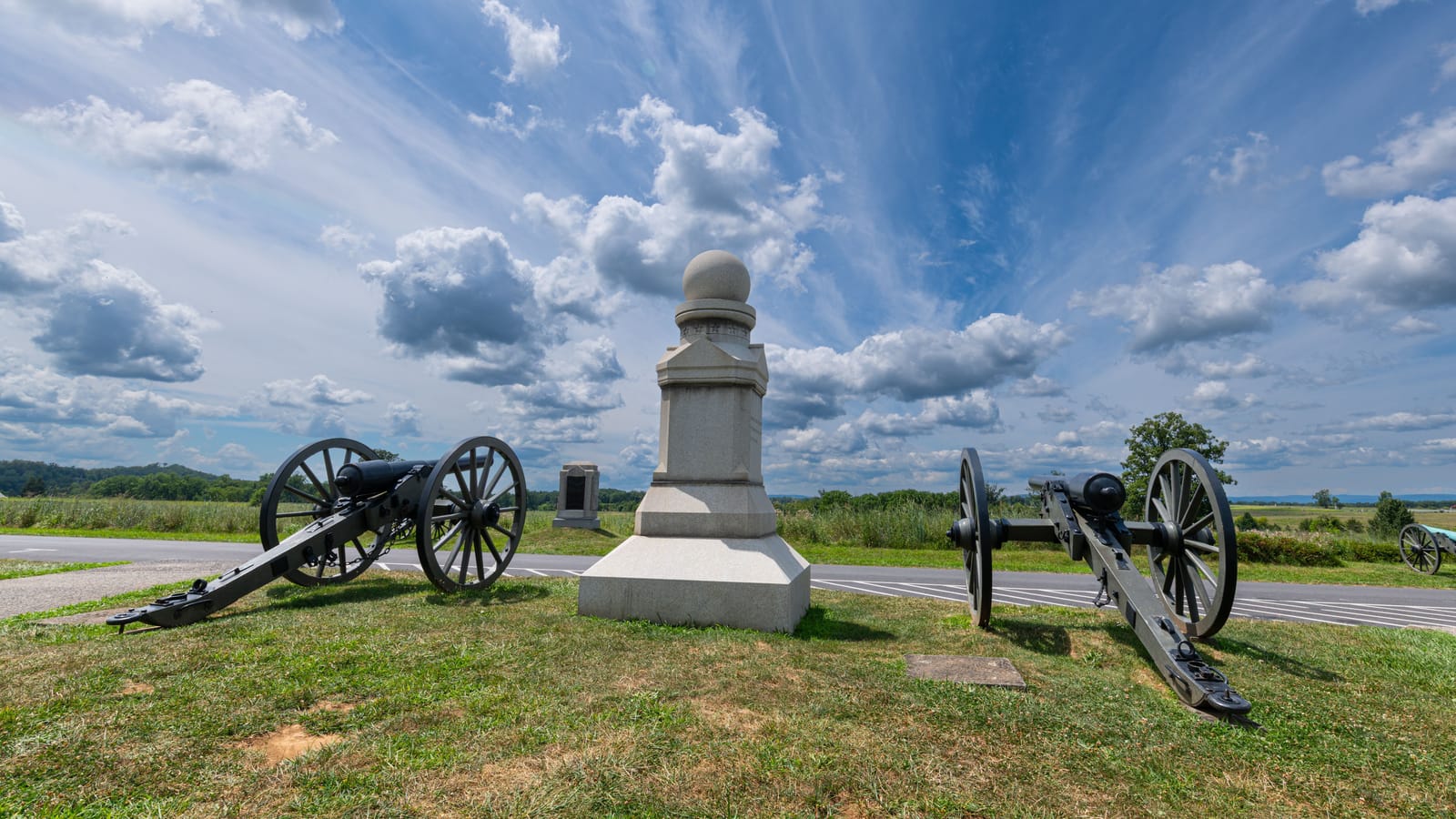
Forty-five miles. That's the whole distance between the Gettysburg visitor center and the Dunker Church at Antietam, and you can cover it in about an hour on Route 15 and Route 34 through apple country. Most people never do. They drive four hours to Gettysburg, spend a hot Saturday getting turned around on the auto tour, buy a kepi in town, and go home thinking they've seen the Civil War.
You can do far better in three days. The route is Gettysburg, then Sharpsburg, then Harpers Ferry, and if you've got a week you keep pushing south toward Manassas, Fredericksburg and Appomattox. It's one of the great American drives and almost nobody treats it like one.
The three-day shape
Drive in Friday afternoon and sleep in Gettysburg. Saturday belongs to Gettysburg entirely. Sunday morning you drive to Sharpsburg for Antietam, and Sunday afternoon you're at Harpers Ferry, which is twenty minutes further and a completely different kind of day. Monday you drive home.
Two battlefields is the limit for a weekend. Three is a forced march and everybody gets that glazed look by mid-afternoon on the second one. If you're the type who'd rather go deep than wide, cut Harpers Ferry and give Antietam a full unhurried day.
Go in late April, May, late September or October. The fields have no shade worth mentioning and July at Gettysburg is a test of character, which is ironic given what happened there on July 1 through 3, 1863.
Gettysburg, in the right order
Start at the Museum and Visitor Center when it opens and buy the combination ticket for the film and the Cyclorama. The battlefield itself is free to drive. The museum complex isn't, and it's run by the Gettysburg Foundation rather than the Park Service, so your America the Beautiful pass won't cover it. Book the earliest film slot you can get.
The Cyclorama is the reason to go inside. It's a painting from 1884 that wraps 377 feet around you, depicting the high-water mark of Pickett's Charge, and it works on a fourteen-year-old with a phone in his pocket in a way that nothing else in the building does. Twenty minutes, then you're out.
Now the part that actually changes the trip.
Hire a Licensed Battlefield Guide. These are Park Service-certified guides who pass a brutal written exam, and they get into your vehicle and direct you around the field for two hours. You sit in your own car with your own kids and your own air conditioning, and a man who's spent thirty years on that ground tells you why Buford picked that ridge. Book it in advance through the visitor center, especially for a Saturday in fall. Walk-up availability exists but it's a gamble.
Two hours with a guide beats six hours with the map. That's not close.
After the guide leaves
The self-guided auto tour is 24 miles and 16 stops, and the numbering is genuinely confusing where the roads loop back on each other. You will miss a turn. Everyone misses the turn.
Once your guide is done, do these on your own and skip the rest:
- Little Round Top and Devil's Den. Check the park website before you go, because rehabilitation work has closed sections of this area in recent years.
- The walk across the field of Pickett's Charge. Park at the Virginia Memorial on Seminary Ridge and walk east toward the copse of trees. It's about three-quarters of a mile. It's dead flat and completely open, and you'll understand more in fifteen minutes of walking it than in any book.
- Soldiers' National Cemetery. Late afternoon, when the buses have gone.
Eat dinner at the Dobbin House Tavern in town if you want the candlelit thing, and know that downtown parking on a Saturday is a scavenger hunt. The Lincoln Diner does breakfast that'll hold a family until two in the afternoon.
If you've got an extra half day, the Eisenhower farm sits right next to the battlefield, but you can only reach it by shuttle from the visitor center and it's a separate ticket. Worth it for anyone who cares about the fifties.
Antietam is the one that stays with you
Leave Gettysburg by eight. You'll be at Sharpsburg before nine and you'll have the place nearly to yourself.
Antietam is the opposite of Gettysburg in every way that matters. Gettysburg has 1,300 monuments and a town wrapped around it. Antietam is still farm fields, still worked, with split-rail fences and corn, and the Park Service has kept it looking roughly like it did on September 17, 1862, the bloodiest single day in American history. Around 23,000 men were killed, wounded or missing between dawn and dusk on ground you can walk in an afternoon.
The auto tour is 8.5 miles and 11 stops, and unlike Gettysburg's, it's easy to follow. Watch the film at the visitor center first. Then the Cornfield, the Sunken Road, and Burnside Bridge.
Burnside Bridge takes a walk down a hill from the parking area and back up, maybe ten minutes each way on a gravel path. Do it anyway. Stand at the bottom and look up at the bluff the Confederates were firing from and you'll stop wondering why it took four assaults.
There's an entrance fee here, per person or per vehicle, and the national parks pass does cover it.
Sharpsburg itself is tiny. Don't count on a late dinner. Nutter's is the ice cream stop everybody local tells you about, and for a real meal you're heading to Shepherdstown across the river or Boonsboro up Route 34.
Harpers Ferry, and then south
Harpers Ferry is twenty minutes from Sharpsburg and it's the best possible third stop because it isn't a battlefield. It's a town in a gorge where two rivers meet, with John Brown's raid, the armory, and a climb up to Jefferson Rock. You park at Cavalier Heights and take a shuttle down. The lower town is all stone and stairs, so bring real shoes.
If you've got the week instead of the weekend, keep going. Manassas is an hour from Harpers Ferry. Fredericksburg and the Spotsylvania battlefields sit another 45 minutes south, and the Sunken Road at Marye's Heights is one of the hardest places on the whole trail to stand in. Richmond gives you Cold Harbor and the Tredegar Iron Works. Appomattox Court House, about two hours southwest of Richmond, is where it ends, and you should end there. The village is restored, quiet, and the parlor where Lee signed is the closing chapter you've been driving toward for six days.
What to put in the car
Download your maps and audio tours before you leave the hotel. Cell coverage at Antietam is thin and it drops out on the back roads between the two parks. Bring more water than you think, a hat, and bug spray, because the grass at Antietam holds ticks. Check yourself and the kids at the end of the day.
Give each kid a job. Junior Ranger booklets at both visitor centers are genuinely good, not busywork, and a nine-year-old chasing a badge walks twice as far without complaining.
One more thing, and it's the whole point. Take your family to the Soldiers' National Cemetery at Gettysburg, find the spot near the Soldiers' National Monument, and read the Gettysburg Address out loud. Two hundred and seventy-two words. It takes two minutes.
Your kids will remember that longer than the Cyclorama, the guide, and the ice cream combined.
Dean Shaw
Gear & Garage
Reads the warranty, the parts list and the long-term owner reviews before anything else. Trucks, tools, watches, and the cheap version that costs more.

Watch
Watch how it's done
Picked for this article.
From channels we rate. Plays on YouTube.
American Battlefield Trust
Little Round Top Tour (Post-Rehab) | Gettysburg 161
Read next