

Check the blade against the miter slot before you touch the fence
Most burned, wandering rip cuts come from a fence that was squared to the wrong thing. Fix the order and the saw starts cutting straight.
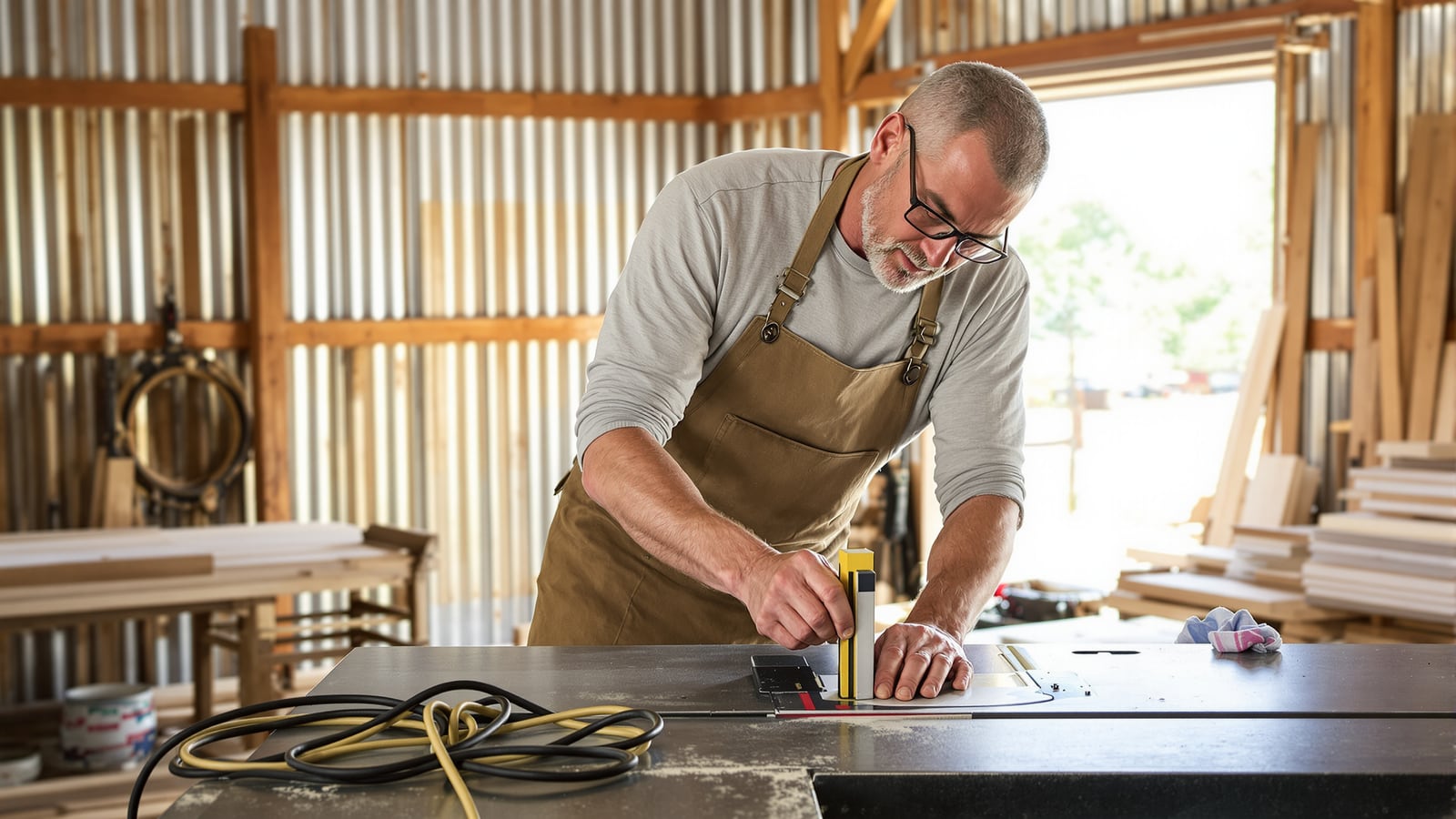
Quick answer: Square the blade to the miter slot first. Then set the fence to the slot, not to the blade and not to the tape on the rail. Unplug the saw before you start. The whole job takes about fifteen minutes and you'll rarely need to repeat it.
The mistake nearly everybody makes
You see a burn mark on the edge of a rip cut. You push the fence over a hair, make another cut, and it looks better. So you call it done.
You didn't fix anything. You moved the fence to match a blade that's out of line with the table. Now the fence is parallel to a crooked blade, and every setting you make from here on carries the error with it.
The miter slot is the one reference on the saw that doesn't move. The fence slides, the blade tilts and the trunnions shift over the years, but the slot stays where the factory milled it. Everything else gets measured against that.
Step one: unplug it and mark a tooth
Pull the plug. Don't flip the switch off and trust it. Pull the plug.
Raise the blade to full height. Pick one tooth and mark it with a marker, one that's set toward the left, so you're measuring the same edge every time. Wipe the sawdust and pitch off the table around the slot, because a pea of resin under your square will throw everything off.
Step two: measure front and back
Hook a combination square or a good tape against the left edge of the slot, the edge nearest the blade. Measure from that edge to the marked tooth at the front of the blade. Write the number down. Don't trust your memory.
Now rotate the blade by hand until that same tooth sits at the rear of the table, and measure again from the same spot on the slot. The two numbers should match.
Off by a sixteenth of an inch? That's a big miss. Off by a few thousandths is normal on a contractor saw and still worth fixing. A dial indicator on a miter bar makes this easy, but a square and a steady eye will get you within 1/64 of an inch, which is plenty for a first pass.
Measuring the same tooth is the whole trick. Teeth are set unevenly, and if you measure two different ones you'll chase a problem that isn't there.
Step three: adjust the blade, not the slot
Every saw does this differently. On a cabinet saw you usually loosen the trunnion bolts under the table and tap the assembly until the numbers match. Many contractor and hybrid saws adjust the table top instead, by loosening the bolts that hold it to the cabinet. Your manual has the exact bolts. Read that page before you loosen anything, because the wrong bolt means a bigger mess than the one you started with.
Move it a little. Tighten. Measure both ends again. Do it as many times as it takes. It's slow work, and the second round always goes faster than the first.
If you can't get it to settle, check the blade before you blame the saw. A warped blade, a dirty arbor flange or a bent plate will all fool you. Pull it, clean it with a resin remover, and try again with a blade you know is flat. A cheap blade with a wobble will make you chase a ghost for an hour.
Also check the 90-degree tilt stop while you're in there. Hold a square against the blade plate, between teeth, not on the carbide tip. Teeth that are set outward will give you a false reading.
Step four: set the fence to the slot
Now the fence. Slide it up beside the miter slot and lock it. Measure from the fence face to the slot edge at the front, then at the back. Same number both places means the fence is parallel to the slot, which means it's parallel to the blade.
Some woodworkers set the fence a hair wide at the back, the outfeed end. The reason is simple. If the rear of the fence pinches the board against the back of the blade, the wood binds and can kick back. A little relief at the outfeed lets the board clear the blade as it passes.
How much is a hair? About the thickness of a sheet of paper. No more. Go farther and your cuts will wander and the edge will come out rough. Many people set it dead parallel and never have a problem. If your saw's fence is precise and locks hard, parallel is fine. If it flexes or shifts a little when you clamp it, give it that paper's width of relief.
Then check your fence scale. Cut a scrap, measure it with a tape, and adjust the cursor if it's off. Don't trust the tape on the rail. Measure the board you cut.
Test it with a real cut
Rip a piece of scrap about two feet long. Pick something straight, like a jointed pine board, not a warped one.
- A burn mark on one edge. The fence and blade still fight, or the blade is dull. Check both.
- A board wider at one end. The fence isn't parallel. Go back to step four.
- A rough, torn edge. That's usually a dull or pitched-up blade. Clean it before you assume it's a setup problem.
Look closely at the first and last inch of the cut. That's where a small error shows.
Keep the setup honest
Check the alignment again every few months, and any time you move the saw. Rolling it across a garage floor is enough to knock it out. A saw that gets bumped, shipped or heavily used on thick hardwood will drift.
Wax the table. A little paste wax on the cast iron lets stock slide without chatter, and it's another thing that quietly improves every cut. Clean the blade when it gets sticky. A saw you leave cleaner and sharper than you found it will pay you back every time you turn it on.
And a plain word on safety, because a tuned saw tempts you to get comfortable. Stand out of line with the blade. Use a push stick when your hands get within six inches of it. Keep the riving knife or splitter on for every through cut. Never rip a board that's twisted or has no straight edge to ride the fence. If you want the longer story on how shops teach this the hard way, read Everything I Do Differently After the Shop Hurt Me.
What good setup buys you
A saw that's truly aligned cuts quieter. It leaves an edge you can glue straight from the blade. It feeds easier and kicks less. Parts come out the same width from the first board to the last, which is how a cabinet door ends up square.
It also makes everything else easier. If your layout is right, which is the point of Measure and Mark So the Cut Is Right the First Time, a true saw means the cut matches the line. If you're still setting up a space to work in, Build a garage workshop you'll use on a Tuesday night is a good place to start.
Fifteen minutes with a square and a marked tooth. Do it once, do it in order, and let the saw do the rest.
Wes Dunbar
Country & Skills
Grew up on an acreage and never quite left. Covers trucks, trades, land, and how to do the thing yourself.

Watch
Worth an hour of your evening
More from Woodworking.
From channels we rate. Plays on YouTube.
Read next