Drill the holes, and your vise does twice the work
A bench dog is just a peg in a hole. It turns a vise that only holds edges into one that holds a board flat while you work it.
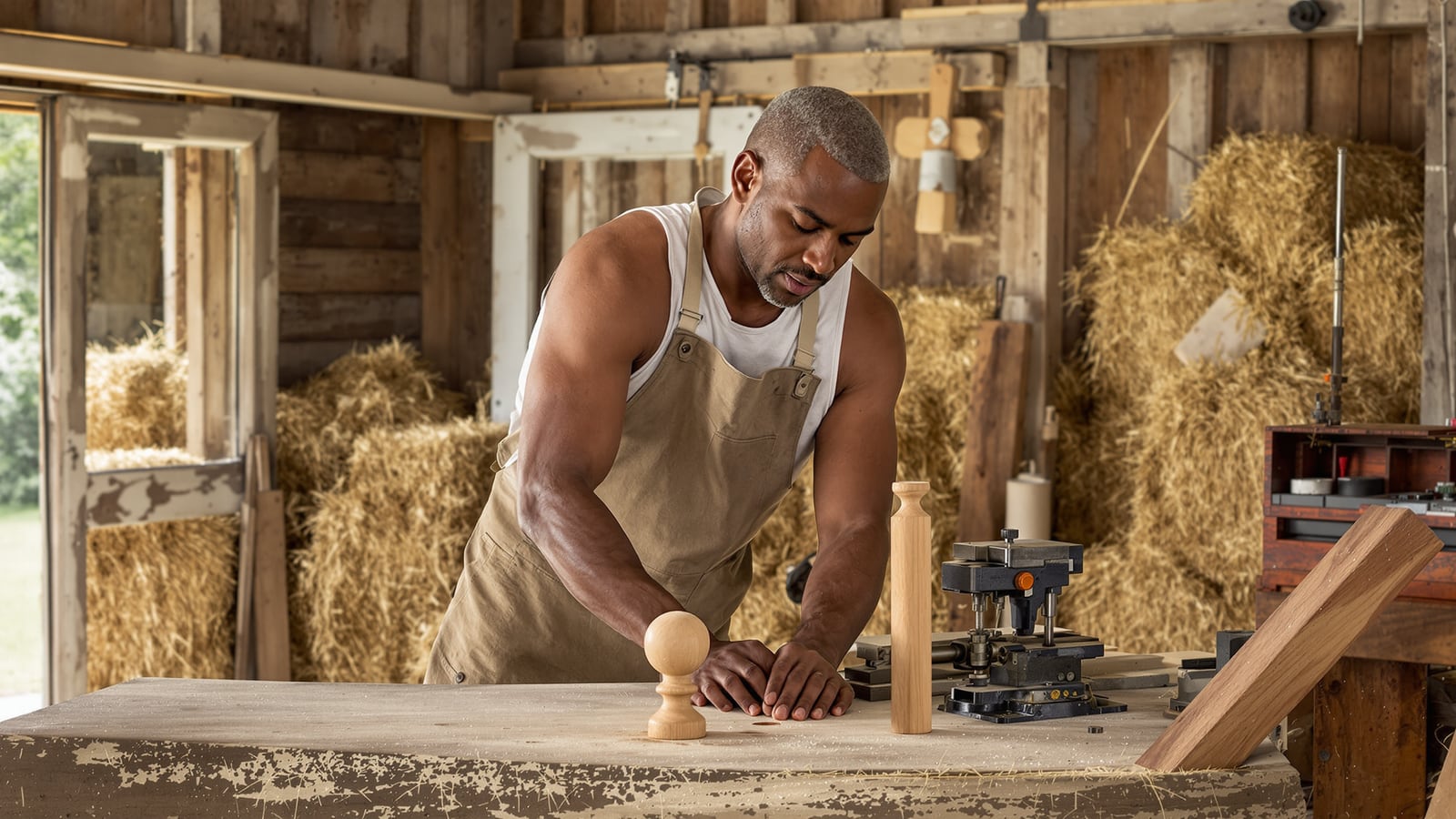
Quick answer: Drill a row of 3/4-inch holes along your benchtop, in line with your vise, and drop a peg in one. The vise now pinches a board flat against the bench instead of standing it on edge. It costs one drill bit and an afternoon, and it's the cheapest upgrade a bench will ever get.
What a dog actually does
A bench dog is a peg that sits in a hole in your benchtop and sticks up a little above the surface. That's the whole device.
Put a board on the bench, set a peg behind one end, and close the vise against the other end. If your vise has its own dog on the moving jaw, the board gets pinched between two pegs. If it doesn't, a wooden jaw with a hole drilled through it does the same job. The board never leaves the benchtop. It's held flat, with the face you want to work pointing at the ceiling and nothing in the way.
Try that with the jaws alone. To plane the face of a wide board, you'd have to stand it on its edge between the jaws, and a plane can't ride a surface that's eight inches off the bench and wobbling. So most people end up with a clamp, a bit of cleat, or a knee on the board. The dog replaces all of it.
Why the vise alone is only half a tool
A vise grips edges. Edges are about a quarter of the surfaces you ever work. The rest are faces, and faces lie flat.
The dog gives you the other three-quarters. You can plane a face, scrape it, sand it, or cut a rabbet along it, all with the work pushed against a solid stop and the vise screw taking the load. The planing force goes into the peg and the benchtop, not into your hands or a rickety clamp.
It also holds the work with no racking. Squeezing a board between two points along its length keeps the stock from twisting the way a jaw grip can. And if you've ever planed a board and heard it shift on the bench halfway through the stroke, you know why that matters. A shifting board means a plane tear, a gouge, or a lost ten minutes.
A sharp plane makes all of this better. If yours isn't, raise a burr, and the rest of sharpening follows.
Drilling the holes
Match whatever your vise uses. Three-quarter inch is the common size in American shops. Some benches and vises are built around 20 millimeters, and the two aren't interchangeable, so check before you buy a bit.
Run the row parallel to the front edge, in line with the dog on your vise. Set the holes four to six inches apart. Closer is more flexible, and farther is fewer holes to weaken the top. Four inches suits most people because you'll find a hole near wherever the board ends.
A few things that save you grief:
- Drill straight. A drill press is best. A hand drill with a small square held against the bit works fine if you stop and check often. A crooked hole makes a peg that leans, and a leaning peg slips.
- Back the exit. Clamp a scrap under the spot you're drilling or the bit will blow out the underside in a ragged splinter.
- Chamfer the rim. A light bevel with a knife or sandpaper keeps the edge from chipping and lets pegs drop in smoothly.
- Mark them all first. Lay out the row with a straightedge and a pencil before you touch the bit. Measure twice, as in measure and mark so the cut is right the first time.
If your benchtop is a hollow-core door or a thin sheet of MDF, hold off. The holes will tear and the peg will have nothing to bite. A solid top, a laminated slab or thick hardwood, takes a hole well.
Making the dogs
You can buy brass-topped dogs, square dogs, and spring-loaded ones. You can also cut a length of hardwood dowel and be done.
Take a piece of 3/4-inch dowel, six to eight inches long. Maple or oak holds up. Cut a shallow flat on one side near the top, so the work has a face to bear against instead of a curve. Test the fit in a hole. It should drop in and stay put when you tap it, but not jam.
If it's loose, glue a strip of leather or a thin bit of veneer on one side, and it'll wedge snug. If it's tight, hit it with sandpaper.
The one rule on height: the peg should sit just below the top face of the board you're planing. If it's proud, the plane iron will strike it. Set it about an eighth of an inch low.
Make four. Make six if you lend your bench to the neighbor kid or your brother-in-law. Pegs wander. Whoever borrows the shop owes you a peg back, and leaves the bench cleaner than he found it. Good dogs are cheap, and it's easier to keep spares than to chase one.
Where it goes wrong
A dog isn't magic.
Thin stock bows. Clamp a half-inch board hard between two dogs and the middle lifts. Snug is enough. For thin work, use a planing board with a stop screwed to it, and pin the work against that.
Holes are permanent. Drill a bench you're willing to commit to. If it's a rental, a shared bench, or a family heirloom, use a planing stop or a clamp-on dog instead. There's no shame in it, and no hole to explain later.
Holes catch things. Pencils roll in. Shavings pack in. A small dowel pushed through from below clears them out, and a pencil on a lanyard stops the rolling.
Not everything wants a dog. Cutting joinery by hand, like dovetails, wants the work standing up in the jaws at a comfortable height. The vise is the right tool there. Use the dog for flat work and the jaws for edge work. You're not choosing one. You're getting both.
The first afternoon
Pick a board you don't mind ruining. Set a peg in a hole. Close the vise. Run a plane down the face of it and feel the board stay where it is.
If you're still building out the shop, the garage workshop you'll use on a Tuesday night is the place to start, and the sawbench is the first thing worth making on a bench with holes.
One more thing. Once your board stays put, you'll find you'd been bracing it with your forearm for years.
Wes Dunbar
Country & Skills
Grew up on an acreage and never quite left. Covers trucks, trades, land, and how to do the thing yourself.

Watch
Worth an hour of your evening
More from Woodworking.
From channels we rate. Plays on YouTube.
Read next