

Your workbench is lying to you, and it's easy to catch
A twisted or bowed bench top quietly builds twist into everything you put on it. Here's how to find it, fix it, and keep it honest.
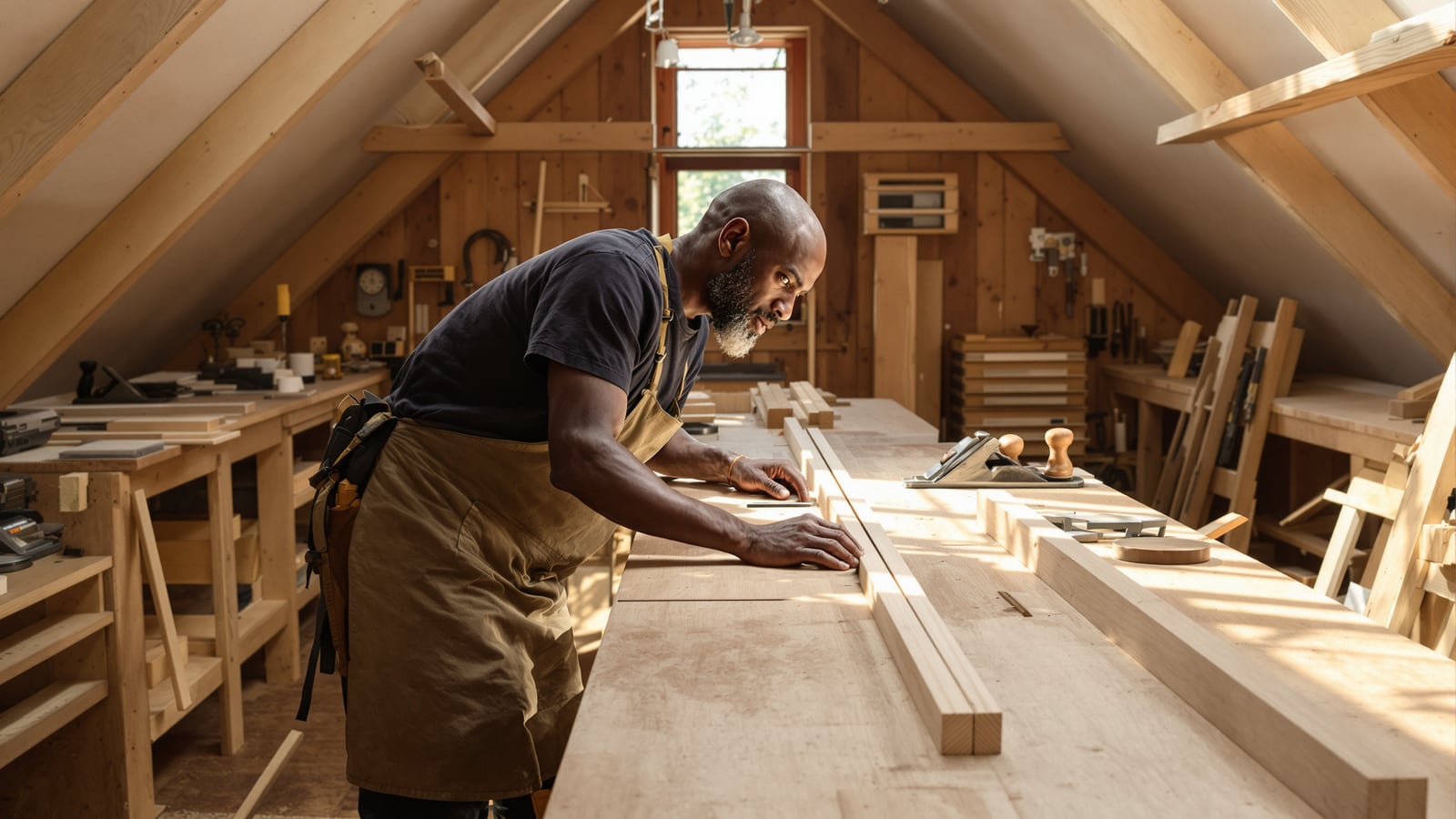
Quick answer: Shim the legs until the bench doesn't rock. Then check the top for twist with two straight sticks and for bow with a straightedge. You're aiming for flat within about 1/16 inch across the area where you actually work, not perfection across the whole slab.
The floor is probably the culprit
A bench that rocks even a hair will make you think the top is twisted when it isn't. Garage slabs slope toward the drain and never sit flat. Start there.
Push down on each corner in turn. If any corner moves, shim the foot with a thin wood wedge or a scrap of hardwood, then check again. Do it before you measure anything else. It takes ten minutes, and it saves you from planing a top that was fine.
If you're still setting up the space, the garage workshop piece covers where the bench should live so you're not fighting the slab slope.
Find the twist first
Twist is the sneaky one. The top can feel flat under your palm and still have one corner high. Build a piece of cabinet on it and the case racks out of square with no clue why.
You need winding sticks. Two strips of straight, stable wood about 18 to 24 inches long and the same width, 3/4 inch thick or so, will do. Plane or joint one edge of each until it's dead straight, and make them identical. A contrasting strip of tape or a dark wood on top of one stick helps your eye.
- Lay one stick across the front of the bench and one across the back, both square to the long edge.
- Crouch down so your eye is level with the front stick and sight over its top edge toward the back one.
- If the two edges line up as parallel, you've got no twist in that stretch. If the back stick appears to tilt up on one side, there's a high corner.
- Slide the sticks down the bench and repeat every foot or two.
Do the sighting with one eye, from low down. A bench top that looks fine from standing height will show its sins at a crouch.
Then check for bow
Bow is a hollow or hump along the length or across the width. You need a straightedge you trust, and trust is earned. A cheap one may not be straight.
Test yours. Draw a line along a board's edge with a sharp pencil, flip the straightedge end for end, and see if it still matches the line. If there's a gap, it isn't straight. A good 4-foot aluminum level or a machinist's rule is fine if it passes.
Lay it across the bench in several places: lengthwise, crosswise, and diagonally both ways. Slide a sheet of printer paper underneath. Paper runs about four thousandths of an inch thick, so if it slips under easily, you've got a gap. Don't chase gaps that small. Work to the 1/16 inch standard and fix anything bigger.
Mark what you find. Use a pencil and write directly on the bench: "high," "low," arrows. You'll forget in thirty seconds.
Flatten with a plane
A softwood bench, the kind built from laminated 2x4s, is the easiest. Hardwood works the same way, just slower.
Use a jack plane with a slightly cambered iron. That's a blade ground with a gentle curve so it takes a shaving thickest in the middle and feathered at the edges, so you don't leave tracks. A sharp iron is not optional here, and the burr piece explains how to get one. A dull plane on a bench top is misery.
Here's the order:
- Pencil a loose scribble over the whole top. Wherever the pencil disappears first, you're cutting.
- Plane diagonally across the grain, working both directions in an X pattern. This knocks down the high spots without following a ridge.
- Check with the straightedge and winding sticks every few passes.
- When it's close, make a few final light passes with the grain to clean up.
Don't plane the whole top to the lowest spot. Take the high spots down to the average and stop. If one corner is a quarter inch low, leave it. Either shim your work or live with it.
If the top is a big plywood or MDF slab, a router sled is the better tool. Build two rails on either side of the bench, ride a router carriage across them with a wide surfacing bit, and take light passes. Wear eye and hearing protection and a dust mask. It's loud and makes a mountain of dust.
Square the working edges
A flat top is half of it. The rest is the edges and the vise.
Check the front edge for straightness with the same straightedge. Then check it for square against the top with a good try square. Clamping work to the front edge is something you do constantly, and an edge that's out of square will skew every clamp-up.
Now check the vise. Set the square on the benchtop and against the vise's front jaw. If the jaw leans, the work you grip will lean with it. Fix it by planing a shim into the jaw liner or shimming behind the chop. Small tweaks matter here.
If you've got dog holes, the row should run straight and parallel to the front edge. Bad ones make a board skew every time you clamp it. Plug and redrill if you must.
What to do about a top that moves
Wood moves. A bench in a humid summer shop and a dry winter garage will cup, swell and shrink a little. Check it twice a year, say when the clocks change, and touch it up with a few passes of the plane. Ten minutes, twice a year, beats a ruined weekend.
Finish the top with a thin coat of boiled linseed oil or shellac and leave it at that. Never wax a bench top. Wax transfers to your workpieces and leaves finish-ruining spots that don't show until you're staining. If you've ever had blotches you couldn't explain, this one on sanding and finish may sort it out.
The cheat sheet you'll actually use
- Shim the legs first.
- Winding sticks for twist, straightedge for bow.
- Take down only the high spots.
- Square the front edge and the vise jaw.
- Check twice a year.
Reference marks are only as good as the surface under them. The measure-and-mark piece covers the other half of that equation.
A true bench won't make you a better woodworker. But it takes away your best excuse.
Wes Dunbar
Country & Skills
Grew up on an acreage and never quite left. Covers trucks, trades, land, and how to do the thing yourself.

Watch
Worth an hour of your evening
More from Woodworking.
From channels we rate. Plays on YouTube.
Read next