

Boaz saw a widow in his field and changed how his men behaved
Boaz didn't rescue Ruth with a speech. He used the authority he already had to make his field safe, her work dignified, and her name clean.
Quick answer: In the book of Ruth, Boaz sees a poor foreign widow working his field and does four things. He speaks to her directly, orders his men to leave her alone, lets her keep her dignity while he provides, and protects her reputation. Then he does the hard part the right way, through the proper legal process. That's the pattern for any man who sees a woman in need.
He noticed, and he walked over
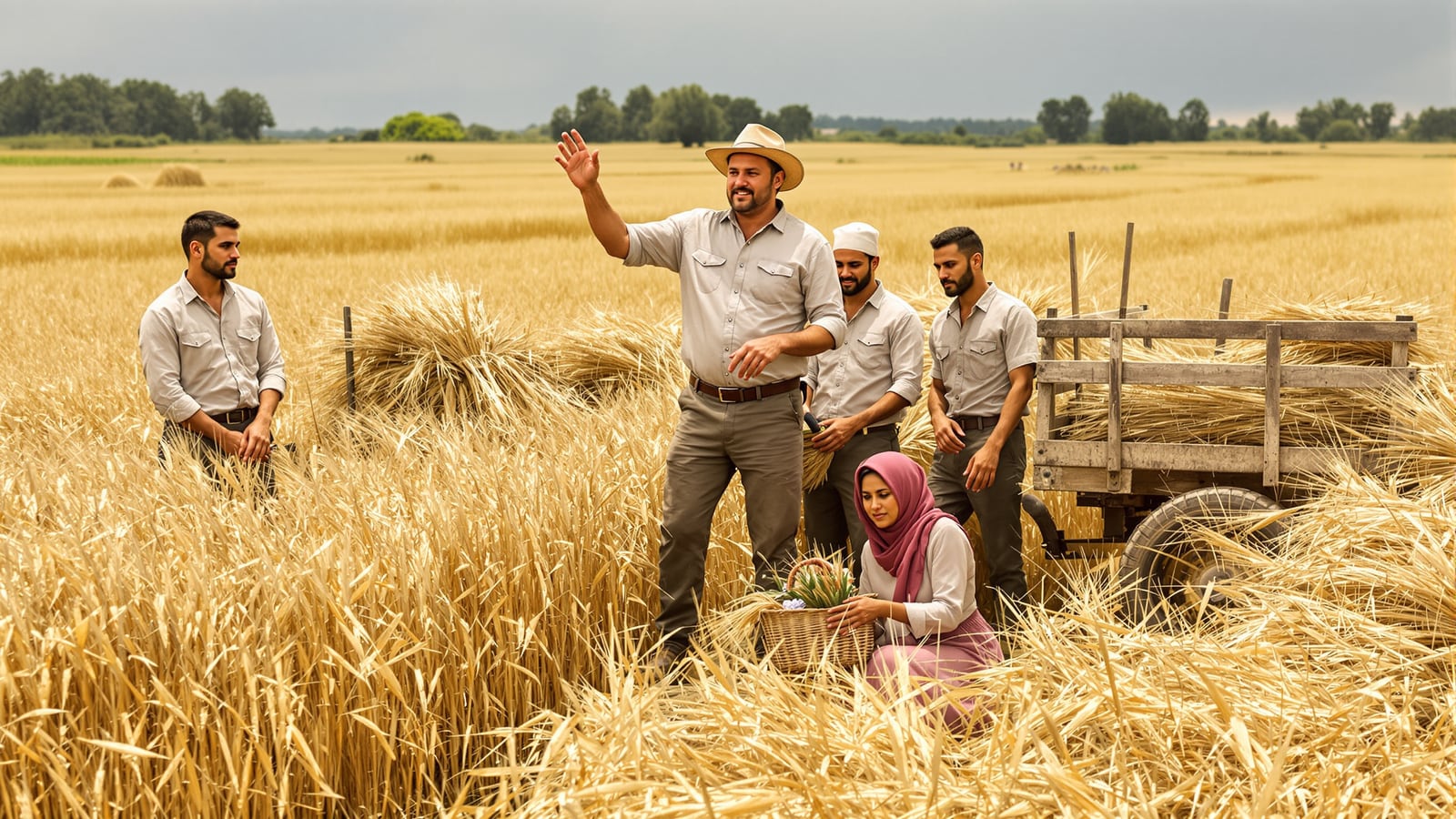
It's barley harvest in Bethlehem. Ruth has been gleaning behind the reapers since early morning, picking up what the workers dropped. She's a Moabite widow who followed her mother-in-law Naomi home to a country that owes her nothing.
The Bible says she "happened" to land in the field of Boaz. The narrator is winking at you. Nothing about this was luck.
Boaz arrives from town and greets his workers: "The LORD be with you!" They answer, "The LORD bless you" (Ruth 2:4, ESV). That's a boss his men like. Then he spots a stranger and asks his foreman, "Whose young woman is this?" (2:5, ESV).
He doesn't look past her or assume somebody else will handle it. He asks, gets the answer, and goes to her himself.
He used the authority he already had
Boaz doesn't announce a campaign or start a fund. He uses what's in his hand, which is his field and his workers, and he sets the rules.
"Now, listen, my daughter, do not go to glean in another field or leave this one, but keep close to my young women. Let your eyes be on the field that they are reaping, and go after them. Have I not charged the young men not to touch you? And when you are thirsty, go to the vessels and drink what the young men have drawn" (Ruth 2:8–9, ESV).
Look at the order. Before she says a word about being afraid, he has already told the men to keep their hands off her. That's a man who knows what happens in a field full of workers and a woman with no family around. He doesn't ask her to be careful. He makes the men careful.
You hold some authority too, even if it's small. You might be the foreman, the coach, the oldest brother, the guy who runs the Saturday crew. Her safety shouldn't depend on her being wary. It should depend on the men under your hand knowing the standard, because you set it out loud.
He didn't turn her into a charity case
Ruth is gleaning because God's law told landowners to leave her kind a way to eat: "You shall leave them for the poor and for the sojourner: I am the LORD your God" (Leviticus 19:10, ESV). Gleaning was work. Ruth was bent over in the sun from morning on.
Boaz doesn't shut that down and hand her a sack of grain to make himself feel generous. He keeps the arrangement and improves it. At mealtime he invites her to eat with the reapers, and she eats until she's full, with food left over. Then he gives the order that quietly changes everything:
"Let her glean even among the sheaves, and do not reproach her. And also pull out some from the bundles for her and leave it for her to glean, and do not rebuke her" (Ruth 2:15–16, ESV).
His men drop extra on purpose and keep their mouths shut about it. She still works, so she keeps her pride, and she goes home with far more than she'd have gathered on her own. He's generous without making her feel like a project.
That's harder than it sounds. A man who gives help in a way that makes a woman feel small hasn't really helped. Ask what would let her keep her head up, then do that.
He looked at her character, not just her need
Boaz tells Ruth he's heard everything: how she cared for her mother-in-law after her husband died, and how she left her own parents and homeland for a people she didn't know. Then he blesses her: "The LORD repay you for what you have done, and a full reward be given you by the LORD, the God of Israel, under whose wings you have come to take refuge!" (Ruth 2:11–12, ESV).
He sees her as a person of worth who's in a hard season. When Ruth asks why a foreigner should find favor with him (2:10), his answer is her faithfulness. Need is what opened his eyes. Her character is what he honors.
He protected her name
Later, Ruth comes to Boaz at night on the threshing floor and asks him to act as her family redeemer, the relative with the right and duty to secure a widow's future. She uses the same image he used, asking him to spread his "wings" over her (Ruth 3:9, ESV).
Boaz answers with respect. He tells her to have no fear, and says the whole town knows she's a worthy woman (3:11). He doesn't take advantage of the quiet hour or the private setting. Before dawn he sends her home with a gift of barley, and he makes sure nobody learns she was there. He's guarding her reputation as carefully as he guarded her safety in the field.
A man's conduct shows most clearly when nobody would ever find out. Boaz's was the same in the dark as at noon.
He did it the slow, legal way
Boaz wants to marry Ruth, and he has a problem. He tells her plainly: "it is true that I am a redeemer. Yet there is a redeemer nearer than I" (Ruth 3:12, ESV). Another man has first claim.
He could have worked around it. Instead he goes to the town gate, sits down in front of ten elders, and puts the matter to the nearer relative in the open. The man declines. Boaz takes the duty, with the whole town as witnesses (Ruth 4).
Notice what he didn't do. He didn't cut a corner because his motives were good. A good cause isn't permission to break the rules. He did the right thing the right way and took the cost of waiting.
Where good Christians differ
Believers read a few things in this book differently.
The threshing floor scene is one. Some read Ruth's nighttime appeal as a bold, faithful request for protection under the law. Others find it riskier and more ambiguous. Almost everyone agrees on this much: the text praises Boaz's restraint and Ruth's loyalty, and nothing in it excuses carelessness.
Another is how much to make of the "kinsman-redeemer" as a picture of Christ. Many Christians see a real foreshadowing of the One who buys back what was lost, and the Bible does end this story in the line of the Messiah: "Salmon the father of Boaz by Rahab, and Boaz the father of Obed by Ruth" (Matthew 1:5, ESV). A Moabite woman who took refuge under the God of Israel ends up in the family tree of Jesus. Others caution against reading Christ into every detail, and they'd say the book's main lesson is how God works through ordinary faithfulness. Both camps take the Bible seriously. Boaz isn't the Savior either way. He's a man doing his duty well, and that's the part you can copy.
If you want more on Ruth herself, see Ruth, Esther and Deborah Did Not Wait to Feel Brave. For another man who kept his word when it cost him, read Three Men Who Kept Their Integrity Far From Home.
What you do on Monday
- Look up. Is there a widow at church, a single mom on your street, or a new hire nobody's talking to? Boaz started by noticing.
- Set the standard out loud. If you run a crew or a team, tell the men how a woman on the property is to be treated, and make it plain you mean it.
- Help in a way she can stand tall in. Offer work, a fair wage, a ride she can repay, or groceries delivered without a lecture.
- Guard her name. Don't be alone with a woman in a way that invites talk. Don't repeat what you shouldn't.
- Go through the front door. If you've got a real interest in a woman, or a real duty to a family, do it openly and honorably, with her family and your community in the picture.
Boaz had the legal right to leave the corners of his field for the poor. He did more. He told his men to pull barley from the bundles and drop it on purpose.
Leave some handfuls on purpose.
Josh Halloran
Christian Bro
Leads a mid-week mens group and has done for eleven years. Writes about faith as a practice rather than a position.

Watch
Worth an hour of your evening
More from Bible.
From channels we rate. Plays on YouTube.
Read next