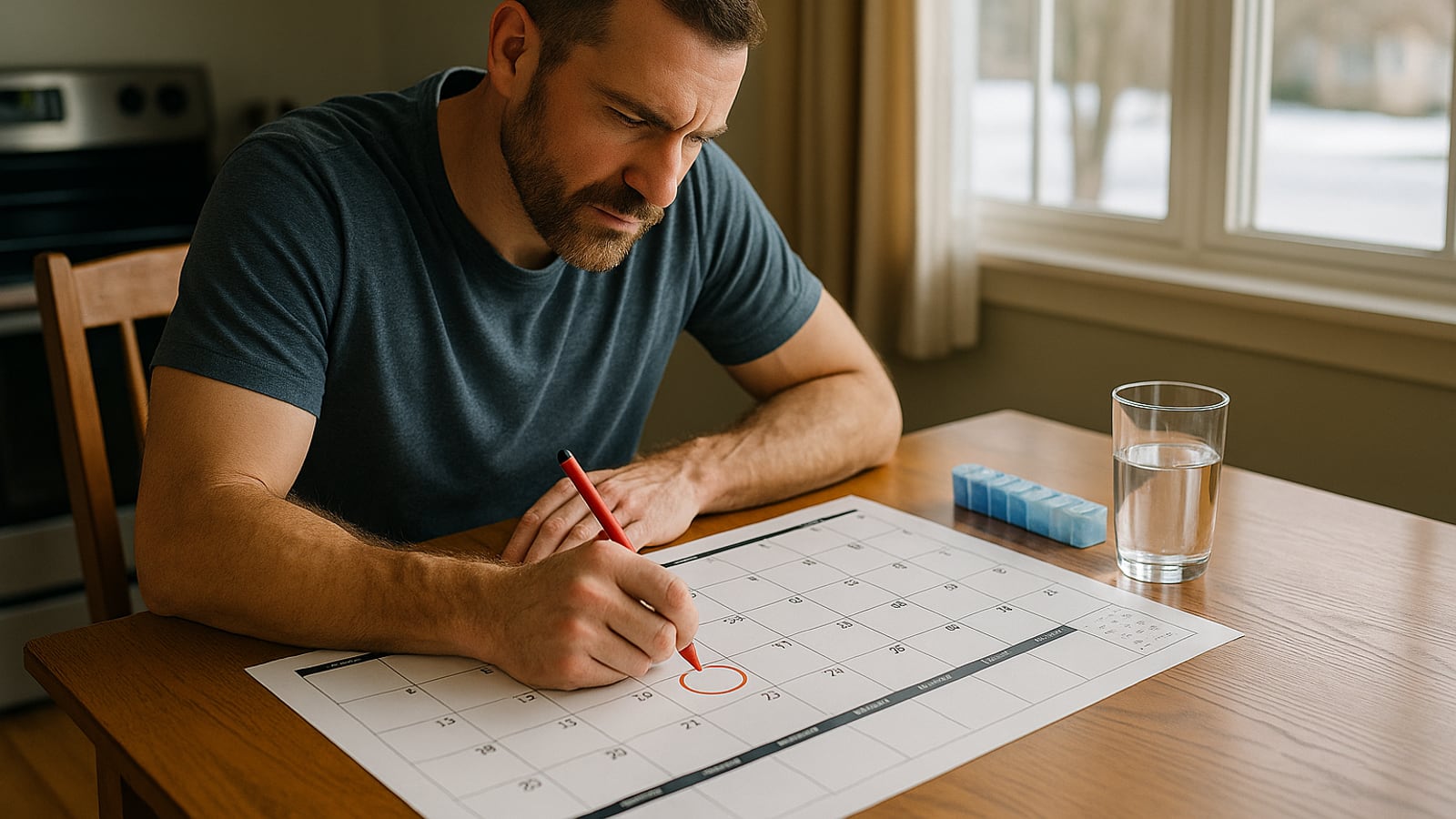
Get a paper wall calendar and put the infusion dates on it in marker. Then, for each one, block out the two or three days after. Not "rest days." Block them like meetings you can't move, because that's what they're. Chemo doesn't hit you at random. It hits on a schedule, and once you know your own pattern, you can build a life around it instead of getting ambushed every two weeks.
Everything below is general. Your oncology team's instructions beat anything you read anywhere, including this. Call them, not the internet.
Learn your own crash window in the first two cycles
Most regimens run on a rhythm. Infusion day itself often feels fine, sometimes oddly good, because of the steroids they give alongside. Then the steroids wear off and day two or three lands hard. By day seven or eight you start climbing back out. By day ten or twelve you might feel close to normal, right up until the next one.
Your window will be your own. Track it. Write one number on the calendar every evening, zero to ten, for how wrecked you felt. After two cycles you'll see the shape of it, and that shape is the single most useful piece of information you'll have for the next four months.
Then use it. Schedule the kid's birthday party, the client dinner, the drive to your parents' place in the good stretch. Put nothing in the bad one. If you work, ask about shifting your heavy days to the back half of the cycle. Plenty of people keep working through treatment, and the ones who do it well aren't tougher. They just stopped pretending every Tuesday is the same.
Chemo fatigue isn't being tired
Being tired is fixed by sleep. This isn't. You can sleep nine hours and wake up feeling like you're wearing a weighted vest, and that's not a sign you did something wrong.
The thing that helps most is also the thing you'll least want to do: move a little, every day, on purpose. Not a workout. A walk to the end of the street and back. Oncologists push walking during treatment for a reason, and the people who keep moving through it generally report less of the heavy stuff than the people who take to the couch for four months.
Ten minutes, twice a day, beats forty minutes once. If ten is too much, do three. On the worst day of the cycle, standing up and walking to the mailbox counts and you should count it.
For strength, drop the barbell and keep the pattern. Sit-to-stand from a dining chair, ten reps. A set of push-ups against the kitchen counter. Carry the groceries in two trips instead of asking someone else to do it. You're not training for anything. You're keeping the muscle you already have, because losing it's fast and getting it back afterward is slow.
Two rules. Don't train to failure, ever, during treatment. And during the days when your white count is at its lowest, which your team will tell you, do it at home or outside rather than in a crowded gym.
Food when everything tastes like a penny
Taste changes are one of the least-warned-about parts of this. Coffee turns foul. Red meat can taste metallic. Water starts tasting like it came out of a pipe, which is a particularly cruel trick when you've been told to drink more of it.
What people actually find works:
- Plastic or bamboo utensils instead of metal. Sounds like nothing. Helps a surprising amount with the metal taste.
- Cold or room-temperature food. Hot food throws off more smell, and smell is half of nausea. A cold chicken sandwich goes down when a plate of the same thing hot won't.
- Tart and salty over sweet. Lemon in water, pickles, a bit of citrus on things. Many people go off sweet entirely.
- Small and frequent. Five small plates beats three real meals. An empty stomach makes nausea worse, not better.
- Protein first, on the good days. Eggs, Greek yogurt, cottage cheese, a shake if chewing is a chore. You're trying to hold onto muscle, and you'll eat better in the second half of the cycle, so make those days count.
Ask about anti-nausea medication on a schedule rather than only as rescue. Taking it before the wave comes works far better than chasing it afterward. Get the prescriptions filled before infusion day, not at 9 p.m. on day two when the pharmacy's closed.
If your mouth gets sore, tell your team early and ask what rinse they want you to use. Don't improvise with anything containing alcohol. Skip anything sharp and crunchy for a few days and lean on soft food.
The numbers that mean stop and call
One temperature matters more than anything else on this list. Most teams say 100.4°F. If you hit it, call right away, including at 3 a.m., including if you feel basically fine. Low white counts mean an infection can move fast and the usual warning signs may not show up. This is the one thing you never wait out until morning.
Get your own thermometer and keep it in the same spot every day.
Also worth a same-day call: shaking chills, uncontrolled vomiting that stops you keeping fluids down, sudden shortness of breath, and new numbness or tingling in your fingers and toes. That last one is nerve irritation from certain drugs, and reporting it early, when it's mild, is what gives your doctor room to adjust the dose before it gets permanent. People downplay it because it seems minor next to everything else. Don't.
Ask for help by the item, never by the category
"Let me know if you need anything" is a kind thing to say and a useless thing to receive. Nobody in the middle of a cycle has the energy to invent a task for a volunteer, so the offer dies right there.
Fix it from your end. Keep a list on the fridge and hand out specific jobs:
- Drive me to infusion on the 14th and sit with me. Bring a book.
- Take my son to practice Saturday and bring him home fed.
- Mow the lawn this week.
- Put the trash cans out Tuesday night.
- I'm out of paper towels, laundry soap and bananas.
If you're the friend, skip the offer and just show up with a specific thing. Text "I'm in the parking lot at the store, what do you need" rather than "what can I do." Set up a meal calendar so the family doesn't get seven lasagnas in nine days and nothing on the second week. Put it in containers you don't want back.
Tell the kids something true and small
Children fill silence with worse things than the truth. Use the real word, cancer, say the medicine is strong and will make Dad or Mom tired and maybe lose their hair, and tell them it isn't catching and it isn't anybody's fault. Then go right back to the normal schedule, because bedtime at the same hour is more reassuring to a seven-year-old than any speech you'll give.
Give them a job. Bringing a water bottle, choosing the movie on crash day, walking the dog. Kids handle hard seasons better when they have a role in them.
And on a day in the good half of the cycle, do something ordinary and loud. Pancakes, a ball game on the couch, the whole family in one room. Those days are the point of all the planning.
Cal Brennan
Fitness
Strength coach. Trains fathers, tradesmen and desk workers, which means programmes that survive a bad week.

Watch
Worth an hour of your evening
More from Fitness.
From channels we rate. Plays on YouTube.
Read next