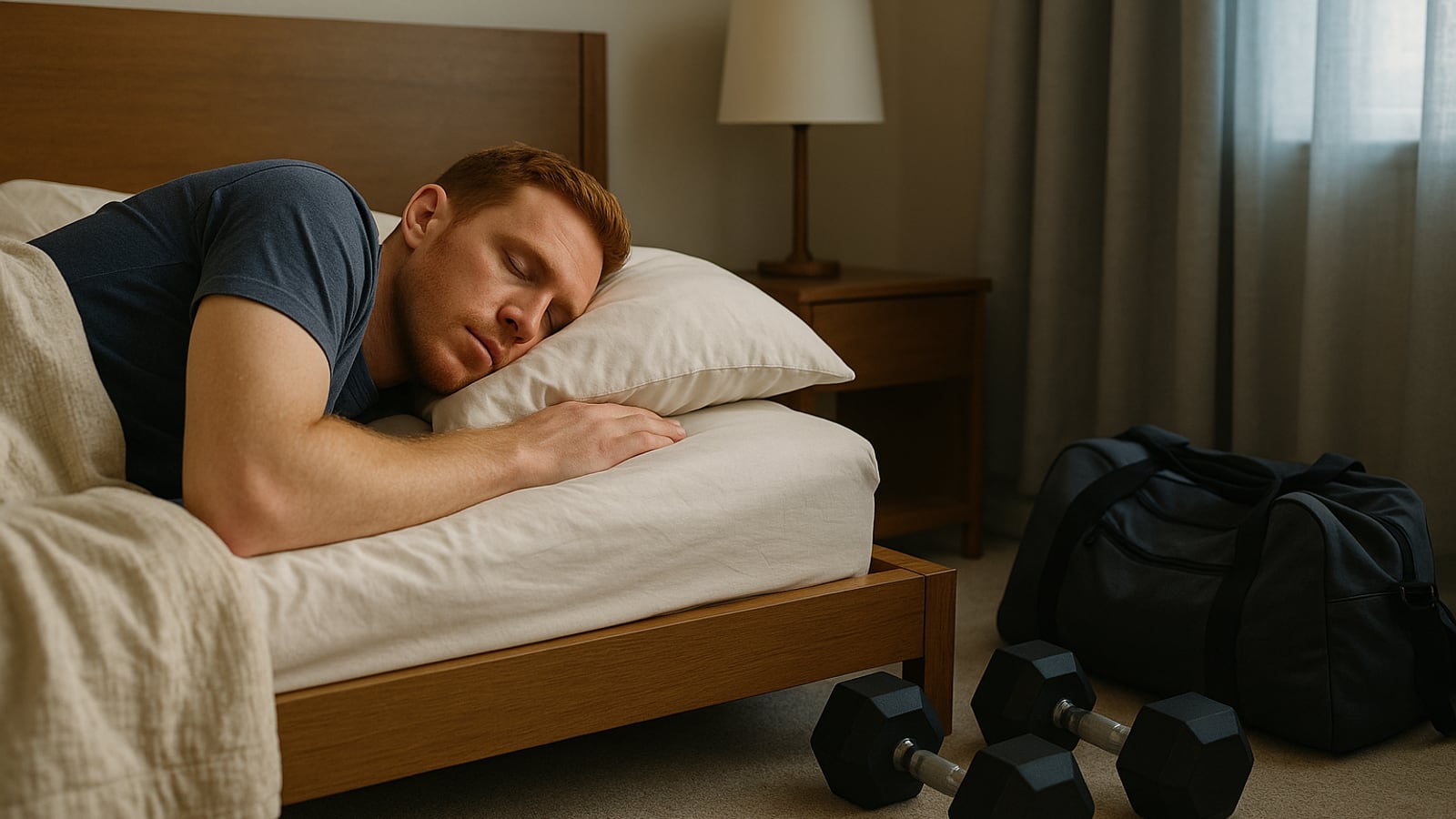
If you're getting six hours a night and training five days a week, drop a training day before you drop another hour of sleep.
That's the useful thing. The rest of this is how to make it work when you've got a job, a commute, and small people who don't care about your training block.
Training is the request. Sleep is the approval.
Lifting doesn't build muscle. Lifting asks for muscle. The building happens afterward, and most of it happens while you're unconscious.
Deep sleep is when the body does its heaviest repair work. Hormone release, tissue remodeling, the nervous system clearing out the fatigue from yesterday's heavy set. Skip it and the request goes unanswered. You still get sore. You just don't get the adaptation you paid for.
This is why the guy training six days a week on five hours of sleep looks the same in March as he did in November. He's not lazy. He's the opposite of lazy. He's just spending money he hasn't earned yet.
The general guidance for adults sits around seven to nine hours. Most people reading this are nowhere near it, and most of them know it. The question isn't whether you should sleep more. It's what you're willing to trade for it.
The 5 a.m. trade almost nobody should take
Somewhere along the line, the pre-dawn gym session became a badge. Alarm at 4:45, squats by 5:30, at your desk by eight.
It works for exactly one kind of person: the one who's actually in bed by nine-thirty. If that's you, carry on.
If you're in bed at eleven-fifteen because that's the first quiet hour you've had since six in the morning, the 5 a.m. alarm isn't discipline. It's a withdrawal. You're funding the workout with the recovery that's supposed to make the workout count.
The honest options are narrower than the internet suggests. Train at lunch. Train at seven at night after bedtime stories. Train Saturday morning while the house is still slow. Or go to bed earlier and genuinely earn the early alarm.
What you can't do is add a training session to a full day and pretend the hour came from nowhere. It came from your sleep. It always comes from your sleep.
Fix your wake time first, and leave it alone
The single highest-return change is a consistent wake time, seven days a week, within about half an hour.
Not bedtime. Wake time. Bedtime drifts because life drifts. Wake time is the anchor that pulls the rest of the system into line, and it's the one you can actually control.
Sleeping until ten on Saturday feels like repayment. It isn't. It shifts your body clock west, then Sunday night you lie there wide awake at eleven-thirty wondering why, and Monday starts in a hole. The lie-in costs you two nights to buy one morning.
Get up at the same time. If Saturday was rough, take a nap in the afternoon instead. The nap doesn't move your clock. The lie-in does.
Give this three weeks before you judge it. The first week is unpleasant. By the third, you'll be tired at a sensible hour without trying, which is the whole point.
The levers that cost nothing
None of this is exotic. All of it works better than whatever's in the tub on your counter.
- Caffeine curfew. Caffeine hangs around for hours. Last cup by early afternoon. If you drink coffee at four and tell yourself it doesn't affect you, you may be right about falling asleep and wrong about sleep quality.
- Alcohol. A couple of drinks will put you under faster and wreck the back half of the night. If you're drinking most evenings and wondering why you wake at three, you've found it.
- Dark and cool. Blackout the room properly. Tape over the standby lights. Turn the thermostat down further than feels reasonable.
- Phone out of the bedroom. Not face-down. Out. Buy a clock.
- A landing strip. Twenty minutes between the last screen and the pillow. Read something on paper. Tidy the kitchen. Talk to your wife about something that isn't logistics.
Pick two. Do them for a month. Then add another.
When the night is out of your hands
Newborns, teething, a sick kid, a night shift. There are seasons where good sleep simply isn't available, and no amount of discipline fixes it.
Train anyway. Just train differently.
Keep the frequency, cut the volume. Two or three sessions a week, still showing up, still moving weight. Drop the accessory work first. It's the least valuable thing in the session and the most fatiguing per unit of benefit.
Leave reps in the tank. On a bad week, stop two or three reps short of failure on everything. You'll still hold your strength. You won't dig a hole you can't climb out of.
Cut intensity before you cut the session. Ten percent lighter across the board beats skipping. Skipping becomes a habit in about nine days.
Don't test. A poor night isn't the day to attempt a personal best, and a failed heavy single on four hours of sleep will tell you nothing except that you're tired.
Maintenance is a legitimate goal. Holding what you've built through a hard eighteen months and coming out the other side still lifting is a win, even if nothing on the bar changed.
Naps, and the twenty-minute rule
A nap is a tool. Twenty minutes, early afternoon, alarm set. You'll wake up foggy for five minutes and sharper for five hours.
Go past about thirty and you drop into deep sleep, and waking out of that feels dreadful. Ninety minutes is a full cycle and works too, but most people with jobs don't have ninety minutes.
If you can't nap, sit outside in daylight for ten minutes instead. It won't replace the sleep. It does help the afternoon.
Know when it's not just tiredness
Some sleep problems aren't fixed by better habits.
Loud snoring, gasping or choking in the night, waking with headaches, falling asleep in the afternoon no matter how early you went to bed. Your wife telling you that you stop breathing. Persistent early-morning waking with a flat mood. Those are worth a conversation with your doctor, not another article.
Sleep apnea in particular is common in men, often goes undiagnosed for years, and affects far more than energy. It's treatable. Go and get it looked at rather than grinding through another decade assuming that's just what being forty feels like.
The household part
Sleep is a family negotiation, not a personal virtue.
If one of you is taking every night wake-up, that person is going to break, and it usually isn't a dramatic break. It's a slow one. Split the nights. Alternate weekends so each of you gets one proper lie-in a month while the other handles breakfast. Protect your wife's sleep as seriously as you protect your own, and say so out loud.
Nobody sells sleep because nobody can. There's no label, no scoop, no monthly subscription. It's given away free to anyone willing to turn the television off and go upstairs.
Most men won't. Be the one who does, and in two years you'll be stronger than the guy who bought everything.
Cal Brennan
Fitness
Strength coach. Trains fathers, tradesmen and desk workers, which means programmes that survive a bad week.

Watch
Worth an hour of your evening
More from Fitness.
From channels we rate. Plays on YouTube.
Read next