
Your manual sets the coolant interval, not the service counter
Some shops push a flush every 30,000 miles. Your car may want one every five years. Here's how to tell the difference and say no politely.
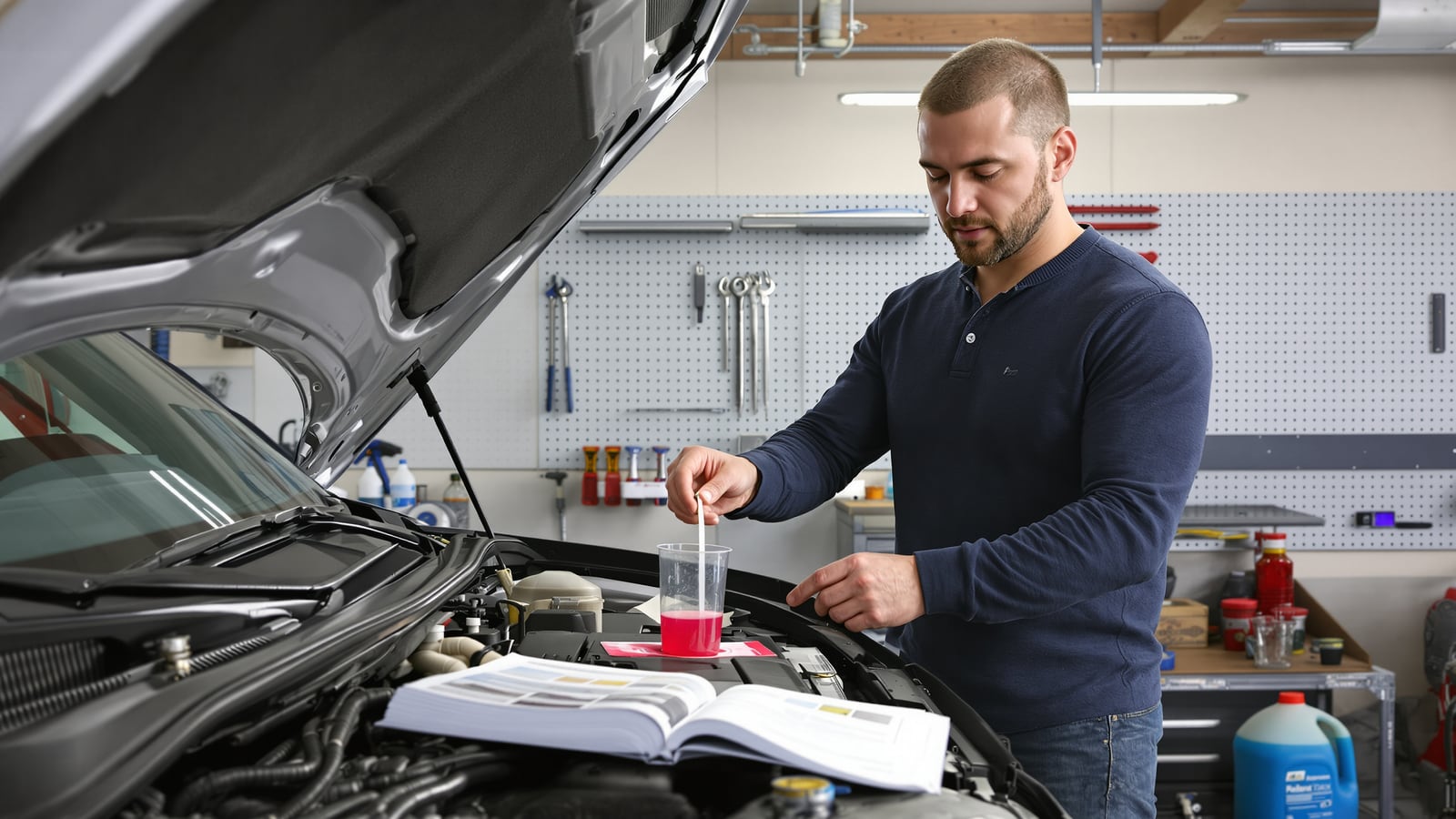
Quick answer: Look up the coolant interval in your owner's manual. It's usually listed in years and miles, whichever comes first. If the shop wants it done sooner, ask them to show you why, and ask for a test of the coolant you've got.
You're at the counter for an oil change. The service writer slides over a sheet with a line on it: coolant flush, recommended. The car has 41,000 miles. You've never had it done. You aren't sure whether that's negligent or normal.
It's probably normal.
Why the number on the menu is often wrong for your car
Coolant isn't one product. Older cars ran a traditional green coolant that wore out in a couple of years. Most cars built in recent decades use long-life formulas, and many of those are rated for five years or well past 100,000 miles. The makers differ, and the first change is often much later than the ones after it.
The problem is that a shop's service menu is built to be simple. One number, every car. "Every 30,000 miles" is easy to print and easy to sell. It isn't what the engineer who designed your cooling system wrote down.
That's not always dishonesty. A lot of service writers are following a corporate menu and have never read your manual. But the effect on your wallet is the same either way.
Also, a flush is a comfortable sale. It's quick, it uses a machine, the markup is good, and the customer can't see inside the radiator to argue. Oil changes get you in the door. Coolant flushes, brake fluid, and transmission services are where a shop makes its money on that visit.
What the coolant actually does, and why it does wear out
Coolant carries heat away from the engine, keeps the system from freezing, and, the part people forget, contains additives that fight corrosion. The additives get used up. Once they're gone, the fluid keeps moving heat around, but it starts eating at the metal it touches.
That's the real reason the service exists. Worn-out coolant corrodes radiators, water pumps, and heater cores. A heater core costs a lot because the dashboard has to come out to reach it. A cooked engine costs more than that.
So don't hear this as "never change it." Hear it as "change it on the schedule the maker set, and check it in between."
Find your number in ten minutes
- Open the owner's manual and find the maintenance schedule. Look for "engine coolant" or "cooling system." Write down both the first-change and repeat-change intervals.
- Check the coolant type on the reservoir cap or in the manual. Use that exact spec. The color of the fluid isn't a reliable guide, because different makers use different dyes and some colors overlap.
- Look at the level with the engine cold. The reservoir has MIN and MAX marks. Never open the radiator cap on a hot engine. The system is under pressure and the fluid will scald you.
- Look at the fluid itself. It should be clean and clear in its color. Rust-brown, oily, or full of floating bits means something's wrong, and it's worth a real look.
- Test it. Auto parts stores sell test strips that check the condition of the coolant, and a shop can check the freeze point with a hydrometer or refractometer. A real test beats a calendar guess in both directions.
If the manual says 100,000 miles and the shop says 30,000, you now know who's reading from the actual source.
Flush or drain and fill
Those two words get used as if they mean the same thing. They don't.
A drain and fill opens the radiator drain, lets the old fluid out, and refills with new. It replaces a good portion of the coolant, but some old fluid stays in the engine block and heater core. Do it twice a few weeks apart and you've replaced most of it.
A flush uses a machine to push fluid through the entire system, so more of the old stuff comes out. It's more thorough and it costs more.
The trade-off is real. On a system that's been neglected for a decade, some mechanics won't run a high-pressure flush, because they worry it will knock loose deposits that were plugging a leak or clogging a passage. Others do it every day without problems. If your car is old and the coolant has never been touched, ask the mechanic what they'd do and why. A good one has an answer.
For a car that's been maintained on schedule, a drain and fill is usually all it needs.
How to say no without being a jerk
You don't have to argue. You have to be specific.
Say: "Thanks. My manual lists that at 100,000 miles. Can you show me why you'd do it sooner on this car?"
Then stop talking. That's the whole move.
A good shop will either show you a test result, a dirty sample, or a service bulletin, or say "you're right, we can wait." Either answer is fine. The shop that gets defensive about a polite question has told you something about its next recommendation, too.
Be kind to the person at the counter. They're usually just doing the job they were handed. Be firm anyway. Your money is your family's money, and you don't owe anybody a yes because the sheet had a checkbox.
When the shop is right
Sometimes the early flush is the right call, and you'd be foolish to refuse.
- The coolant tests bad. Weak additives or a bad freeze point mean change it now, whatever the mileage.
- You towed or hauled hard, or live somewhere with brutal summers or winters. Severe use can shorten the interval, and many manuals say so in the fine print.
- The car's history is unknown. If you bought it used and the coolant was never documented, a fresh fill of the correct type resets the clock and removes the guesswork. That's cheap peace of mind. It's the same logic behind what to check before you hand a stranger cash for a car: you don't know what you bought until you look.
- A previous owner mixed types. Different coolants can react with each other and form sludge. A full change to the right spec fixes it.
Do it yourself, and do it right
A drain and fill is one of the friendlier jobs for a beginner. It's also a reasonable first step if you're thinking about a boring, cheap, popular project car. Do it with the engine cold and the car level. Use the coolant spec your car calls for, mixed 50/50 with distilled water unless it's sold premixed. Tap water leaves minerals behind.
Two things people skip.
Coolant tastes sweet and is poisonous. Dogs and small children will drink it off a driveway. Wipe up every drop, and keep the jug capped and out of reach.
And never pour the old stuff down a drain or onto the ground. Most auto parts stores and county waste sites take it for free. Carry it there in a sealed jug. Leave the garage floor cleaner than you found it.
Where this fits in the bigger picture
Coolant is one of those jobs that sits between "can't wait" and "can." Skip it forever and you'll eventually pay for it. Do it twice as often as needed and you'll quietly overpay for years. Neither extreme is wise. The car servicing that can't wait, and the kind that can walks through where it sits among the other jobs, and what it really takes to get a car past 250,000 miles shows why this kind of boring, on-schedule care is how a car gets there.
Read the manual once. It's the cheapest tool in the glovebox, and it's the only one that knows your engine.
Dean Shaw
Gear & Garage
Reads the warranty, the parts list and the long-term owner reviews before anything else. Trucks, tools, watches, and the cheap version that costs more.

Watch
Worth an hour of your evening
More from Cars.
From channels we rate. Plays on YouTube.
Read next