

Your First Knife Is Mostly Grinding, Not Hammering
A propane forge, a chunk of railroad track and a driveway corner are enough to make real knives and tools. Here's the true cost and the order to do it in.
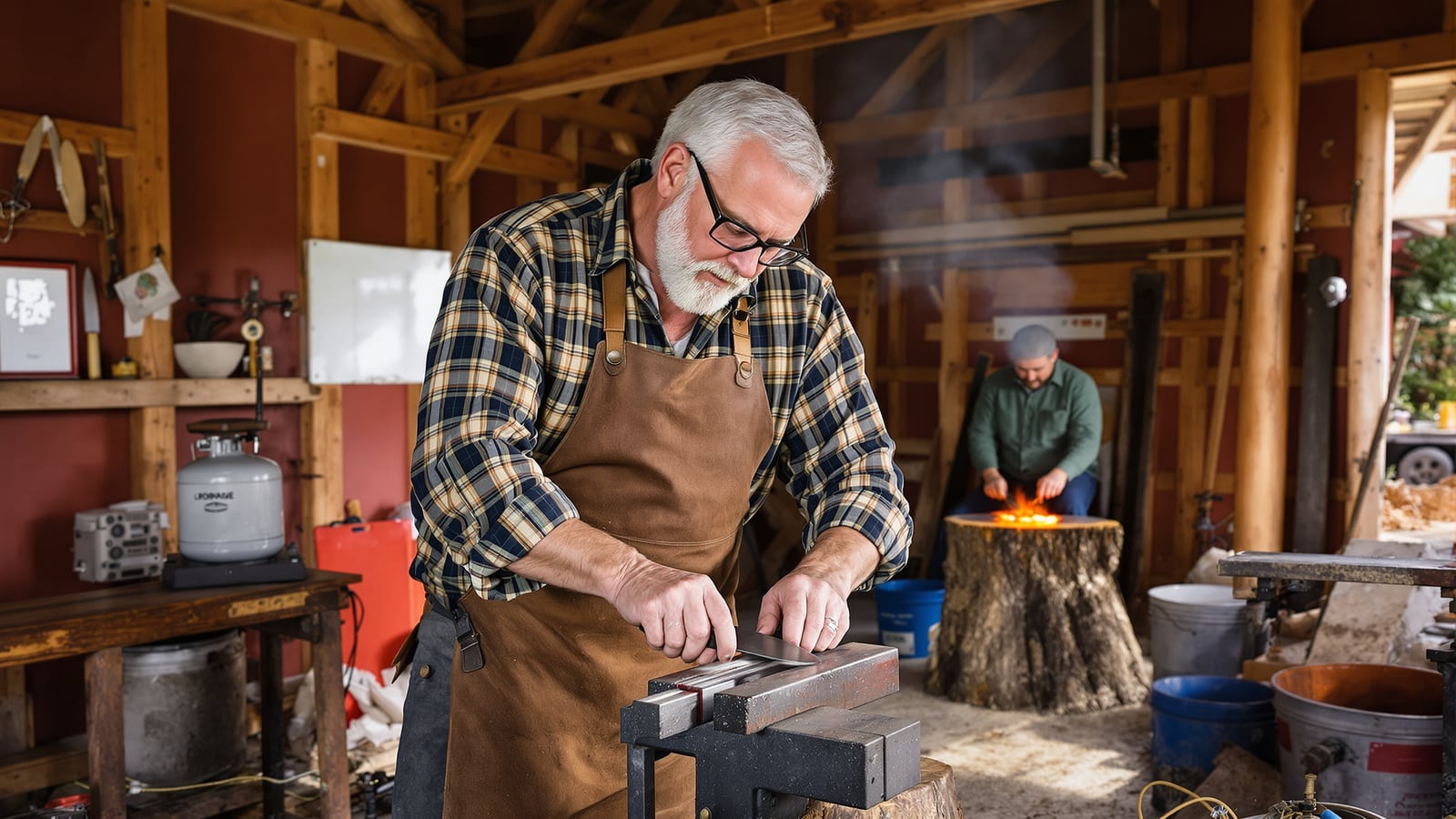
Quick answer: You can start forging in a garage or driveway with a small propane forge, a hard flat surface to hammer on, a two-pound hammer and tongs. Budget roughly $500 to $700 all in, safety gear included. Your first knife will take far more filing and grinding than hammering, and that's fine.
What it is, and why it gets hold of people
Forging is heating steel until it glows orange and moving it with a hammer. Bladesmithing is the knife branch of that. Plenty of people do both, because the tools you learn on (hooks, pokers, tongs, chisels) are the same moves in a smaller dose.
People get hooked because the feedback is instant and physical. You pull a bar out of the fire, hit it eight times, and it's a different shape. Nobody has to tell you whether it worked. A coat hook you made hangs on your wall, and it's still there in thirty years.
Here's the part nobody mentions: the hammer work is maybe a third of a knife. The rest is grinding the edge, heat treating, tempering and handle work. If you love the fire, you'll love forging tools. If you love the finished edge, you'll end up a bladesmith who forges only enough to get close. Both are fine.
What it really costs to start
Prices move, so treat these as ballparks and check before you buy.
- Propane forge: $250 to $450 for a single-burner unit from a maker like Devil Forge or NC Tool Co. A 20-pound grill tank costs about $20 to refill.
- Anvil: A 100-pound-plus steel anvil used runs several hundred dollars and sells fast. A two-foot piece of railroad track set on end in a stump or bucket of sand is the classic starter and often costs next to nothing from a scrapyard or a friend.
- Hammer: A two-pound cross-peen, $30 to $50.
- Tongs: $25 to $40 a pair. Get flat-jaw tongs first, sized to your stock.
- Safety gear: Safety glasses, a leather apron, leather gloves for the grinder, hearing protection, and a P100 respirator for grinding. Roughly $100 total. Don't skip any of it.
- Steel: A foot or two of 1084 bar stock, a simple high-carbon steel that forgives beginners, is about $10 to $20 from suppliers like New Jersey Steel Baron. Buy a few feet of cheap mild steel too, for practice.
- Files and finishing: A couple of good flat files, sandpaper and a clamp or vise: $50 or so.
- Quench: A metal pail and a few gallons of canola oil works for 1084. Parks 50 is the purpose-made option if you want it.
A belt grinder is the thing everyone eventually wants, and a decent 2x72 runs well over $1,000. Don't buy one yet. Files make a fine first knife.
The first three things to do this week
1. Watch somebody else do it. Find a local smithing group and go to a session. Watching one person keep a fire at the right heat will teach you more than a month of video. Bring coffee or a bag of charcoal or something for the shared shop. Leave the place cleaner than you found it, and return any tongs you borrow.
2. Set up a safe spot before you buy steel. You need concrete or packed gravel (not a wooden deck), nothing flammable within ten feet, good airflow, a fire extinguisher in reach, and a lid for your quench bucket in case the oil flashes. Propane forges produce carbon monoxide, so never run one in a closed garage. Door wide open at minimum, outside is better. Wear cotton or wool, because synthetic clothing melts onto skin.
3. Make a hook out of mild steel. Not a knife. A hook. Heat a foot of quarter-inch round bar to bright orange, draw out a taper, bend a curl, flatten the other end and drill or punch a hole. You'll learn fire control, hammer control and tong grip in an hour. It'll look ugly. Hang it up anyway.
Your first knife, in order
When the hook feels easy, move to 1084.
- Forge or cut a rough blade shape, about a quarter inch thick. Leave it a bit fat.
- Normalize it: heat to orange, let it cool in still air, three times. This relieves stress and keeps the blade from warping later.
- File and grind the profile and bevels. Leave the edge about the thickness of a dime.
- Heat to the point where a magnet no longer sticks to it, a bright orange, and quench it in warm oil.
- Temper right away in a kitchen oven at 400°F for an hour, let it cool, and do it again. Skip this and the blade is glass-hard and can snap.
- Finish the edge, add handle scales, and make a sheath. If you want a leather one, leatherworking is two needles, a knife and a piece of hide.
Plan on a weekend or two for the first knife, most of it at the vise with a file.
The beginner mistakes that cost you the most
- Hammering steel that's gone dull red. If it's not glowing orange, put it back in the fire. Cold steel cracks and wastes your effort.
- Burning the steel. White sparks flying off means you've overheated it and ruined the bar. Back the heat down.
- Mystery metal. Rebar, bolts and random scrap aren't hardenable steel. Use bar stock you can identify for knives.
- Skipping the temper. A hardened blade that hasn't been tempered is a liability.
- Buying the big anvil and big grinder first. Spend on safety gear and on instruction before you spend on iron.
- Chasing Damascus. Pattern-welded steel is a year-two problem. Learn to make a plain knife that cuts well.
- Letting anyone rush your safety setup. A friend who says "you don't need the respirator" is wrong. Be polite about it and put it on anyway.
If you get burned, run cool water over it and get medical help right away for anything beyond a small, minor burn. Keep a first aid kit in the shop, and check that it holds what you'd need.
How to find your people
Smiths are some of the most generous hobbyists around. Start here:
- ABANA, the Artist-Blacksmith's Association of North America. It lists local affiliate chapters, and most host regular meetings and open forge days.
- The American Bladesmith Society. It's the place for knife-focused classes and learning from working makers.
- Makerspaces and community college welding or fabrication programs. Many run introductory forging classes with the gear provided.
- Hammer-ins. These are casual gatherings where smiths share fire and tools and swap tips. Show up, ask questions, and stay to help clean up.
Check your state and local knife laws before you carry or sell anything you make. Making a knife is one thing, and carrying and selling them is another. A quick call to your local police or sheriff's office will answer it.
And if you already swing a detector, where you can legally metal detect can turn up a rusty hand-forged nail, which is the kind of find that starts some people on this whole path.
Your first piece will be crooked. Keep it on the shelf anyway, next to the tenth one.
Dean Shaw
Gear & Garage
Reads the warranty, the parts list and the long-term owner reviews before anything else. Trucks, tools, watches, and the cheap version that costs more.

Watch
Worth an hour of your evening
More from Hobbies.
From channels we rate. Plays on YouTube.
Read next