

Read the heart, then walk the trail backward
A deer track tells you which way it was headed and roughly when. It can't tell you what the animal will do next. Here's how to read the first two and stay humble about the third.
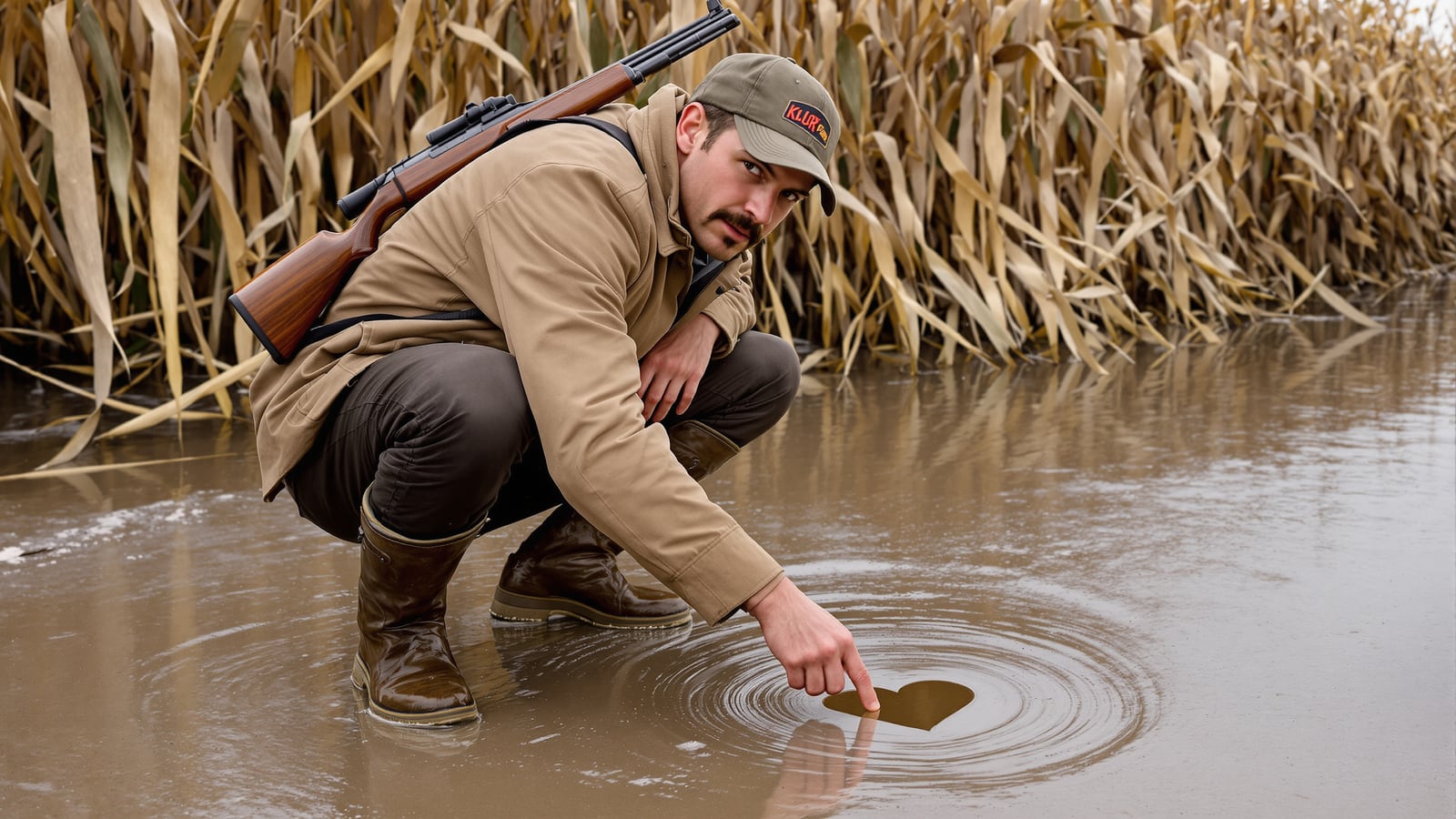
Quick answer: The point of the heart-shaped print aims the way the deer was going. Sharp edges, clear water and no debris inside mean fresh. Size and depth hint at a bigger animal, but a single print never proves one. And you'll learn more walking a trail backward than chasing it forward.
The part everyone knows, and the part they skip
A whitetail print is two toes, split down the middle, with the tips together. Think of a narrow heart. The point is the front. That's direction of travel, and it's right nearly every time.
The "nearly" matters. On a steep bank, a deer sliding downhill can leave a smeared print whose point faces the wrong way, with the toes skidded together. One print can lie to you. Three in a row can't. Find the next print, then the next, and let the line of them settle the argument.
Now look at what the foot did, not just the shape. A walking deer sets its hind foot close to where the front foot just landed, so the prints fall in a tidy, near-straight line. A trotting deer stretches the gaps. A bounding deer leaves clusters far apart, deep at the toes, with two small dots behind each print where the dewclaws hit. A deer on a hard push-off also flings soil backward from the toes, which gives you direction a second way. If the dirt was thrown behind the print, the deer was heading away from it.
Dewclaws showing in a walking print means soft, deep ground or a heavy animal. Keep that in mind for the next section.
Reading age: the track, not the deer
You can't read a deer's age in years from a footprint. Anybody who says they can is selling something. What you can read is size and weight, and those are only loose hints.
Rough rules of thumb, which shift with region and herd:
- A mature deer's print runs around three inches long or a little more. Fawn and yearling prints run noticeably smaller, often under two and a half.
- Bigger bodies press deeper. In the same mud, a heavy deer sinks further than a light one.
- A heavy deer tends to show rounder, blunter toes and more spread. Young deer look narrower and sharper.
- Dewclaw marks in an ordinary walking track suggest weight.
Concede the obvious: a big doe leaves a bigger print than a spike buck. Northern deer run larger than southern ones. Don't call a buck from a track alone. Tracks tell you something walked through here, and it was big or it wasn't. That's a reason to hang a trail camera or sit a stand, not a reason to take a shot. And identify what's in front of you before any shot, every time. When you're not sure of the shot, you already have your answer.
Reading the clock
This is where the real value is. Fresh and old trails can look the same from ten feet. Get down close.
In mud:
- Fresh edges are crisp and wet. Old ones crumble, dry to a crust or round off.
- Water that has seeped into a print tells a story. If it's still cloudy, the silt hasn't settled, so the deer went through minutes ago. Clear water means hours.
- Check inside the print. A fallen leaf, a pine needle, a bit of bark or a spiderweb across the toes means time has passed.
- After a rain, anything with sharp edges was made after the rain stopped. Anything melted and pocked wasn't.
In snow:
- Find when the snow stopped falling. Prints with fresh snow inside them came before the flakes. Prints sitting clean on top came after.
- Frost on a cold morning works the same way. Frost crystals in the print mean it's older than the frost. A clean, frostless print on a frosted floor was made after.
- Sun lies. A print in direct sun will widen and soften by afternoon, so it looks older than the same print in shade. Compare tracks in the same light.
- Wind rounds edges and fills small prints with blown snow.
Make your own clock
Before you start guessing, stamp your boot into the same ground. Note the time. Come back in an hour and look at how the edges changed. Do it again in the afternoon.
It sounds fussy. It's ten seconds, and it calibrates your eye to this soil, this temperature and this day better than any rule. Clay holds its edges for hours. Sand loses them in minutes. A boot print you made at 6:40 a.m. is the only honest ruler you'll carry.
Walk it backward
Here's the contrarian part, and it's the whole reason to learn direction. Most beginners find a fresh trail and follow it forward. All that does is push the deer ahead of you and turn the best sign on the property into a deer that's now somewhere else.
Read the direction, then do the opposite. Walk the trail back the way it came. You'll find where the deer left its bed, where it crossed a creek, where it stopped to feed, and where it came out of cover. A trail in the other direction tells you where it's going. A trail backward tells you where it lives.
Then find the pinch: a gap in a fence, a saddle in a ridge, a shallow crossing. Several trails leading to one spot mean that's your setup, downwind and well before first light. Sit there. For more on this, Reading Sign Is a Clock, Not a Map covers how the pieces fit together.
One other reason to back off. Deep winter snow costs deer energy. Pushing them through it, again and again, isn't good for the herd you're trying to keep. Conservation-minded hunters give them room to rest.
Rules, land and safety
Rules on tracking vary by state and province, and they change. Some places restrict tracking with dogs, some limit how you can follow a wounded animal onto neighboring land, and snow-tracking may be treated differently from stand hunting. Read your wildlife agency's current regulations before the season, not during it.
Private land is private land. A trail doesn't care where the fence line is, and neither does a hunter who's following it. Stop at the boundary. Get the neighbor's permission before the season, not after the shot. If you've got no land of your own, where to hunt when you don't own a single acre is a good place to start.
And keep your head up. Tracking with your eyes on the ground is how people walk onto thin ice at a creek edge, step into a bog, or lose daylight three miles from the truck. Tell somebody where you're going and when you'll be back. Carry a light even if you plan to be out by noon. Mud and snow both hide holes. Slow down and look where you're stepping.
What to carry out of this
Take a notebook, or the notes app, and write down three things for every trail: direction, estimated age, and the time you wrote it. Come back the next day and check yourself. If you called it three hours old and the deer was long gone, adjust.
Do that for one season and you'll stop guessing. A track is a note somebody left in the dirt. Learn to read the date on it.
Wes Dunbar
Country & Skills
Grew up on an acreage and never quite left. Covers trucks, trades, land, and how to do the thing yourself.

Watch
Worth an hour of your evening
More from Hunting & Shooting.
From channels we rate. Plays on YouTube.
Read next