
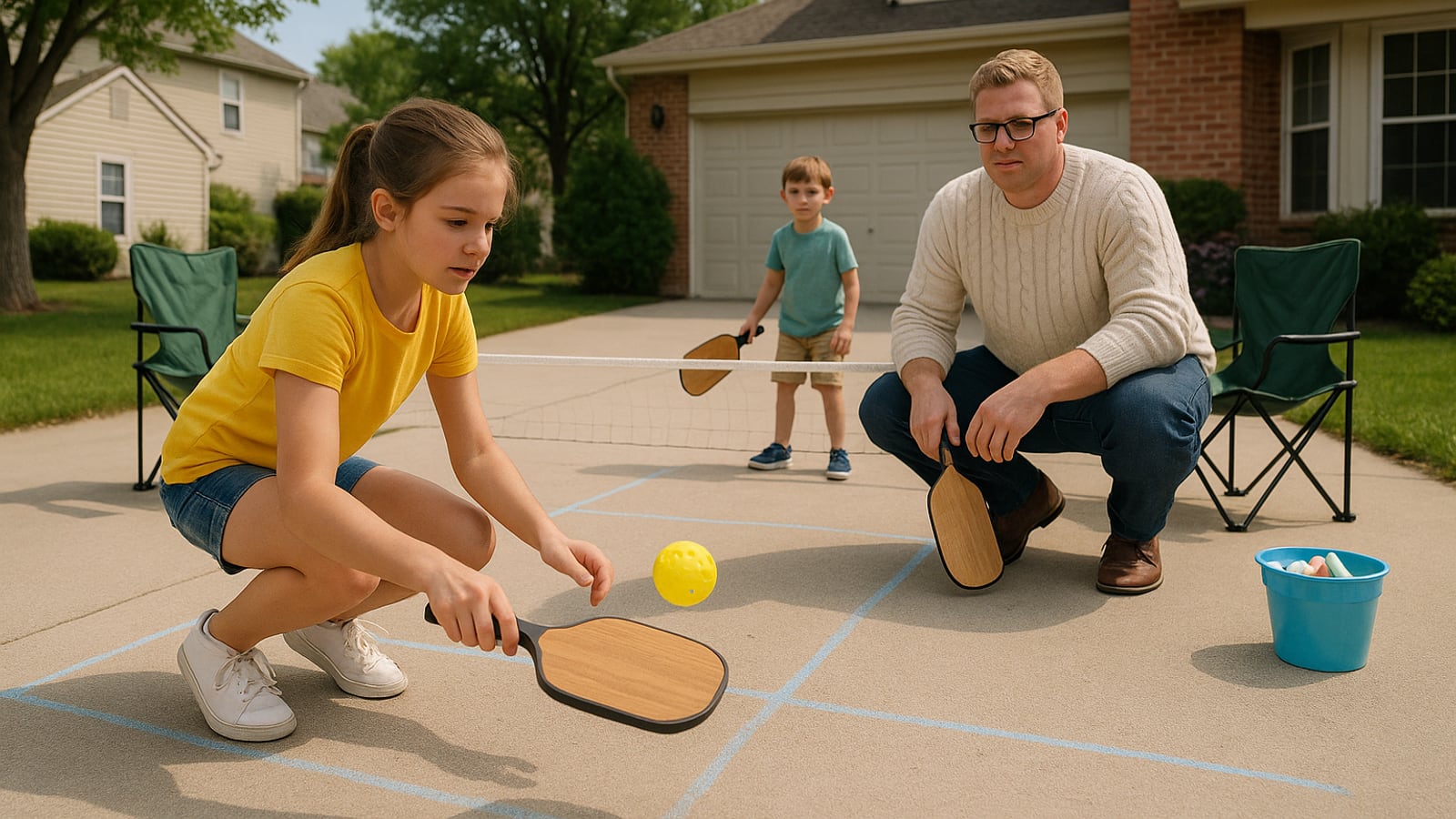
Quick answer: Chalk two lines seven feet from a rope strung about three feet high, and have your kids hit soft shots back and forth inside those boxes. Skip serving and scoring for the first few weeks. Most kids quit pickleball because somebody started them at the baseline.
A regulation pickleball court is 20 feet wide and 44 feet long. Your driveway probably has the width and runs out of length somewhere around the garage door. Your seven-year-old won't notice, and you shouldn't worry about it either.
Draw from the middle out
Put the rope where you want it first. Then measure seven feet toward each end and chalk those two lines. That seven-foot box on each side is the non-volley zone, which everybody calls the kitchen, and for the first month it's the only part of the court that matters.
After that, run the baselines back as far as the concrete lets you, up to 15 feet behind each kitchen line. A court that's 29 feet end to end is a fine kid court. So is one that's 20.
A few things nobody mentions until you've already done it wrong:
- Use washable sidewalk chalk, not the chalk line in your garage. Red carpenter's chalk and some of the colored powders are made to be permanent. Use one and your driveway will have a pink rectangle on it until you sell the house.
- Hand your kid the dumb end of the tape measure. Holding the tape on the mark is a real job, and kids take it seriously.
- Snap a photo of your measurements. One good rain takes every line. With the numbers written down, you can redraw in ten minutes.
- Close off the street. If the open end of the driveway faces the road, park a car or roll the trash cans across it. Make one rule before the first ball goes over the rope. If it rolls into the street, nobody chases it and a grown-up gets it. No exceptions, not even for the good ball.
The rope is the hard part
A real net is 36 inches high at the sidelines and 34 in the middle. Your rope will sag more than that, so pull it as tight as you can between two anchors that get you close to three feet. Camp chairs work, and so do sawhorses or a trash can on each side with the rope tied to the handles. For kids under about seven, drop it to two feet. Nobody learns anything hitting into a wall.
A bare rope is almost invisible when a ball's coming at you, and it starts the "that went under" argument every single rally. Clip dish towels along it with clothespins every couple of feet, or slit a pool noodle lengthwise and push it over the rope. Now it looks like a net and the argument goes away. The towels also flap when the ball clips them, which settles the close ones.
Buy less than you think
You need two paddles and a handful of balls. Wooden paddles are cheap and nearly indestructible, but they're heavy for a small wrist. If your kid's arm tires after five minutes, a lighter composite paddle helps.
Buy outdoor balls, the ones with more and smaller holes, because they're built for hard surfaces like concrete. They get brittle and crack in real cold, so this is a spring-to-fall game unless you like buying balls. For kids under about six, start with a beach ball or a light foam ball. The point is contact, not realism.
Don't buy a portable net yet. The rope is the trial run. If your kid is asking to play on the third weekend, a real net earns its garage space. If not, you're out a clothesline.
Start in the kitchen, not at the baseline
The usual first lesson goes like this. Dad explains the underhand serve, then the rule that it has to go diagonally and clear the kitchen, then the two-bounce rule, then the three-number score call that confuses most adults. The kid serves into the rope eleven times and goes inside to find the tablet.
Do the opposite. Both of you stand at your kitchen lines, close enough to hand each other a sandwich. Push the ball over the rope softly so it lands in the other kitchen. That shot is called a dink, and experienced players spend a big share of every game trading them, so you're not teaching a kiddie version. You're teaching the real thing first.
Make it cooperative. Don't keep score. Say, "Can we get ten in a row?" Count out loud together. When you hit ten, go for fifteen.
Picture a Tuesday at seven o'clock. Your eight-year-old wants to crush every ball into the neighbor's hedge. Two nights of chasing ten in a row, and he starts slowing down on his own, because a smash ends the count and he wants the count. You didn't lecture him about patience once.
Add one rule at a time
Go by the kid in front of you, not by the birthday. What your four, eight and twelve year old can actually do is a good gut check if you're not sure how much to ask.
- Around four to six: Bounce the ball up on the paddle, catch it, then tap it over the rope. A balloon is perfect indoors on a rainy day.
- Around six to eight: Kitchen dinks, then take one step back each and let the ball bounce once before hitting. Add an underhand serve, straight across at first, diagonal once they're landing it.
- Around nine to twelve: Real rules. The serve is underhand, contact below the waist, diagonal, and it has to clear the kitchen. Serve and return both have to bounce before anyone volleys. And nobody volleys while standing in the kitchen.
For scoring, start with rally scoring, where every rally is a point for somebody. First to 11, win by two. Switch to traditional scoring, where only the serving side can score, once they're asking why the pros do it differently.
They call their own lines
This is the part that makes pickleball worth the trouble. In casual play, each side calls the lines on its own side, and the rule is that a ball you can't clearly call out is in. The benefit of the doubt goes to the other player.
That means every driveway game is a small, weekly test of whether your kid will tell the truth when it costs him a point. When your kid calls a ball out that plainly landed on the line, stop the rally. Don't give a speech. Just say "That one was in, their point," and serve again. When your kid calls one against herself, mention it later, quietly, to her and to nobody else. Teaching a kid to tell the truth when it costs him something goes deeper on why that quiet word matters more than the correction.
The other half of that lesson matters too. If a cousin or a neighbor kid calls everything out, your kid doesn't have to smile and keep losing to it. Teach him to say, "That was in," once, calmly. If it keeps happening, he can come get you. Being a good sport doesn't mean being a doormat.
Mind the concrete
A driveway in July soaks up heat all afternoon and gives it back all evening. Play before ten in the morning or after six at night, and keep a water bottle on the steps.
Put sunscreen on them either way. Any broad-spectrum SPF 30 or higher is far better than skipping it. For kids, mineral formulas with zinc oxide or titanium dioxide are the gentler pick. They sit on the skin, and they're the only two filters the FDA proposed in 2019 as generally recognized as safe and effective while it asked for more data on the rest. Some leave a white cast. Thinkbaby SPF 50 and Blue Lizard Sensitive Mineral SPF 30 are easy to find. Reapply every two hours, and sooner if they've been sweating.
Put it back better than you found it
The game isn't over until the court is. The rope gets coiled, the chairs go back where they came from, and the balls go in a bucket. Have the kids sweep the grit off the playing area too, because sand on concrete is how a kid slides and loses skin. If you borrowed the neighbor's sawhorses, they go back that night, swept off. If this becomes the summer of pickleball, it pairs well with a few of these summer projects kids will actually finish.
Leave the chalk lines, though. Rain will take them eventually. Until it does, every time your kid walks out to the car, they'll see that kitchen line and ask if you've got ten minutes.
Say yes.
Sam Ortiz
Dads & Family
Father of three. Writes about presence, discipline and the long game, without pretending any of it's tidy.
Watch
Watch how it's done
Picked for this article.
From channels we rate. Plays on YouTube.
Z Sisters Pickleball
How to Turn Any Driveway Into a Pickleball Court
PickleballCentral
How to Build a Pickleball Court... ANYWHERE!
Read next