

Ask for the letter while your officer still remembers you
Your evaluations stay in a file. A strong letter from the officer who led you follows you into every door you knock on after the uniform comes off.
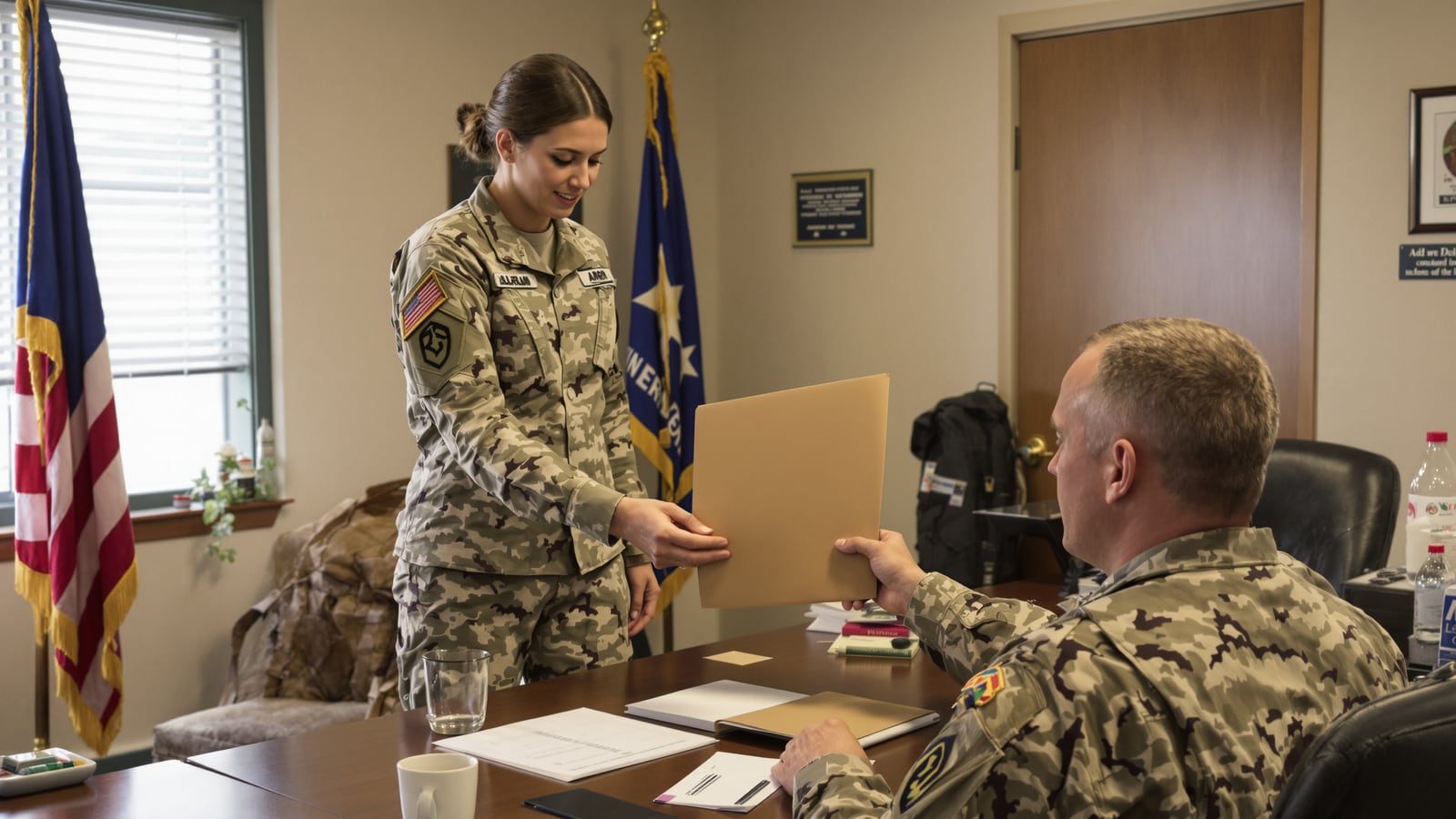
Quick answer: Ask for the letter before you leave, while the officer still remembers your work in detail. Give them a one-page summary to write from, get it in writing, and keep copies in more than one place. You'll use it for years.
The paper that doesn't travel
Your evaluations are written in a dialect. Eleven bullets about "directed operations" and "ranked number one of nine" mean a great deal inside the service. A hiring manager at a trucking company, a admissions office at a state university, or a fire department's review board mostly can't read them. And most of them will never see them anyway.
A letter from the person who led you reads in plain English. It says who you are, what you did, and why a stranger should bet on you.
Picture a former staff sergeant, seven years out, applying to a nursing program. She has the grades. What she doesn't have is anyone who can speak to how she handles a bad night under pressure. Her old company commander can. But he's retired, he moved, his email bounced, and he remembers her as "a good one." That's a nice sentence. It's not a letter.
Why it matters more after you leave
During service, the system vouches for you. Your rank, your evaluations, your awards and your chain of command do the talking. Nobody asks for a character reference to confirm you're a sergeant.
Civilian life has no such system. Every door asks someone to take your word for it, and a credible third party is the cheapest way to settle the question. That's why the same letter that sat unused for your whole enlistment becomes the strongest page in an application package.
Time works against you in three ways:
- Memory fades. A commander who led 140 people can recall specifics about you this year. In five years, he'll recall the outline.
- People scatter. They PCS, retire, change numbers and change emails.
- Some people are gone for good. You can't ask them later. You can only ask them now.
When to ask
Ask at a natural break. A change of command, the end of a deployment, a PCS, or when you give notice that you're getting out. The officer has just watched you finish something, and the details are fresh.
Don't wait for your last week. Final weeks are crowded with clearing paperwork and goodbyes, and a rushed letter reads rushed. If you're inside the last year and a half, start with the plan in What to Do in the 18 Months Before You Take Off the Uniform.
How to ask without making it a chore
Officers say yes to this all the time. The ones who write good letters are the ones who've been made it easy.
Bring a one-page summary. Include:
- Your dates under their command and your job title
- Two or three specific things you did, with outcomes (the section you trained, the inspection you passed, the equipment you kept running)
- What you're applying for next, in a sentence
- A deadline, if there is one, and a date that's reasonable
Then ask plainly: "Sir, would you be willing to write a strong letter of recommendation for me?" The word strong matters. It gives a lukewarm officer a polite way out, and you want that. A lukewarm letter is worse than none.
Skip the "to whom it may concern" request. Ask for a general letter now, and offer to send the specifics of any application later so the officer can tailor a paragraph.
What a good letter actually says
The best letters share a shape. They say how long the writer has known you and in what role. They give one concrete story with a result. They compare you honestly to others the writer has led, if the writer can do it truthfully. And they end with contact information and an offer to talk.
Specific beats glowing every time. "Outstanding leader with unlimited potential" reads like every other letter in the stack. "When our generator failed during the storm, he reorganized the shifts and had the section running in an hour" gets remembered.
Your summary page is what makes that story possible. Don't write the letter for them. Hand over the facts and let them use their own voice.
Don't stop at officers
An officer's title carries weight, and some employers and schools want to see one. But the person who watched you every day was often a first sergeant, a chief or a platoon sergeant. That person can describe your habits in a way a commander at a distance can't.
Aim for two or three: one from the officer who led you, one from a senior enlisted leader, and one from a peer, a supervisor or a civilian who worked alongside you. Different angles make a stronger case than three copies of the same praise.
If you want to see how this material fits into the rest of your application, Turning Your Military Record Into a Resume Civilians Can Read covers the other half.
The other use nobody plans for
A recommendation letter and a statement supporting a VA claim are different documents. But the people who can write either are the same people, and they're equally easy to lose.
The VA accepts lay and witness statements from people who were there when an event or an injury happened. The form is VA Form 21-10210. A claim that comes up years later is much easier to support if you still know where your old squad leader lives. Get contact details before you separate, and check the current process at VA.gov or with an accredited veterans service officer. That's general information, not advice for your specific claim, and a VSO is free and the right person to ask.
Your installation's Transition Assistance Program can also point you to current resources on references, resumes and benefits. Use it.
Keep the letter alive
When you get the letter, scan it. Save a copy to your email, a cloud account and a thumb drive in a drawer. Note the writer's name, rank, last known unit and contact information.
Then send a short note when something good happens. You enlisted, you got hired, you finished the degree. A two-line message once a year keeps the relationship warm, and it makes the next favor easier to ask.
And the old code applies here too. Leave it better than you found it. When a younger Soldier, Sailor, Airman or Marine asks you for a reference, say yes and write a good one. Somebody did it for you.
The uniform comes off. The people who vouched for you in it don't have to.
Ade Fisher
Young Men
Teaches the trades intake at a community college. Writes the manual he wishes his students arrived with.

Watch
Worth an hour of your evening
More from Military & Vets.
From channels we rate. Plays on YouTube.
Read next