Learn Piano by Ear With One Song and Three Chords
You already know the melody. Here's how to find it on the keys, add a left hand, and play a whole song this week without reading a note.
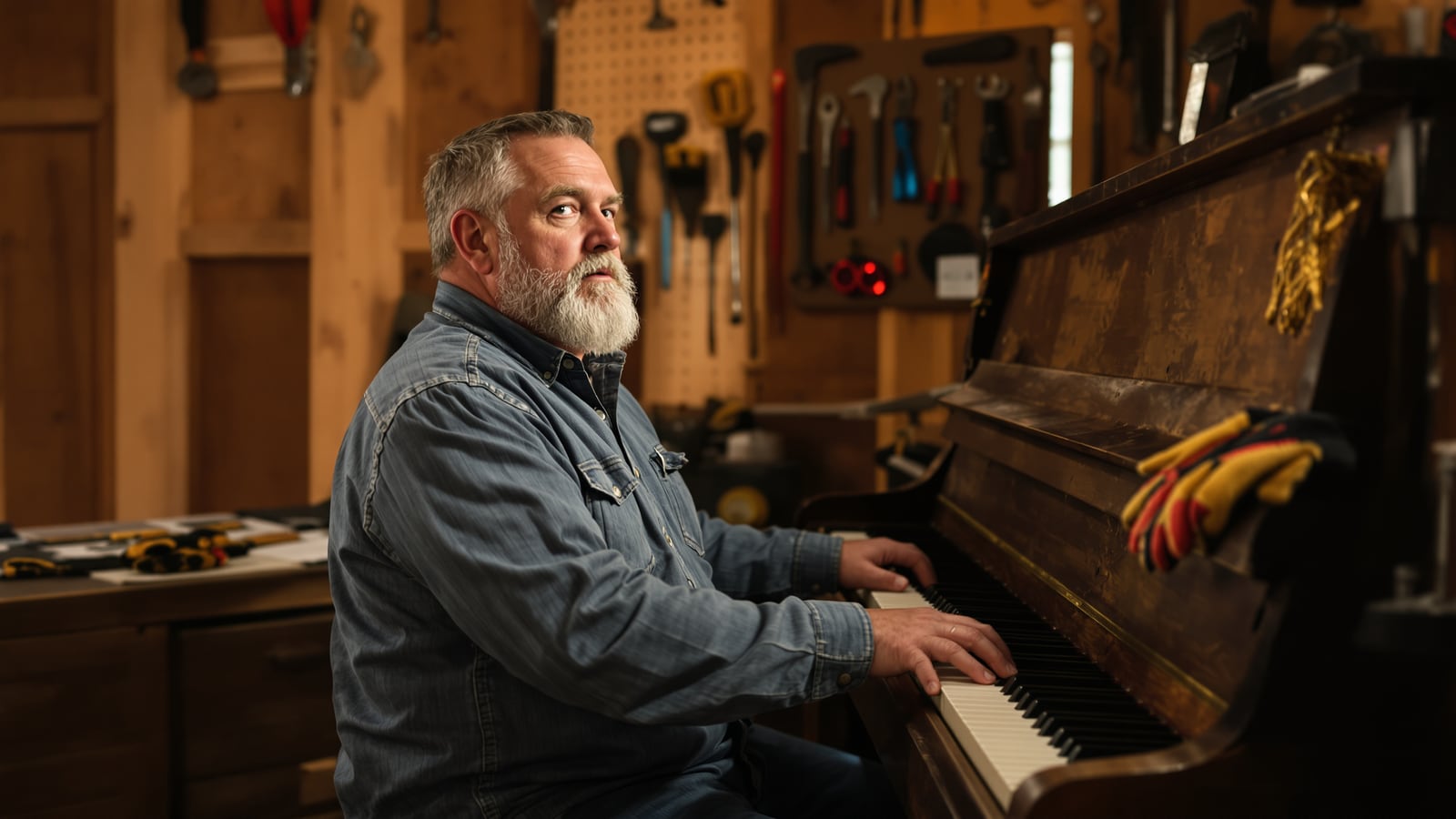
Quick answer: Pick a song you can hum. Find its home note, pick out the melody with one finger, then add three chords in the left hand: the 1, the 4 and the 5. In the key of C that's C, F and G. Do that with one song and you've learned more than most beginners do in a month of drills.
Start with a song you can't forget
Choose something simple that you've heard a thousand times. "You Are My Sunshine" works. So does "Amazing Grace," "Happy Birthday," or any old country standard you grew up hearing in your dad's truck.
Skip the song you only half remember. You need the whole melody running in your head, because that's what you'll be checking the piano against. The sheet music is only a written record of that tune. You already own the original.
Concede the obvious: reading music is a real skill, and you'll want it if you ever play in an orchestra, accompany a choir from a score, or tackle a classical piece. But plenty of the best country, gospel and bluegrass players learned the other way, and the ear is the part that can't be faked. Many players who read well still can't play a song they've just heard. The reverse is easier to fix. A player with a good ear can pick up reading later, and it'll make sense when he does.
Find the home note
Every tune has a note where it feels finished. Hum the last line of your song and hold the final note. Now press keys, one at a time, until one matches the note you're humming.
Don't worry about the name yet. You're listening for the moment when the piano note and your voice become one sound.
To check, play that key and then hum the opening of the song. If it sounds settled, you've probably found home. If something sounds off, try the white key next to it. Move one key at a time.
If you want to play the song in C and your voice sits higher or lower, fine. Just find C and sing along from there, even if you have to sing an octave away. Pick one key and stay in it for the first month.
Hunt the melody with one finger
Use your right index finger only. Start on the first note and pick your way through the tune.
Here's the trick that saves hours: most melodies move by neighbors. The next note is usually the same note, the key beside it, or one key over from that. Big leaps are rare, so you don't search the whole keyboard. You search a few inches.
When you land on a wrong note, you'll hear it. It rubs. Move up or down one white key and try again. It's a slow game of warmer and colder, and it trains your ear faster than any app will.
Take it a phrase at a time. Get "You are my sunshine, my only sunshine" and stop. Play it five times from memory. Then add the next line.
If you lose the thread, sing it out loud. Your voice knows where the tune goes before your fingers do.
Add the left hand: three notes do the work
Here's where the song stops sounding like a doorbell and starts sounding like music.
In the key of C, the three chords that carry most country, gospel, bluegrass and early rock are C, F and G. Count them as 1, 4 and 5. Put your left pinky on those notes and play them one at a time, low on the keyboard.
Now play the melody with your right hand and hold C in your left. Where it sounds right, stay. Where it starts to clash, the harmony is changing. Try F. If that clashes, try G. You'll hear the fit the way you hear a key sliding into a lock.
Most simple songs follow a pattern. They sit on C for a while, move to F, come back to C, touch G, and land on C again. Use that as a rough map and let your ear correct it.
Once root notes feel natural, build full chords:
- C is C, E and G.
- F is F, A and C.
- G is G, B and D.
Play them with the left hand while the right carries the tune, or let the right hand play the chords and sing the melody yourself. Both ways are real piano.
Make the chords move smoothly
Jumping from a C chord to an F chord and back is clunky. The pros don't hop. They keep as many fingers still as they can.
Play C: C, E, G. For F, keep the C where it is and move the other two fingers: E goes up to F, G goes up to A. Now your hand has barely moved. For G, drop that top C down to B and move the others around it. This is called inversion, and it's the whole reason a hymn sounds smooth under a congregation.
You don't need the term. You just need to notice that your hand wants to move the least amount possible. Let it.
Steal the sound of the style you love
Once the basics work, the genre starts to show through in the small touches.
Country piano leans on the "slip note," where a finger slides onto a chord tone from the key just beside it. Floyd Cramer made it his signature in the early 1960s, and it's the easiest way to make a plain tune sound like Nashville. Play the note a half step lower, then slide up to the right one.
Gospel and hymn playing runs on rolling left-hand patterns and filling the gaps between phrases. Bluegrass and early rock lean on a steady left-hand beat. When you're ready, learn one lick at a time and drop it into a song you already know. If you want tunes to practice on, the hymns piece here is a good place to find ones that sit well on the keys.
What goes wrong
You stare at your hands. Look at the keys if you must, but listen harder than you look.
You stop to fix every miss. Don't. Keep the beat going and fix it on the next pass. A song with a wrong note that keeps moving is better practice than a perfect measure played once.
You stay in one key forever. C is a fine place to start. Once a song feels solid, try it in G. The chords will be G, C and D, and it'll feel like starting over for about ten minutes. Then your ear catches up.
You skip recording. Prop up your phone and make a voice memo. Listen back the next day. You'll hear the mistakes you were too busy to notice, and you'll hear progress too.
Fifteen minutes a day is enough. A week on one song beats a day each on seven. If you've been through the first ninety days of guitar, you already know how this goes: the early weeks feel slow and then they don't.
The test
Play it for somebody. Your wife, your kids, your neighbor. Don't announce it. Just sit down and play something they know, and watch them start to sing.
That's when you'll know it worked. Nobody asks if you can read music. They just want to hear the next verse.
Dean Shaw
Gear & Garage
Reads the warranty, the parts list and the long-term owner reviews before anything else. Trucks, tools, watches, and the cheap version that costs more.

Watch
Worth an hour of your evening
More from Music.
From channels we rate. Plays on YouTube.
Read next