

Your family band starts with a bucket and three chords
You don't need a music store. You need a kitchen, a closet, one patient adult and a song everybody already knows.
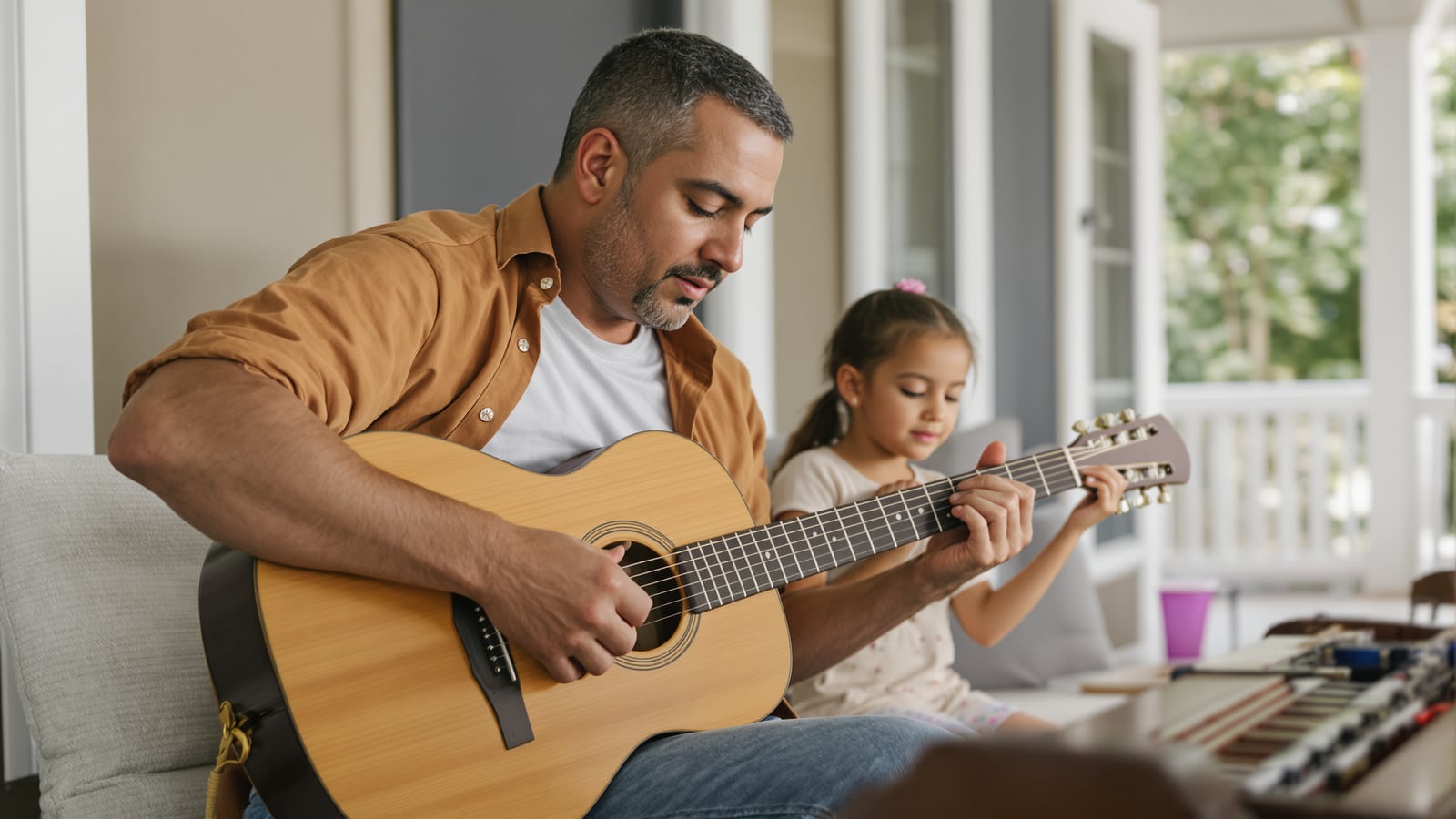
Quick answer: Pick one song with three or four chords. Give every person a part they can't mess up. Play it for fifteen minutes on a set night each week. Buy nothing until the band has survived a month.
Start with the song, not the gear
Most families do this backward. Dad buys a guitar, the kids get a recorder from the school closet, and by Thursday nobody knows what they're supposed to be doing.
Choose the song first. It should be one the whole house can already hum, with a chorus a six-year-old can shout. "You Are My Sunshine" works. So does "Take Me Home, Country Roads," which is four chords: G, Em, D and C. "Wagon Wheel" uses the same four in a different order. "Will the Circle Be Unbroken" has a chorus that gets everybody singing in the first pass.
Write the chords on an index card. Tape it to the fridge.
Now look at what's in the house.
What you already own
You have more instruments than you think.
- A coffee can or plastic jar with dry rice inside. Seal the lid with tape. It's a shaker, and it's the first job for your youngest. Keeping a steady shake is harder than it looks, and every band needs somebody who can do it.
- A five-gallon bucket, flipped over. Two wooden spoons make it a drum. Sit the drummer down and teach one rule: hit it on the beat, not on every beat you feel like.
- Spoons. Real ones. Old-time bands used them for generations, and a kid can learn the rattle in one evening.
- A kitchen chair and a wooden box. Sit on the box, slap the front with your palms, and you've got a cajón, which pros sell for real money. Yours cost nothing.
- That guitar in the closet. Somebody got it for Christmas in 2009. Check it before you play it. See if the neck is straight by sighting down it like a rifle barrel, and see if it holds a tune for ten minutes.
New strings run about the price of a lunch out. Put them on before anything else. Old, dead strings are the number one reason a beginner quits, because everything sounds muddy and hurts the fingertips twice as much.
What to borrow, and where
Ask around before you open your wallet. Somebody you know has a guitar, a harmonica or a keyboard sitting in a case. Grandparents are the best source. Ask politely and promise to return it better than you got it: fresh strings, a wiped-down neck, a case that's been dusted. That's the old rule, and it's also how you get asked again.
Other places to look:
- School band programs, which often rent instruments by the semester.
- Some public libraries, which now lend instruments the way they lend books. Call and ask.
- Pawn shops and local classifieds. A used ukulele is the easiest instrument in the world to learn, and used ones show up constantly.
- A neighbor who quit playing and feels guilty about it.
If you do end up buying one thing, make it a harmonica in the key of C, or a ukulele. Both are forgiving. If you're eyeing an acoustic guitar, read what actually matters when you buy your first acoustic before you hand anyone money.
Give everybody a job they can't blow
This is where a family band lives or dies. Every person needs a part that's both easy and necessary.
- The youngest keeps the beat on the shaker or the bucket. Everything depends on them, and they know it.
- The middle kid sings the chorus. Only the chorus. Let the verses go to whoever is willing.
- The teenager plays two chords on the guitar. Not four. Two. G and C will carry a lot of songs while their fingers learn.
- Mom or Dad plays the harmonica or the full guitar part, and stays one step back.
That last one matters. If you're the dad and you take every solo, you've built a solo act with an audience. Serve the band first. Let the nine-year-old with the bucket have the loudest moment in the song.
But hold a few lines, because a band without rules is a noise complaint. Start on time. Phones go in a basket by the door. Everybody plays or nobody does, so no one sits on the couch narrating. You're the leader, and kindness doesn't mean letting it fall apart.
The rehearsal that actually works
Fifteen minutes, once or twice a week, same time. Fifteen. Nobody was ever driven out of a family band by a rehearsal that was too short.
Run it like this:
- Tune the guitar, or have someone tune it. A free tuner app on a phone does the job. Put the phone away right after.
- Play the first four bars alone, just the rhythm players. Get the beat locked before anyone sings.
- Add the singers. Go through the whole song once, even if it falls apart in the second verse.
- Stop the second the first kid gets bored. End on a laugh while it's still a good time.
If a chord change is giving someone trouble, slow the whole song down instead of drilling the one player. Slow is how you get fast. The same idea shows up in the first ninety days of learning guitar as a grown man, and it holds for kids too.
A capo is the best ten dollars-ish tool you can own. Clamp it on the second fret and the same shapes sound higher, which fits a child's voice better than the original key. Let the smallest singer decide where the song sits. Go lower or higher until they stop straining.
Grow it slowly
After a month, you'll know who likes it. Don't force it on the kid who'd rather be in the yard. Let them run the sound, or the camera, or just clap. A band has room for a few people who only clap.
Once you've got two songs that hold together, write a third. Have the kids tell you a story from the summer, then turn it into a verse. Turn a story into a song without losing the story walks through exactly how. A song about the dog eating a whole pie is better than any cover, because it's yours.
Play it for somebody
Set a date. Sunday supper, Grandma's birthday, the back porch with the neighbors invited. A deadline turns "we're kind of practicing" into "we're a band."
It will be rough. The bucket will drift off the beat and somebody will forget the second verse. Grandpa will clap like it's the Grand Ole Opry.
Years from now nobody will remember whether you hit the G chord clean. They'll remember the shaker, the bucket, and your kid grinning because they were the reason it kept time.
Dean Shaw
Gear & Garage
Reads the warranty, the parts list and the long-term owner reviews before anything else. Trucks, tools, watches, and the cheap version that costs more.

Watch
Worth an hour of your evening
More from Music.
From channels we rate. Plays on YouTube.