

Grandpa's barn ledger still beats your budget app
A pencil on a string and a green cloth book did something no calculator ever managed. You can run the same system starting tonight.
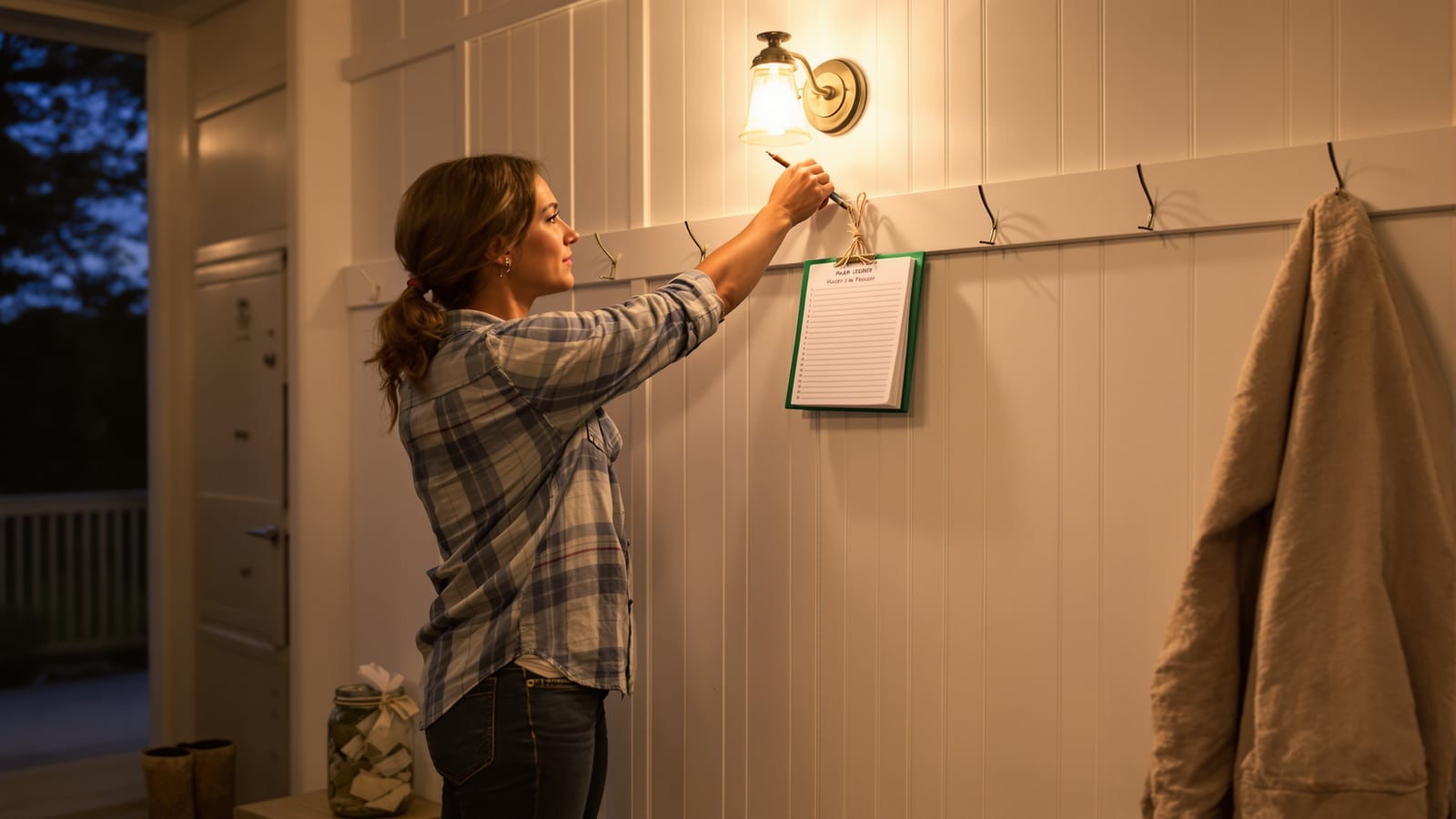
Quick answer: Keep a paper ledger with four columns (date, what, in, out) plus a short note beside every entry. Write it daily, total it weekly, read it back monthly. The math is the easy part. The notes are what change your spending.
My grandfather kept his books on a nail by the feed bin. A cloth-bound ledger, green going gray at the corners, with a pencil tied to it by a length of baling twine. If you wanted to know what he'd paid for anything since Eisenhower, you didn't ask him. You walked out to the barn and looked.
The calculator that lost every argument
Around my sixteenth birthday I bought him a solar calculator. I was proud of it. It was the size of a playing card and did in half a second what took him a minute with a pencil.
He thanked me, set it on the shelf over the workbench, and used it exactly one way. After he'd added a column by hand, he'd punch the numbers in to check himself. It agreed with him nearly every time. When it didn't, he checked the calculator's work, which I found insulting on its behalf.
Then one winter I asked why he bothered writing everything down when the machine could tell him the total. He flipped back a few pages and put his thumb on a line.
Part for baler. Wrong part.
The amount was in the "out" column. The note was in the margin. "The calculator'll tell you what you spent," he said. "It won't tell you that you spent it because you didn't read the number off the old one before you drove to town."
That's the whole system in one line. The numbers tell you the damage. The note tells you the cause.
What was actually in the book
I inherited the ledgers, and I've read them like other people read novels. Every entry had a date, a thing, and an amount, in or out. Beside most of them, in smaller pencil, a few words.
Feed, two bags. Cheaper by the ton, next time split with the neighbor. Hauled the neighbor's hay. No charge. Owes me nothing. Returned the post-hole auger. Sharpened it first. Rain, finally.
That last one has no dollar amount at all. He wrote down weather, favors, and mistakes with the same pencil he used for money, because on a farm they were all the same ledger. A dry month and a bad month were one subject.
You can see a man's character in a book like that. You can also see where the money leaked. Reading back, he'd circle the repeats in the margin. Wrong parts, rush trips to town, a pattern of paying full price at the one store because it was close. Nobody told him to cut those. He saw them in his own handwriting and quit.
Why paper beats the app (mostly)
Your bank app already tracks every dollar. It sorts them into little colored categories and shows you a pie chart. It's fine. Use it.
But it's passive. You never touched the money, so nothing about it sticks. And it only knows what, never why. "Hardware store, $63" tells you nothing. "Hardware store, $63, bought a second tape measure because I can't find the first" tells you something.
Writing it down takes about ninety seconds a day. That friction is the feature. You feel a purchase when you have to put it in ink. Some things you'll buy anyway. Some you'll quietly stop buying, because you don't want to write that sentence.
The honest trade-off: paper won't catch an automatic subscription charge you forgot about. Check your statement once a month for those. Paper handles the daily stuff the app can't.
Set one up this week
You need a ruled notebook and a pencil. A spiral from the drugstore is fine. Don't buy anything fancier until you've kept it for three months.
- Rule four columns. Date, what, in, out. Leave room on the right for the note.
- Write it the same day. Before supper works for most people. Keep the receipts in your pocket until then, or just remember the big ones. Round to the dollar if you like. The habit matters more than the pennies.
- Write the note on anything you'd do differently. Not every line. Just the ones that taught you something. Keep it under ten words.
- Total it Saturday night. Add it by hand, carry the balance forward, and check it with a calculator if you must. My grandfather would approve of that order.
- Read the whole month back on the last day. Circle three things. Only three. Pick the ones that repeat.
If you miss a few days, don't start a fresh book and don't quit. Rebuild from the bank statement, write "caught up" in the margin, and carry on. He had a page or two like that himself. Caught up. Was laid up with the flu. Nobody's perfect, and the book wasn't meant to be a monument.
If you want to pair it with a spending limit, the old cash rule works well alongside it. The ledger shows you where the money goes. The envelope stops it. And if you'd rather learn what a household that ran on a ledger looked like day to day, waste nothing, feed everyone, clean as you go covers the kitchen side of the same habit.
What the book gave him that math couldn't
A calculator gives you an answer and forgets it. The ledger kept the whole year: what he paid, what he fixed, who he helped, what he regretted. When money was tight in a bad season, he didn't panic or guess. He turned back to the same month the year before and read what he'd done.
It also gave him something to hand down. My father and I were reading it at the kitchen table a few weeks after the funeral, trying not to say much. He tapped a page from a hard year, the kind my grandfather never talked about. The numbers were ugly. Beside the worst one he'd written three words.
Paid it anyway.
The last page of the last book is mostly fence staples and a note about rain. Ordinary business. He kept his books right up to the end, and I doubt he ever thought of it as a record of his life.
It was, though. So buy the notebook.
Nina Castellan
BRO for Her
Runs the women-facing desk. Same standard, same tools, written for a different reader — not a softer one.

Watch
Worth an hour of your evening
More from Old School.
From channels we rate. Plays on YouTube.
Read next