

Grandpa's front step told him what was rotting before it fell
He never climbed a ladder or hired an inspector. He stood on the top step with his coffee and paid attention. You can copy the whole method this weekend.
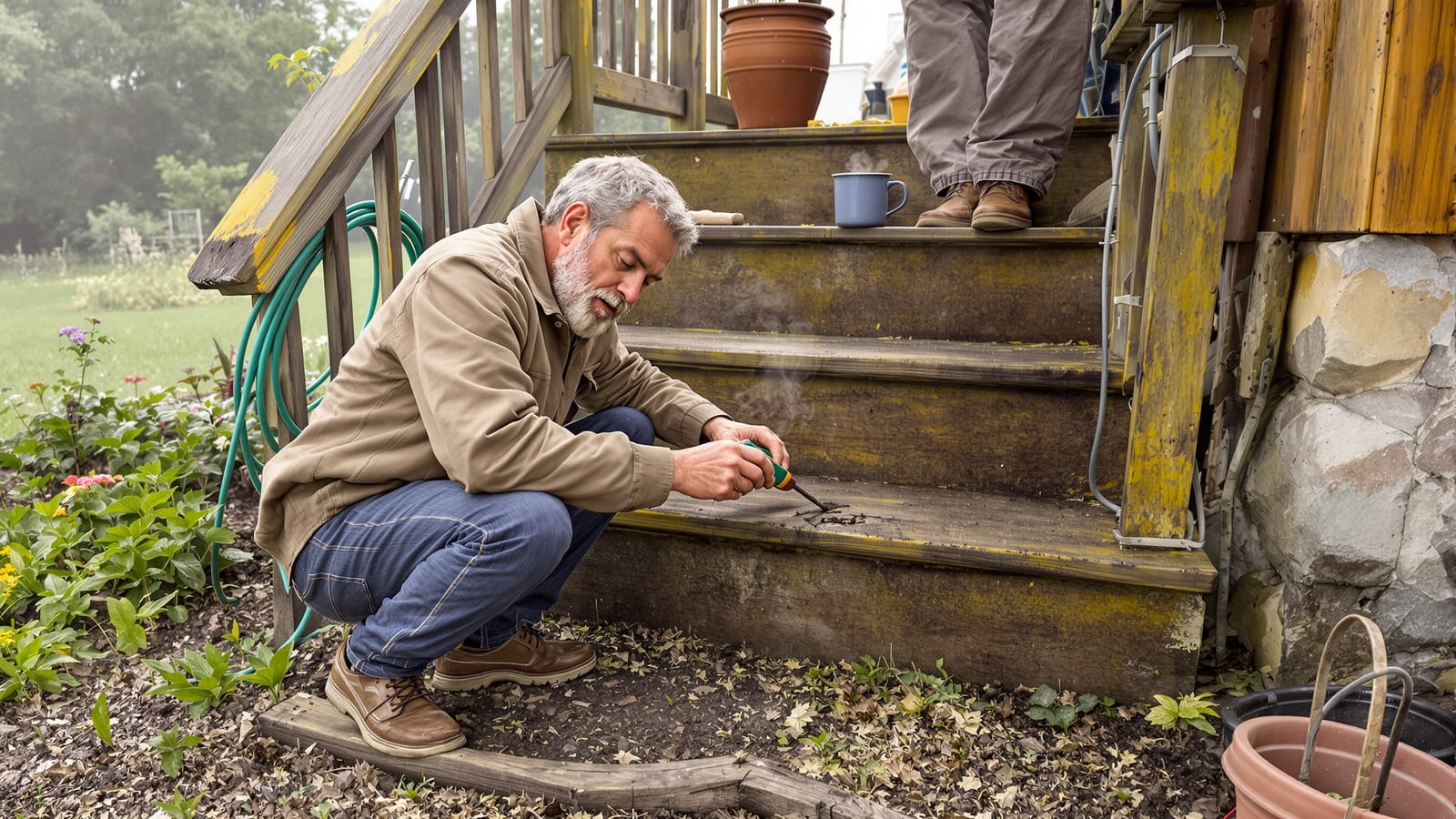
Quick answer: Rock on your front step, push on your railing, and poke the wood with a screwdriver. Soft, loose or leaning means fix it now, while it's a small job.
My grandfather had a ritual. Saturday morning, coffee in his left hand, he'd walk out the front door and stop on the top step. He didn't look at anything. He stood there and shifted his weight from heel to toe, slowly, like a man trying to decide whether to buy the horse.
I asked him once what he was doing. "Listening," he said. Then he went back inside for a refill.
It took me years to understand he was running a test. It was cheap and fast, and it caught problems months before anybody got hurt. Wood porches don't fail all at once. They tell you, in small ways, for a long time, and most of us are walking over the warnings with a laundry basket.
The rock
Stand on the top step with your feet together and rock heel to toe. Then step to the middle of the porch and do it again.
You're feeling for three things. Give, where the board sags a little more than it did last year. Bounce, where the whole floor flexes like a diving board. And a click or a shift, which means a fastener has let go or a joint has moved.
Do it on the first step too. The bottom step goes first, every time, because it sits closest to the dirt and takes the splash from every rainstorm. If anything in the whole structure is going to rot early, that's your candidate.
Grandpa also set a marble on the porch floor now and then. If it rolled to one side faster than before, something underneath had settled. A level works better, but the marble was free, and he liked watching it go.
The poke
This is the part that actually finds rot. Take a flat-head screwdriver and push the tip into the wood with moderate pressure. Not a stab, just a firm push.
Sound wood fights back. The tip might dent it. If it sinks in about a quarter inch without much effort, or the wood crumbles or feels like wet cardboard, you've found rot. Paint hides it beautifully. A porch can look fine from the yard and be mush an inch down.
Check these spots first, because water collects in them:
- The bottoms of the posts, where they meet the concrete or the ground
- The ends of the boards, where the grain is open and soaks up water like a straw
- Under the steps, on the stringers, the long angled boards that carry the treads
- Anywhere two pieces of wood overlap, since water gets in and can't get out
- The spot right under a gutter downspout, if there's one
Bring a flashlight for the underside. It's not glamorous work. You'll lie on your back and get a cobweb in your ear. But five minutes down there tells you more than a year of looking from above.
The push
Grab the railing with both hands and shove it, outward and side to side, hard enough that you mean it. It shouldn't wobble. If you can feel it move, the posts or their connections are loose, and a loose railing is what catches a kid or a grandmother carrying groceries at the worst possible moment.
A wobbly rail is usually a cheap fix. Often it's a loose bolt or a screw that backed out. But the same push will find rot at the base of a post, and that's a different problem. A rotted post can't hold a new screw, no matter how tight you drive it.
Then look at where the porch meets the house. The board bolted along the wall is the one holding the whole thing up on that side. Look for rust streaks running down from the fasteners, a gap between the porch and the wall, or the porch pulling away from the siding. Don't improvise on that one. A porch that's separating from the house is a job for a licensed contractor, and you should keep people off it until somebody qualified has looked.
The look
This one costs nothing, since you're already standing there.
Peeling paint means water is getting under it. Dark gray streaks mean moisture sits there after the rain. Green fuzz means the board never dries out, and a board that never dries out is a board with a limited future. Nails working their way up out of the wood are called pops, and they mean the board is moving. Small cracks that run along the grain are normal. Cracks that run across it aren't.
And look at what's piled on the porch. Grandpa swept leaves off the steps every fall, not because he was tidy, though he was, but because a pile of wet leaves holds water against wood all winter. Flowerpots set directly on the boards do the same thing. Put a few little feet under them, or a brick, so air can get through.
What to do about it
Most of what you find in a first inspection is small, and small things are cheap. Tighten the loose hardware. Replace nails that have popped with exterior-rated deck screws, which grip far better. Clean the dirt and leaves off the wood. Re-seal or repaint any bare spots before the next wet season, and pay special attention to board ends and the top of the steps.
Replacing one rotted board is an afternoon. Replacing the stringers under a collapsed step is a week and a lot of money. Waiting turns the first into the second. That's the same math behind the old cash rule: pay a little now, on your schedule, or pay a lot later, on the porch's.
Some things need a pro. Rot in the posts that hold up the roof, a sagging beam, or a porch pulling off the house isn't a weekend project for a beginner. A good local carpenter will look at it and tell you what's what. Ask for a written estimate, and get a second opinion if the number makes you wince.
The neighbor part
My grandfather's test had a second half that never got written down anywhere. On the way back from the mailbox, he'd glance at the widow's steps next door. If the top board had come up, he'd show up an hour later with a drill and a handful of screws, say "Was in the neighborhood," and be gone before she could offer him anything. She had lived next door for thirty years. He knew perfectly well she didn't need him in the neighborhood.
That's the habit worth stealing. Check yours, then look at the one next door, especially if the person living there's older or alone. Nobody asks for help with a porch. They just stop using the front door and don't mention why.
If you want the bigger picture of why that stoop mattered so much, the front porch did a job the group chat can't do covers it. It also helps if the thing is worth keeping up.
Put it on the calendar. First Saturday of every season, coffee in hand, five minutes. Rock, poke, push, look.
My grandfather's porch outlasted him by a lot of years, and the people who own it now have no idea why.
Nina Castellan
BRO for Her
Runs the women-facing desk. Same standard, same tools, written for a different reader — not a softer one.

Watch
Watch how it's done
Picked for this article.
From channels we rate. Plays on YouTube.
This Old House
How to Identify and Repair Rotting Wood | Ask This Old House
Craftsman Home Inspections llc
Aurora CO Home Inspector How to inspect a deck for wood rot craftsman home inspections llc
Read next