

Frozen laundry dries, and Grandma knew it
Cold air is dry air, and dry air pulls water out of a wet shirt even when it's freezing. Here's how to hang a winter line that works.
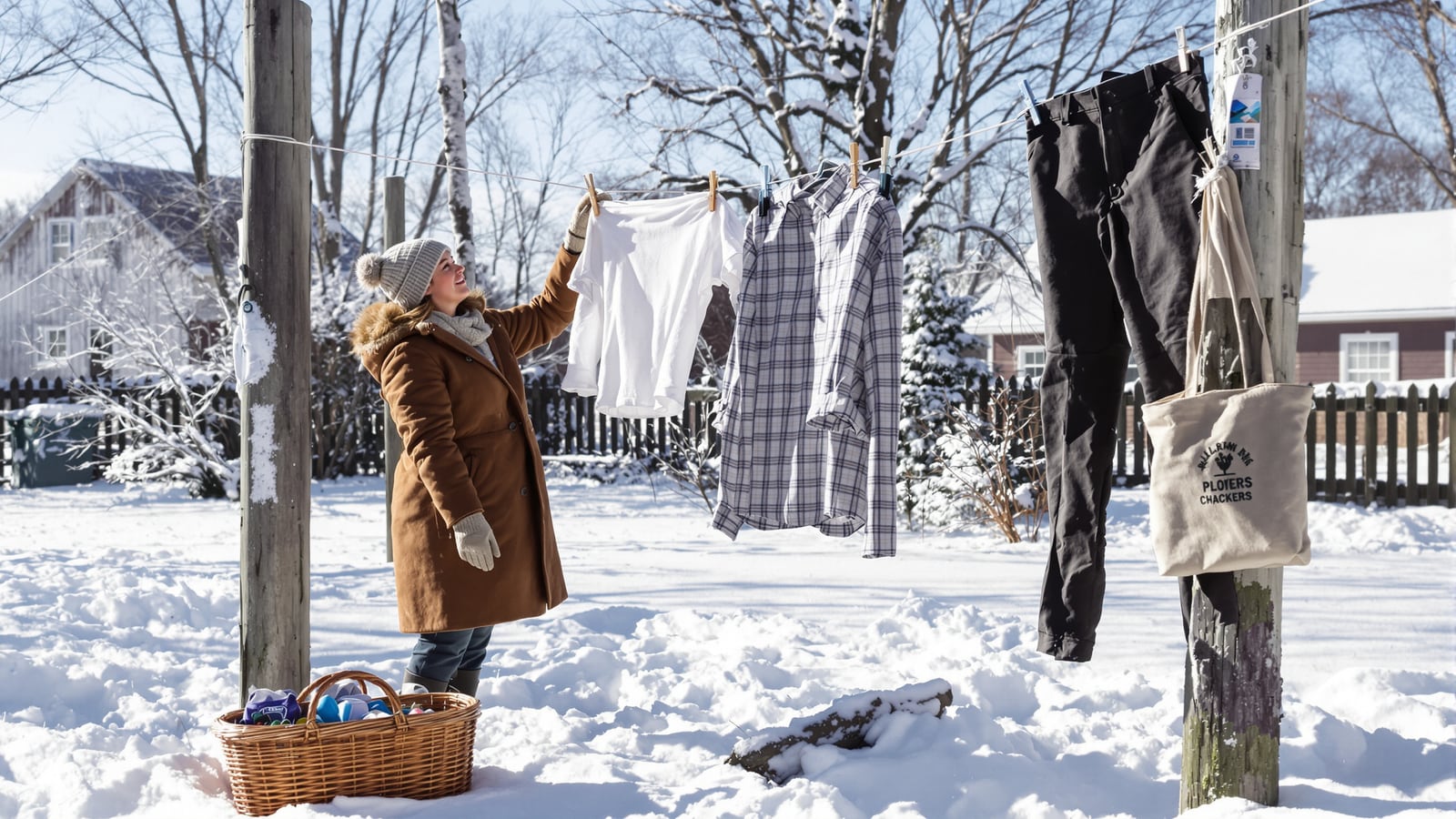
Quick answer: Wring the load hard, hang it on a clean line on a cold, breezy, dry day, and leave it until it's stiff and then limp. Freezing doesn't stop the drying. Ice in the fabric slowly turns straight to vapor, and a winter wind is happy to carry it off.
The first time I saw a shirt stand up on its own
My grandmother hung wash outside every month of the year. In January, I'd watch her carry a basket out the back door in her coat and come back in with her cheeks red and her hands empty. An hour later I looked out the window and saw my grandfather's work shirt standing on the line like a man with no head. It was frozen solid, sleeves out, doing a very bad impression of him.
I asked if it was ruined. She said, "It's drying." I thought she was kidding.
She wasn't. Water in the fabric freezes, and then, given cold air with little moisture in it and some wind, the ice goes straight to vapor without ever turning back into water. It's the same thing that shrinks the ice cubes in your freezer over a few months. It's slower than a July afternoon. It still works.
Why winter air does the job
Cold air can't hold much water, so when it's cold and clear, whatever it does hold is usually far below what it could carry. A wet shirt is the most interesting thing in that yard. The air takes the moisture, the wind keeps moving fresh air across the cloth, and the sun, even a thin one, helps.
That tells you which days to pick:
- Good: cold, clear, breezy. Even bright and still is fine if you're patient.
- Okay: overcast but dry. It'll take longer.
- Skip it: fog, drizzle, sleet, or a day where everything outside is wet. Nothing dries in air that's already full. Wait.
My grandmother didn't read a weather app. She stepped outside, sniffed, and looked at the sky. If the porch rail was dry and the wind had an edge, it was a wash day.
The method
Most of what she did was in the setup, not the hanging.
Wring it harder than you think. The less water you start with, the faster it goes. She wrung by hand, twisting each piece until it quit dripping. If you've got a washer, run the extra spin. A washer's spin cycle uses a small fraction of the power a dryer does, and it does most of the work.
Wipe the line. Run a damp rag down it before you hang anything. Winter lines collect grit and soot. Clean laundry on a dirty line is a waste of a Saturday.
Hang it so it breathes.
- Shirts by the tails, not the shoulders, so the line doesn't leave a bump in the cloth.
- Pants by the cuffs or the waistband, open so air gets inside the legs.
- Towels and sheets doubled over the line with a gap between layers, never bunched.
- Socks in pairs, pinned at the toe.
Give everything room. Pieces touching each other stay damp where they touch. A hand's width between items is enough.
Use wooden pins. Plastic pins get brittle in the cold and snap, usually when the wind is up and you're holding a wet sheet. Old wooden spring pins keep working, and a cloth bag on your belt means you're never bending over a basket with numb fingers. Pin everything twice in a wind, once on each side of a sheet.
Wear gloves, but take them off to pin. She'd hang the load wearing thin cotton gloves and peel one off for the pins. A basket of wet cotton in January will take the feeling out of your hands in about a minute.
When to bring it in
This is the part that looks wrong. Frozen laundry is stiff as a board, and that's normal. Don't test it by bending it. Wait until it softens and swings a little in the wind. That's your sign the ice is gone and what's left is dry or nearly so.
Pull everything in while it still feels slightly cool and clean. Hang the heavy items, like jeans and towels, over a chair or a rack inside for an hour to finish. If you own a dryer, five minutes on low fluffs up a load of stiff towels. Without one, shake each piece hard before you fold, and the cloth relaxes. A frozen-dried towel is rougher than a dryer towel, and some people love that and others don't. A flannel sheet that's spent a day in cold air smells like nothing else you can buy.
What this will and won't do for you
It's slow. A load that takes a summer afternoon can take most of a day in January, and a sodden gray week will beat the method. If you've got a baby, a 5:30 a.m. shift, and nothing clean to wear, use the dryer. Nobody gave out medals for suffering.
But for sheets, towels, work clothes and weekend wash, the line carries more than people think. A dryer is one of the bigger electricity users in a house, and every load you hang is a load you didn't pay to run. My grandmother's rule was the one in Waste Nothing, Feed Everyone, Clean As You Go: if there's a free way that works, don't pay for the other one. Run the numbers against your own bill and you'll see what it's worth. Our piece on the old cash rule runs the same math on bigger things.
No yard? She had a plan for that too
Her sister lived in a second-floor apartment and did the same thing indoors.
- A folding wooden rack near a heat source, never on top of it. A register or a radiator, with a few inches to spare.
- A fan on low, pointed across the rack, not at it.
- A window cracked an inch, so the moisture goes outside instead of into the walls.
- Heavy things on the rack's outer bars, thin things in the middle.
Indoor drying puts water in your air. A closed room full of wet laundry can fog the windows and invite mildew, so don't dry a whole week in a bedroom with the door shut. A basement with a dehumidifier or a bathroom with a fan will do better.
The neighbors will notice
The wash on the line was a kind of conversation. Neighbors knew who was home, who had a new baby, whose husband was back from a job out of town. It did the same work the porch did, which I wrote about in The front porch did a job the group chat can't do. Some subdivisions have rules against clotheslines, and you should check yours. Plenty of states have passed laws protecting the right to hang laundry, so ask your local government rather than guess.
Try it on the next dry, cold Saturday. Hang one load of sheets. Go inside, drink your coffee, and come back at lunch. If a shirt is standing in your yard like a headless man, you did it right.
Nina Castellan
BRO for Her
Runs the women-facing desk. Same standard, same tools, written for a different reader — not a softer one.

Watch
Worth an hour of your evening
More from Old School.
From channels we rate. Plays on YouTube.
Read next