

Build a pack fishing kit that survives the walk in
Most trail-fishing disasters happen before the first cast. Pack a kit that lands at the lake with its line intact and its hooks out of your jacket.
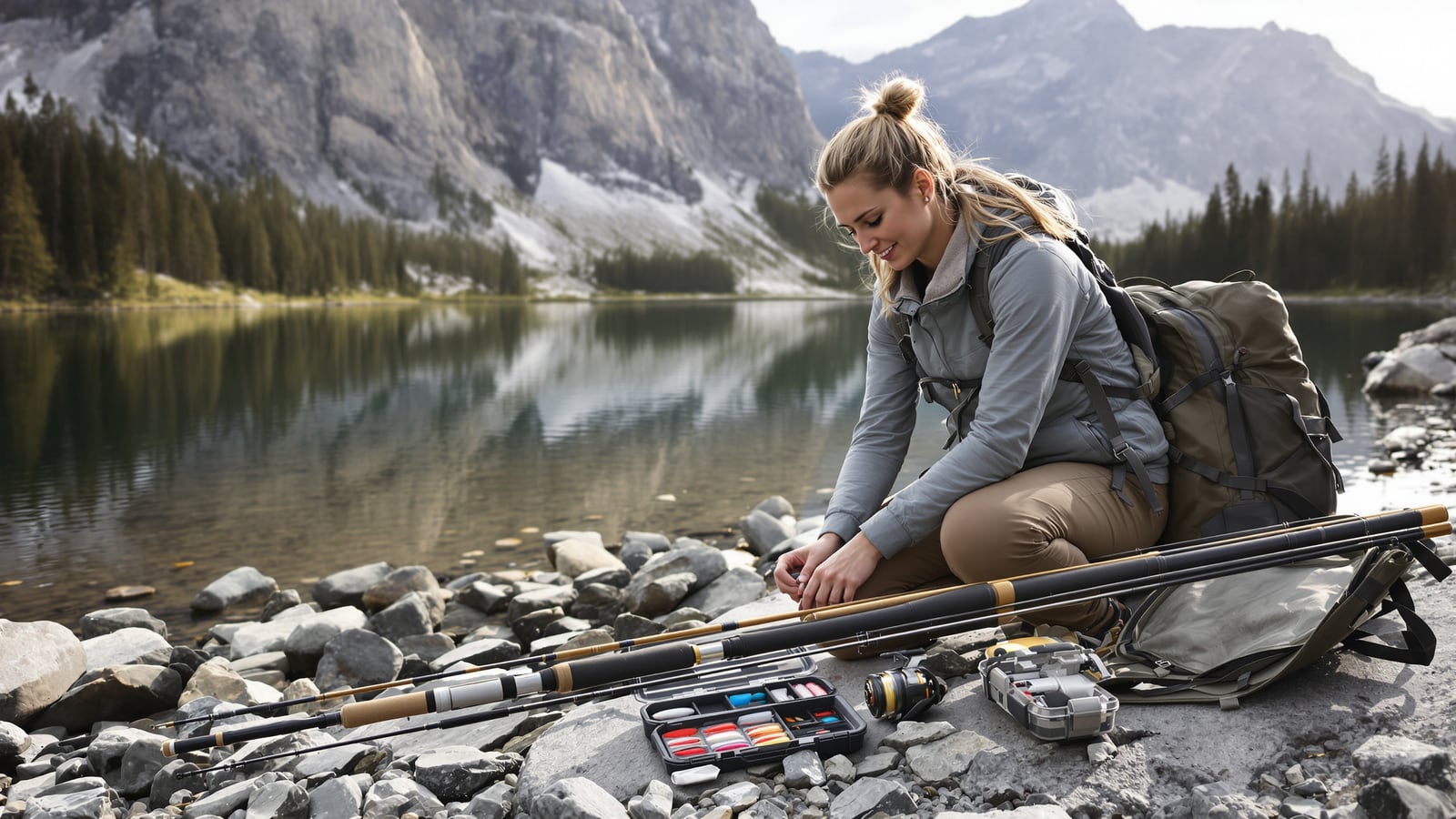
Quick answer: Carry a four-piece spinning rod in a tube, a small reel spooled with fresh 4 to 6 pound monofilament, and one small box holding about a dozen lures with the barbs pinched down. Check the last few feet of line before you cast. Pack out every scrap.
The walk is what kills your gear
Three miles up the trail, you sit down at a lake and open the pack. A treble hook has found your down jacket. The line has wound itself around the lure, the stove, and a spoon you forgot you owned. The rod tip is two inches shorter than it was in the driveway.
None of that happened while fishing. It happened while walking.
So build the kit around the hike, not the fishing. Trout in a high lake aren't picky about brand names. They're picky about a clean presentation, and a kit that arrives in one piece gives you that.
The rod: four pieces, one tube
A multi-piece pack rod, about six to seven feet, light action, in four sections. It collapses to roughly the length of your forearm and a half, and it rides in a hard tube strapped to the side of the pack.
The trade-off is real. Telescoping rods are even more compact and fine for kids, but the guides can bend and the sections can stick. A one-piece rod casts beautifully and has no business on a trail with brush.
Two habits protect the rod:
- Seat the joints firmly and line up the guides before you cast. A loose joint works itself apart mid-cast and your lure goes swimming without you.
- Never carry it assembled through timber. The tip is the weakest part, and a branch will find it. Break it down, tube it, walk.
Don't lean it against a tree or the truck either. Lay it flat. Every rod tip that has ever been broken was resting somewhere "just for a second."
The line: boring wins
Fill a small spinning reel (a 1000 to 2500 size is plenty) with fresh monofilament in the 4 to 6 pound range. Mono is forgiving. It stretches a little, it knots easily, and it doesn't dig into itself on the spool.
Braid is thinner and strong for its diameter, and plenty of experienced anglers love it. It also wind-knots, and when braid tangles in a reel, you don't fix it so much as surrender to it. If you want braid, tie a few feet of mono or fluorocarbon leader to the end, partly for stealth and partly so the knot to the lure behaves.
Two spooling rules prevent most bird's nests:
- Don't overfill. Stop about an eighth of an inch below the rim of the spool.
- Put on fresh line each season. Old mono holds its coil, loses strength, and breaks right when the fish is worth it. Line that rode around in a hot truck all summer counts as old.
Fraying: use your fingers
Before the first cast, and again after any snag, pull the last arm's length of line slowly through your fingertips. A nick, a rough patch, a flat spot, and you cut it off and retie. It takes thirty seconds and it's the cheapest insurance in fishing.
Retie after every fish too. A hooked trout rubs line against its teeth and the rocks, and the knot is where the damage hides.
Learn two knots at your kitchen table with a piece of string, not at the lake with cold hands: the improved clinch and the Palomar. Wet the line before you cinch either one. Dry mono heats under friction and weakens.
The lure box: fewer, better, pinned down
A dozen lures. That's it. You can't fish more than a few in an afternoon anyway.
- Three or four small inline spinners
- Two small spoons
- A handful of jig heads with soft plastic bodies
- A few small hooks, a bobber and split shot, if bait is legal where you're going
Treble hooks cause most of the tangles. Three points on each lure means three chances to catch the lure beside it, your sleeve, or your thumb. Swap trebles for single hooks where you can, and pinch the barbs flat on whatever you keep with pliers. Many waters require barbless or artificial-only. Check the rules for the specific lake, not just the state. Pinched barbs still hold a fish if you keep tension, and they come out of a finger without a fight.
Store the lures in a small hard box with foam or separate compartments, or in a pill bottle if you're going very light. Skip the loose zip bag. A bag of lures is a ball of hooks that you'll pay for later.
The tangle-proof hookup
Before you strap the rod to your pack:
- Hook the lure onto the hook keeper or the lowest guide, then reel until the line is snug. No slack loop.
- Close the bail.
- Put a hair tie or a Velcro strap around the sections so nothing shifts.
- Point the tip up and back along the pack, covered by the tube or a sleeve.
Take thirty seconds to do it at the trailhead. You'll spend thirty minutes untangling if you don't.
Safety: the hook and the eye
Wear sunglasses when you cast. They're eye protection too, and anyone who has watched a weighted jig whip past an ear understands why.
Carry a small pair of pliers or clippers. A pinched-barb hook that goes into a finger can usually be backed out. If it's deep, in the face, near an eye, or in a joint, don't dig. Cut the line, leave it, and get medical help. Tell someone where you're going and when you'll be back before any of this matters. The Ten Essentials still apply when the plan is "just fishing."
Buy the license before you leave. Rules vary by state and by water. Wardens aren't impressed by "I didn't know."
Leave the lake cleaner
Fishing line doesn't rot on a useful schedule. Birds and small animals get tangled in it, and it lasts for years. Carry a zip bag for every snip, every snagged lure you can't free, every worn-out knot you cut off. Pack it out. If you break off a lure on a snag, retrieve it if you safely can.
Check whether lead split shot is restricted where you're fishing. In some places it is, and tin or steel works the same. Pick up any line or tackle you find that isn't yours. That's the old rule: leave it better than you found it.
If you're still building the rest of the load, your first overnight backpacking trip is a good place to see what else to leave home. And when you choose where to camp near the water, pick a site you can bail from in forty minutes.
The fish at the end of the trail aren't the hard part. Getting a tidy rod, a clean line and a sharp hook there is. Do that, and the rest takes care of itself.
Wes Dunbar
Country & Skills
Grew up on an acreage and never quite left. Covers trucks, trades, land, and how to do the thing yourself.

Watch
Worth an hour of your evening
More from Outdoors.
From channels we rate. Plays on YouTube.
Read next