

Build giant Jenga from six 2x4s, then win on the setup
Six eight-foot boards, one saw and an hour make the best backyard game going. Most people lose before the first block moves.
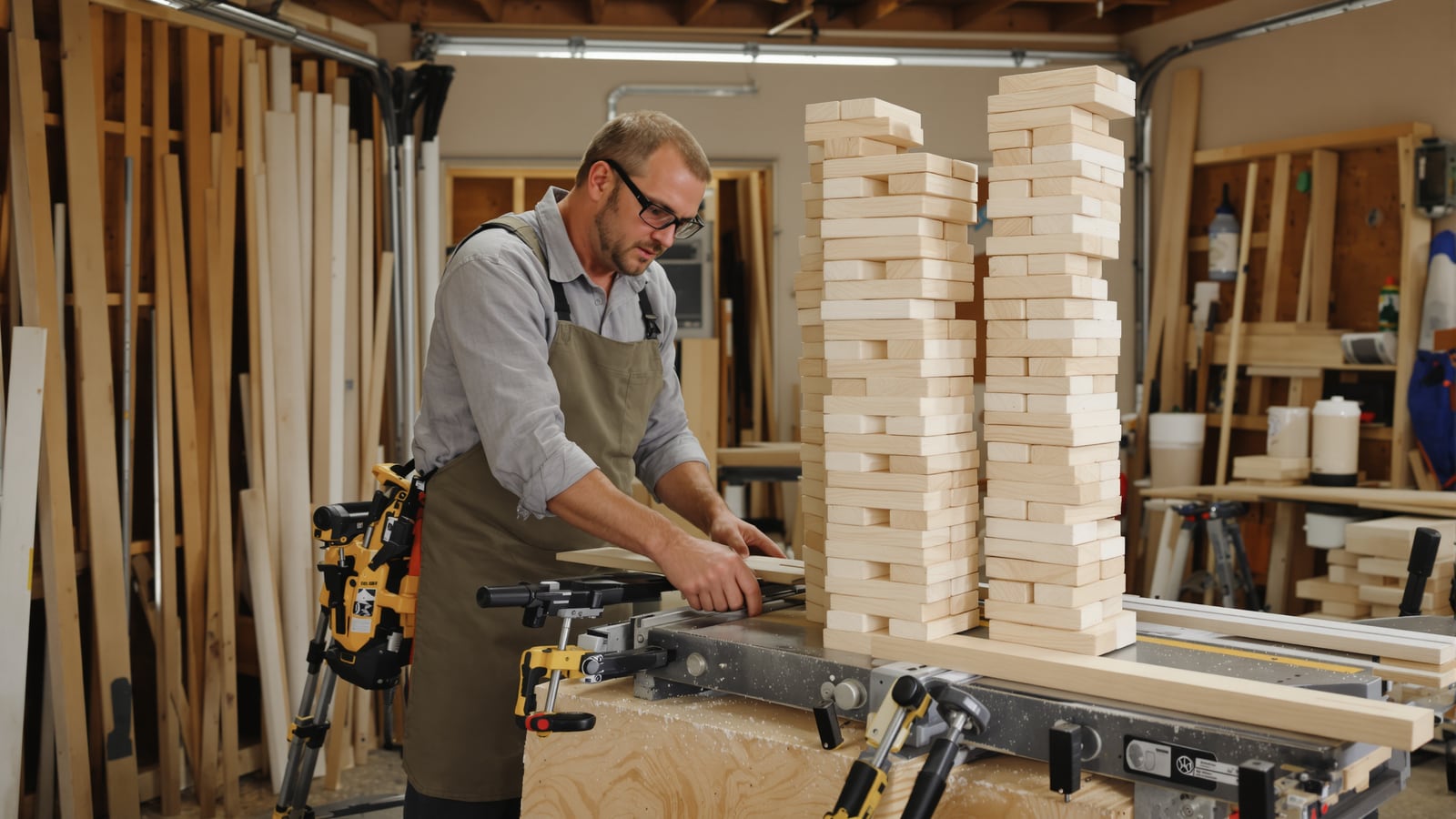
Quick answer: Six eight-foot 2x4s cut into 54 blocks of 10½ inches each make a full set. Play it on something flat and hard, not your lawn, and put a 30-second clock on every turn.
A store-bought giant set costs real money and still ends up in the garage with a cracked block. The homemade version costs six boards and an afternoon, and you can't mess up the math. A 2x4 is actually 1½ by 3½ inches. Lay three side by side and you get 10½ inches. Cut every block to 10½ inches and the layers interlock exactly like the original.
An eight-foot board is 96 inches. Nine blocks at 10½ inches is 94½. Six boards, nine blocks each, 54 blocks. Nothing wasted but a sliver of scrap.
Cutting 54 identical blocks
Identical is the whole job. If one block runs an eighth of an inch long, you've built a tower with a built-in grudge.
Clamp a stop block to your miter saw fence at 10½ inches and make every cut against it. Don't measure each board. Measuring each board is how you end up with 54 slightly different blocks. If you don't own a miter saw, a circular saw and a speed square will work, but borrow the saw if you can. Bring it back with a fresh blade guard wiped down and a thank-you that includes a cold drink. That's the code.
Pick straight, kiln-dried boards, and sight down each one at the store before it goes in the cart. A bowed board gives you bowed blocks, and bowed blocks wobble in ways nobody can plan for. Skip pressure-treated lumber. It's wet, heavy and not something you want ground into palms.
Wear eye and ear protection while you cut. Then sand every edge and corner with 80-grit, finish with 120, and round the ends slightly so nobody catches a splinter. A cheap coat of clear exterior sealer keeps dew from swelling the wood. Let it dry fully before you stack, or the blocks stick together and the game turns into an argument.
If you want a weekend hobby that leaves a little sawdust behind, this is a good reason to start one.
Where you play decides who loses
Grass is a terrible surface. It looks flat and it isn't. Every blade is a tiny spring, and the first block you pull sends a shiver through the whole stack.
Play on a patio, a driveway, a deck, or a sheet of ¾-inch plywood laid on the lawn. Check it with a four-foot level. If a marble rolls, the game is rigged against whoever pulls second.
Wind matters too. A breeze that doesn't bother you will find the top three layers of a tower and shove them. Set up with your back to the wind, or against a fence or wall if you've got one.
The setup nobody takes seriously
Build the starting tower tight. Seat each block against its neighbors and push every layer down with your palms before you start the next. Rotate each layer 90 degrees as you go, 18 layers of three blocks. A loose starting tower falls on turn two and everyone goes home annoyed.
Then agree on the rules before anyone touches a block:
- One hand at a time. Switching hands is fine between turns, never during one.
- Take from any layer except the top two and the one directly under them.
- Tap before you commit. You can test a block with a fingertip, but the moment you pull, you own it.
- Thirty seconds a turn. Somebody's phone can keep time.
- Whoever knocks it, rebuilds it.
That last rule matters more than it sounds. The loser stacks the next round while everyone else grabs a drink. It keeps the game friendly, it keeps people from sandbagging a turn to dodge the work, and it puts the cleanup on the guy who made the mess. Which is how most things should work.
How to actually play it
Most players pick the block that looks easiest. Don't. Find the one that feels easiest.
Push a block gently from the side with one finger. A loose one will slide half an inch with almost no pressure. That's the block carrying no weight, and it's the one you want. If it takes a real shove, leave it alone and test the next.
The middle blocks of a layer carry more load than the edges. But a layer that has lost both of its side blocks is balanced on a single center, and the next player wants to see that. Don't leave one behind you. Take one side block, then make the next person's life harder by leaving the center and the other side in place.
Pull slowly. Fast is how you pull the neighbors along. Brace the tower with your free hand flat against the base if the rules allow it, or keep your free hand out of the way entirely.
When you stack on top, square the block against the edges below and let go like you're setting down a full cup. Don't tap it into place. The tap is what brings everything down.
Late in the game, the tower leans. You'll want to play the physics. Resist that urge. A leaning tower isn't unstable because of the lean, it's unstable because of where the weight sits. Take from the side the lean is moving away from, and you'll often relieve load instead of adding it.
Who it's good for
Giant Jenga works at a cookout because it demands almost nothing and makes everybody talk. You can hold a plate in one hand and still play. The seven-year-old and the seventy-year-old are on the same level, and the loudest guy at the party isn't favored to win. A steady hand beats a big personality.
It's also hard to lose with kids. Give them a head start by letting the little ones pull from the bottom layers, where blocks come out easily, while the adults work the upper floors. Everybody learns the same lesson: slow wins.
If you've got three hours and a father or a neighbor you've been meaning to spend time with, a simple game does more than a conversation ever will. And if you'd rather turn this into a regular thing, start the weekly game yourself, because nobody else will. For a rainy day, there's a list of board games that actually get played twice.
Keep it in shape
Store the blocks off the ground, covered, and dry. A plastic bin with a lid in the garage works. Hit any rough spots with sandpaper once a season, since blocks that get handled a lot develop a burr.
If you lend the set, send it back with the bin wiped out, and send it to the person who lends it next. That's how a homemade game ends up at every graduation party in the neighborhood for the next ten years.
And the guy who knocks it over at the end? Hand him the first block of the next stack. He's earned the chance to put something back.
Marcus Vale
Editor-in-Chief
Twenty years in magazines, most of it deciding what to cut. Writes about work, discipline and the decisions that compound.

Watch
Worth an hour of your evening
More from Play.
From channels we rate. Plays on YouTube.
Read next