Pick up an instrument in January, still be playing in June
Most adult beginners quit around week ten. The fix is boring, cheap and has almost nothing to do with talent.
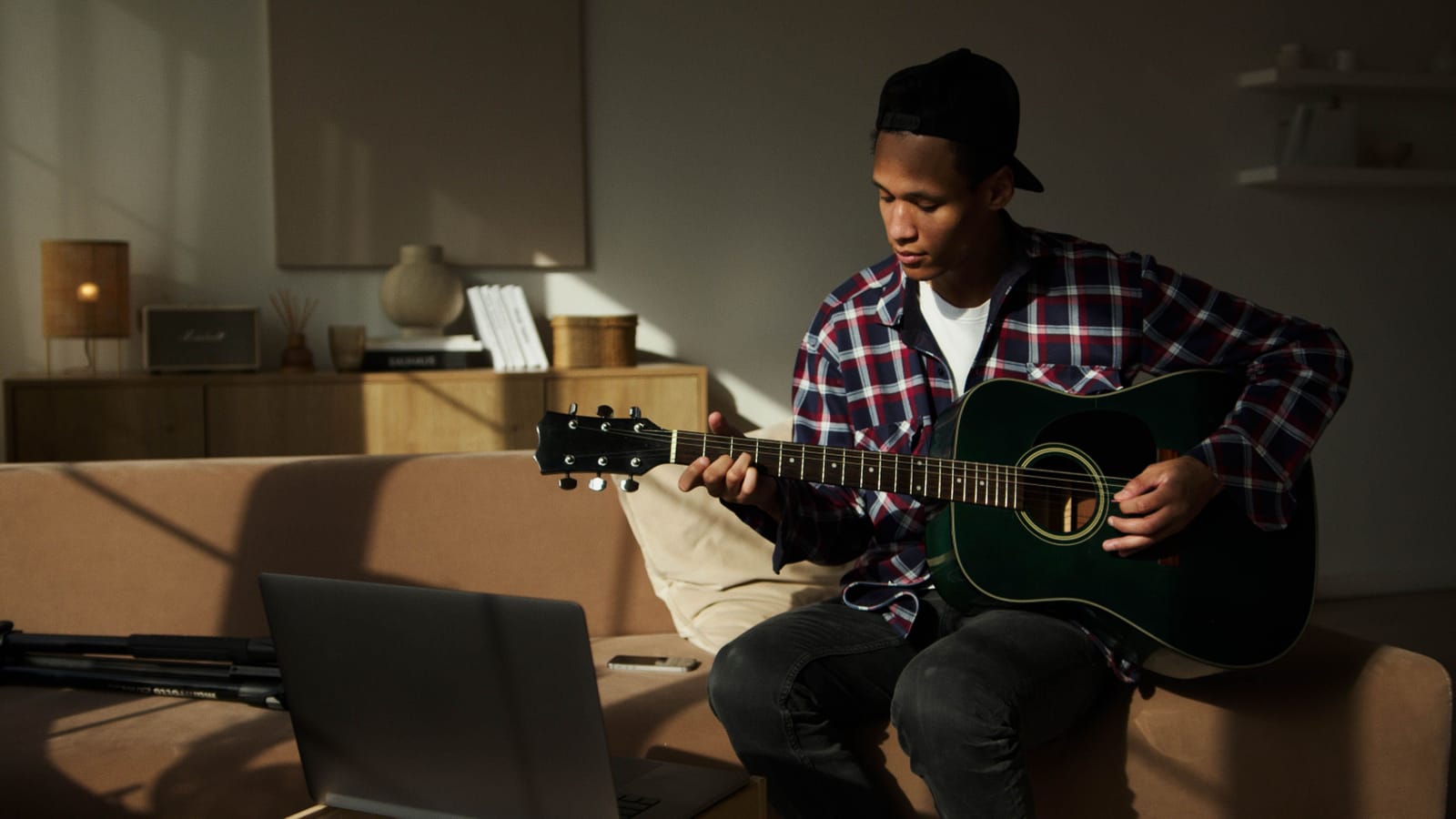
Take the instrument out of the case and put it on a stand, in the room where you already sit in the evening. That single move does more for your odds than any app, any course, any expensive upgrade. An instrument in a case in a cupboard gets played when you feel inspired. An instrument on a stand three feet from where you drink your coffee gets played for four minutes while the kettle boils.
That's the whole game, really. Not intensity. Access.
Adults don't quit instruments because they lack talent. They quit because they built a practice habit that only survives on enthusiasm, and enthusiasm has a shelf life of roughly ten weeks. January feels great. February is fine. March is when the novelty is gone, the calluses hurt, you still can't play anything anyone would recognize, and the guitar goes back in the case "for a bit".
Choose the instrument by the sound in your head
Not by what's easiest. Not by what someone told you is a good starter instrument. If you've spent thirty years loving piano records and you buy a ukulele because it's cheap and forgiving, you'll be bored by spring.
The honest trade-offs:
- Piano or digital keyboard. Fastest route to making a satisfying sound on day one. Nothing to tune, nothing to callus. Hardest part comes at month four when your hands have to do two different things at once.
- Guitar. Portable, social, cheap to start, and directly useful at a campfire or a church service. The first six weeks genuinely hurt your fingertips, and barre chords will humble you around month three.
- Drums. Most physically fun, worst neighbor situation. An electronic kit with mesh heads solves most of that. A practice pad and a pair of sticks solves the rest for far less.
- Bass. Underrated for adults. Fewer notes to learn, immediately useful in any band, and you'll be asked to play with people far sooner than a guitarist will.
If you want to play in a church band, ask what that band is short of. Most are short of a bass player and a competent drummer, and awash with guitarists. That's a real answer to "which instrument", and it comes with a built-in reason to keep going.
Buy something playable, then stop shopping
A cheap instrument that's badly set up will make you think you're the problem. On guitar, the string height at the twelfth fret is the whole story. If the strings sit high off the fingerboard, chords take twice the force and your hand gives out before your attention does. A setup at a local shop costs a fraction of a new guitar and can transform an instrument you already own.
On keys, the thing that matters is weighted keys and a full-size span. Unweighted plastic keys teach your hands the wrong amount of force, and you'll feel it the first time you sit at a real piano.
Buy used from a shop that checks instruments, or buy new from a brand that's been making student instruments for decades. Then close the tabs. Gear research is the most enjoyable way to avoid practising ever invented.
What twenty minutes should actually contain
Most adult practice is just playing the bits you can already play, slightly badly, while thinking about work. Twenty structured minutes beats an hour of that.
Split it three ways.
Five minutes of one mechanical thing. Chord changes between two shapes. Scale with a metronome. Single-stroke rolls. Pick one and stay on it for a fortnight, not one session.
Ten minutes on one song, in pieces. Not the whole song. The four bars you can't play. Slow it down until it's clean, then nudge the tempo. If you can't play it perfectly at a crawl, speed won't rescue it, it'll just bake the mistake in.
Five minutes playing something you enjoy and can already do. This is the part beginners cut first, and it's the part that makes you want to come back tomorrow.
Use a metronome from week one. It's unpleasant and it's non-negotiable. Time is the thing that separates people who sound like musicians from people who sound like they're practising.
March is a scheduling problem
Pick a floor so low you'd be embarrassed to miss it. Fifteen minutes, six days a week. Not thirty. Not "an hour on Saturday", because Saturday is the first thing your family, your job and your car will take from you.
Attach it to something that already happens. After the kids are down. Before the coffee. The trigger matters more than the time of day.
And separate the floor from the ceiling. On a bad Tuesday you do fifteen minutes badly and you count it. On a good Sunday afternoon you do ninety and enjoy it. The floor keeps the habit alive between the good days. Miss one day, fine. Never miss two.
Track it somewhere physical. A wall calendar with an X on it does the job better than any app, because you can't close it.
Get a teacher, even once a month
You'll get further with one lesson a month than with a hundred free videos, because a teacher watches your hands. Videos can't tell you that your wrist is collapsing, that you're gripping the neck like a hammer, or that the reason your left hand won't cooperate is that you're holding your breath.
Monthly lessons also create a deadline. Somebody's going to ask what you've been working on. That question, arriving on a predictable date, has kept more adults playing than motivation ever has.
If money's tight, look at group classes at a community music school, or ask around your church. Plenty of decent players will trade an hour for a favor.
Play with other people before you're ready
You will never feel ready. Do it anyway, at about month six.
Playing with other humans exposes exactly what solo practice hides. You'll discover you can't hold tempo, can't come in on the right beat, and fall apart the moment you make a mistake, because you've spent six months stopping and starting over. In a room with other people you can't stop. You learn to keep going, which is the single most useful skill a musician has.
A worship team, a pub session, a friend's garage, a group of parents who all started at the same time. It doesn't need to be good. It needs to be other people.
Record thirty seconds on the first of every month
Phone, propped against a mug, one take, no retries. Play the same thing each time for the first year.
Progress on an instrument is invisible day to day and obvious across ninety days. Without a recording you'll swear you've made none, and that belief is what ends most attempts. With one, you get to hear February beside May, and the difference isn't subtle.
Keep them all. Don't delete the bad ones. The bad ones are the evidence.
Your kids are watching this, by the way. Not the playing. The part where an adult is openly, visibly poor at something and keeps showing up anyway. They've almost certainly never seen that. It'll stick with them longer than the music will.
Marcus Vale
Editor-in-Chief
Twenty years in magazines, most of it deciding what to cut. Writes about work, discipline and the decisions that compound.

Watch
Watch how it's done
Picked for this article.
From channels we rate. Plays on YouTube.
Jazz at Lincoln Center's JAZZ ACADEMY
How to Develop a Practice Routine
MusicOnline UK
How to practice - some expert advice from Itzhak Perlman.
Read next