

Why a shuffleboard table beats cornhole once the snow comes
A nine-foot table, a can of powder, and a garage that finally earns its square footage in January.
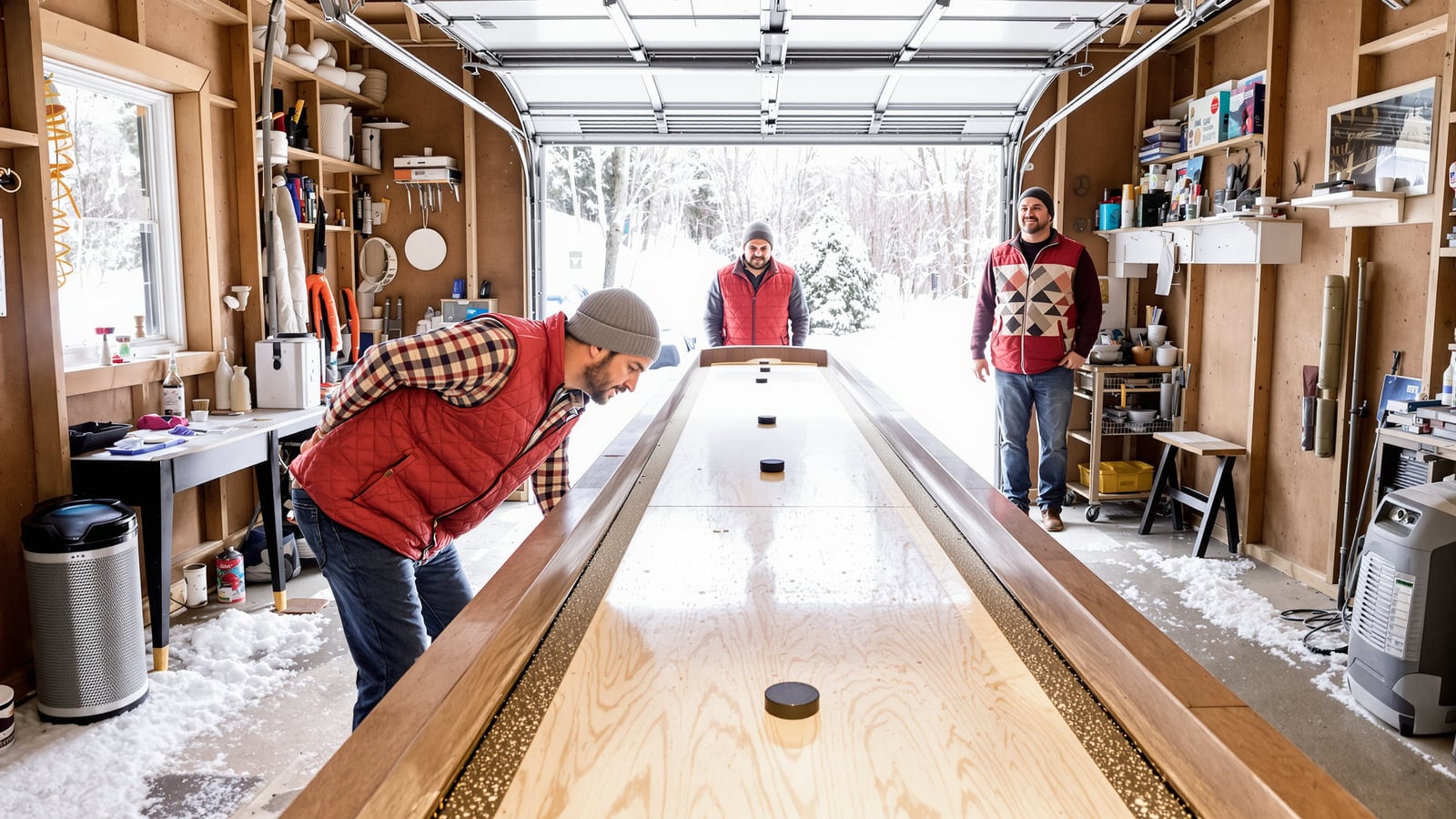
Quick answer: Measure your garage first. A 9-foot table needs about 15 feet of floor, because you need room to stand and shoot at both ends. Buy a used, level one, keep it off damp concrete, and run a thin line of powder before every game. It's easy to learn in ten minutes and hard to master.
Cornhole has a season
Cornhole is a great game in July. Then it snows, the bags freeze to the porch, and the boards lean against the fence until May.
A shuffleboard table doesn't care about the weather. It sits in the garage, and when your brother-in-law shows up in January with nothing to do, you can hand him a set of pucks and watch him lose with dignity.
Cornhole wins on price and portability. You can throw it in a truck bed and take it to a tailgate. A table doesn't go anywhere once it's in place. But a game people can play in the dead of winter is worth more than a game they can play twice a year.
Do the floor math before you buy
This is where most people go wrong. They fall in love with a 14-foot table and find out it doesn't fit.
A table is a foot and a half to two feet wide, but you're not standing on the table. You shoot from the end, so you need roughly three feet of clearance behind each end, plus a little room to walk around the side. A 9-foot table wants about 15 feet. A 12-footer wants 18.
Lay down painter's tape in the garage and mark the footprint. Then park the truck and see what's left. If the answer is "I can't park inside anymore," you've found out the real price of the table. Some men happily trade a parking spot for a game room. Some wives will have opinions about the cars sitting in the driveway through February. Know which house you live in.
Also check the ceiling. Your shot is low, so height isn't an issue. But a garage door track hanging down over the end of the table is a problem you'll discover with a puck in your hand.
Buy used, but check three things
A new regulation table is a serious purchase, and a beginner doesn't need one. Used tables turn up on local marketplace listings, usually because somebody moved or a basement got turned into a nursery. They're heavy and awkward to haul, so the seller is often happy to see one go.
Before you hand over cash, check these:
- The playfield. Lay a long straightedge down the surface. Gaps or humps mean warping, and a warped table plays like a bad road.
- The legs and levelers. Each corner should have an adjustable foot. If one is stripped, you'll fight the table's slope forever.
- The pucks. A full set is eight, four of each color. Missing pucks are cheap to replace, but ask anyway. Sellers will often toss in the powder.
Bring three people and a dolly. Don't pick it up with your back and call it a plan.
Your garage will try to ruin the wood
A table is a long piece of wood, and wood moves with the weather. An unheated garage in a snowy state swings in temperature and humidity more than any room in your house.
Get the table off any wet or sweaty concrete. Keep a cover on it when nobody's playing, and check the level every few weeks, especially after a big temperature swing. A table that was dead flat in October can drift by February.
If you can only afford one improvement, make it a space heater for game nights, set well away from the table, and never anywhere near fuel cans or paint. Your hands will work better, and so will your shot.
The powder does the work
Shuffleboard powder is what lets a puck glide. A thin, even line along the lane is enough. Too much and the pucks sail off the end. Too little and they die halfway down.
Powder comes in different speeds. If your pucks keep stopping short, go faster. If they keep flying off the far end, go slower. Wipe the surface with a clean cloth between games so old powder doesn't clump into a speed bump.
Keep drinks off the playfield. One sweating can makes a ring in the finish, and you'll look at that ring every time you play for the next ten years.
The rules take ten minutes to learn
You'll find local variations, but the common version goes like this. Two players, four pucks each. You shoot down the table, then walk to the other end and shoot back. Pucks have to cross the foul line to count, and any puck that drops off the side doesn't score.
At the far end are scoring zones worth one, two, and three points. A puck hanging over the very edge without falling is a "hanger" and is worth four. After each round, only the player with the farthest puck scores. They count every one of their pucks that's farther than the opponent's best.
Play to 15. Play to 21 if you've got time.
That scoring rule makes it better than it sounds. A bad shot can knock your opponent's lead off the table, so a game that looks lost can flip in one throw. An eight-year-old and a grown man can both stay in it, and you'll hear about the hanger for a month.
House rules make it a place
A table in the garage becomes the thing your family does only if you give it habits.
Pick a night. Start the tournament yourself, because nobody else will. Start the weekly game yourself, because nobody else will covers how to keep it going past week three.
Then use it for something that matters. If you've drifted from your dad or your son, a three-hour game can do what a conversation can't. The easiest way back to your father is a three-hour game makes that case. A table gives you something to do with your hands while you talk.
Teach the kids to reset the table when they finish. Pucks back in the case, powder wiped, cover on. Leave it cleaner than you found it. That's the same rule you'd apply to a borrowed truck or a friend's kitchen.
If you like the idea of a hobby that leaves a mark on the garage, the case for a hobby that leaves sawdust on the floor is worth a read before you start building shelves for the pucks.
Then lose to somebody you love
The first time you play, you'll be terrible. You'll shoot too hard, and the puck will sail off the end and land in the snow shovel.
Don't worry about it. Your nephew will beat you, and so will your father-in-law. Somewhere around the fourth game, you'll hang a puck over the edge, and the whole garage will go quiet.
That's the moment you bought the table for.
Marcus Vale
Editor-in-Chief
Twenty years in magazines, most of it deciding what to cut. Writes about work, discipline and the decisions that compound.

Watch
Worth an hour of your evening
More from Play.
From channels we rate. Plays on YouTube.
Read next