Pull the red cord before the storm makes you
When the power dies, your garage door becomes a 150-pound lid on your car. Learn the manual release in daylight, on a calm afternoon, with the door closed.
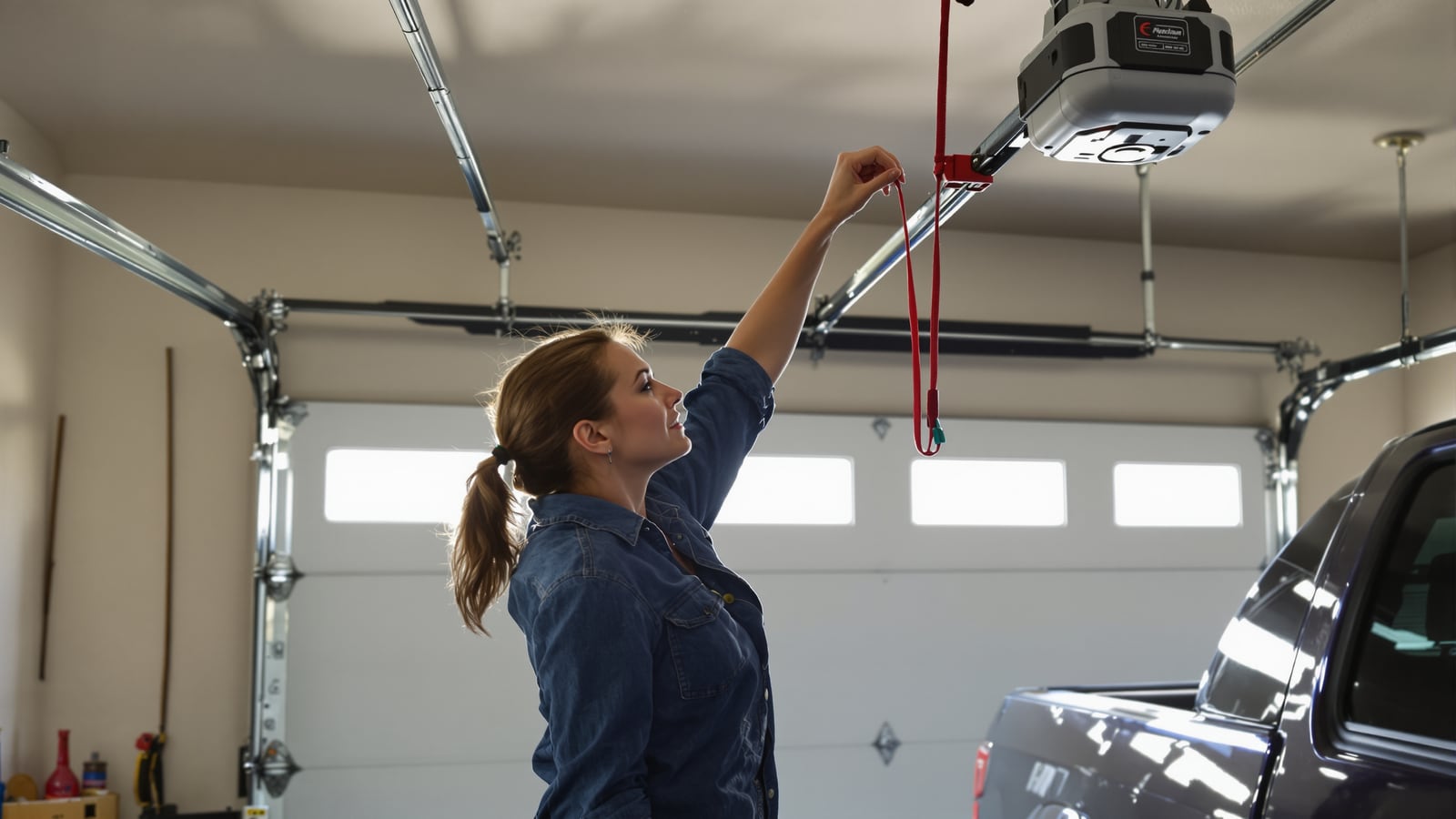
Quick answer: Find the red cord hanging from the opener rail. With the door fully closed, pull it down and back toward the door. The door disconnects from the opener and you can lift it by hand. Do it once this month so it isn't a first attempt in the dark.
The cord you've walked under a thousand times
Look up next time you park. On the rail that runs from the opener to the door, there's a carriage that rides back and forth. Hanging from it is a cord, usually red, with a handle on the end. That's the emergency release.
Pull it and the door lets go of the opener. That's all it does. It doesn't open the door and it doesn't break anything. It just frees the door so your arms can do what the motor can't.
Most people have never touched it. They find out it exists during an outage, with water coming up the street and a truck stuck inside. That's the wrong time to read the manual.
Do the drill with the door closed
This is the one rule that matters most. Pull the cord with the door down, not up.
A garage door is held up by springs, not by the opener. If those springs are worn or broken and you disconnect the opener with the door raised, the door can come down hard. Closed is the safe state. Start there.
Then run through it in daylight:
- Stand inside, door fully closed, and unplug the opener if you want to simulate the outage.
- Pull the handle down and back, toward the door. Don't yank it sideways. You'll hear a click as the carriage lets go.
- Check for a slide lock or a side lock bar on the door itself. Some doors have one. If it's engaged, the door won't budge, and forcing it bends metal. Unlock it first.
- Grab the bottom edge or the handle and lift. Keep your fingers away from the section joints, where hinges pinch.
- Raise the door all the way up and make sure it stays there.
Now the part nobody mentions. Lift it slowly to about waist height and let go. A balanced door hangs roughly where you left it, or drifts a little. If it slams down, or it's brutally heavy to raise, stop. Your springs are out of balance or failing.
If the door fights you
That's useful information, not a reason to muscle through it.
The springs and the cables that run along the sides of the door carry enormous tension. This is not a weekend project, and it's not a place for a borrowed wrench and a YouTube video. Call a licensed garage door technician and tell them the door is hard to lift by hand. A service call is cheap next to an emergency room visit.
You can do a few things yourself. Wipe the tracks clean. Lubricate the hinges and rollers with a garage door lubricant or silicone spray, and keep grease off the tracks themselves. Tighten any loose hardware you can reach without touching the springs or the cable brackets. A door that moves cleanly is easier to lift by hand and easier on the opener the other 364 days.
Teach it to everybody who might need it
You aren't always home when the power fails. Your wife may be the one pulling out. Your teenager may be the only one there.
Run the drill with every family member old enough to manage it, and give them a job. Someone pulls the cord. Someone lifts. Someone holds. A younger kid can't lift a full door, and shouldn't try. Their job is to know where the cord is and to get an adult.
Take a minute to point out the side entry door too. The garage door isn't your only way out, and in a fire or a flood it may not be your best one.
Holding it open, and holding it closed
Once the door is disconnected, it's no longer bound to the opener's lock. A couple of things follow from that.
If you need it up while you load the car, put a pair of locking pliers on the track just below the bottom roller. The door can't drop on a person or a bumper. Take them off before you drive through.
If you pulled the cord and decided to stay put, close the door and lock it manually if it has a lock. A disconnected door is just a door, and an unlocked one will open for anyone who lifts.
Mind the cord's security too. If your door has a gap at the top, someone can fish a wire through and snag the release. Some families shorten the cord or add a small shield over the latch. A garage door company can set that up in minutes.
Getting it connected again
Reconnecting varies by model, so read your opener's manual and keep it where you can find it. On many openers the sequence is simple: close the door, pull the handle toward the opener, and the carriage re-engages the next time the opener runs. Others have a lever you flip back.
When the power returns, don't run the opener until the door is closed and the carriage is latched. Then cycle it once and watch it. Listen for grinding. If it binds, stop.
The battery question
Many newer openers have battery backup built in, and older ones can take an add-on unit. Check yours. A backup battery usually gets you a number of open-and-close cycles during an outage, which covers a short one. It won't run a long one, and batteries wear out, so test it when you test the cord.
Don't count on it, though. A battery can die. A cord doesn't.
What to leave better
You just spent twenty minutes under your own garage ceiling. Don't walk away with it exactly as it was. Wipe the dust from the tracks. Hang the manual in a zip bag on a nail by the opener. Write the technician's number on a piece of masking tape and stick it to the wall. The next person to stand there, maybe your wife in a storm, will have what she needs.
One more thing, and it's a firm one. Never start a car or run a generator in a garage with the door closed, and don't run one with the door cracked either. Lifting the door by hand doesn't make that safe. For generators, read the twenty-foot rules first.
If the whole house is going dark for days, the door is one item on a longer list. A week without power takes more than a flashlight, and your seventy-two hour kit should already be somewhere you can reach it without opening the garage at all.
A red cord. Ten seconds to learn it and a closed door to do it on. Go pull it this weekend.
Wes Dunbar
Country & Skills
Grew up on an acreage and never quite left. Covers trucks, trades, land, and how to do the thing yourself.

Watch
Worth an hour of your evening
More from Preparedness.
From channels we rate. Plays on YouTube.
Read next