

The Gas Can Math That Decides How Long Your Generator Runs
Untreated gas goes stale in months, and your local fire code probably caps what you can keep. Here's how to store enough fuel safely and make it last.
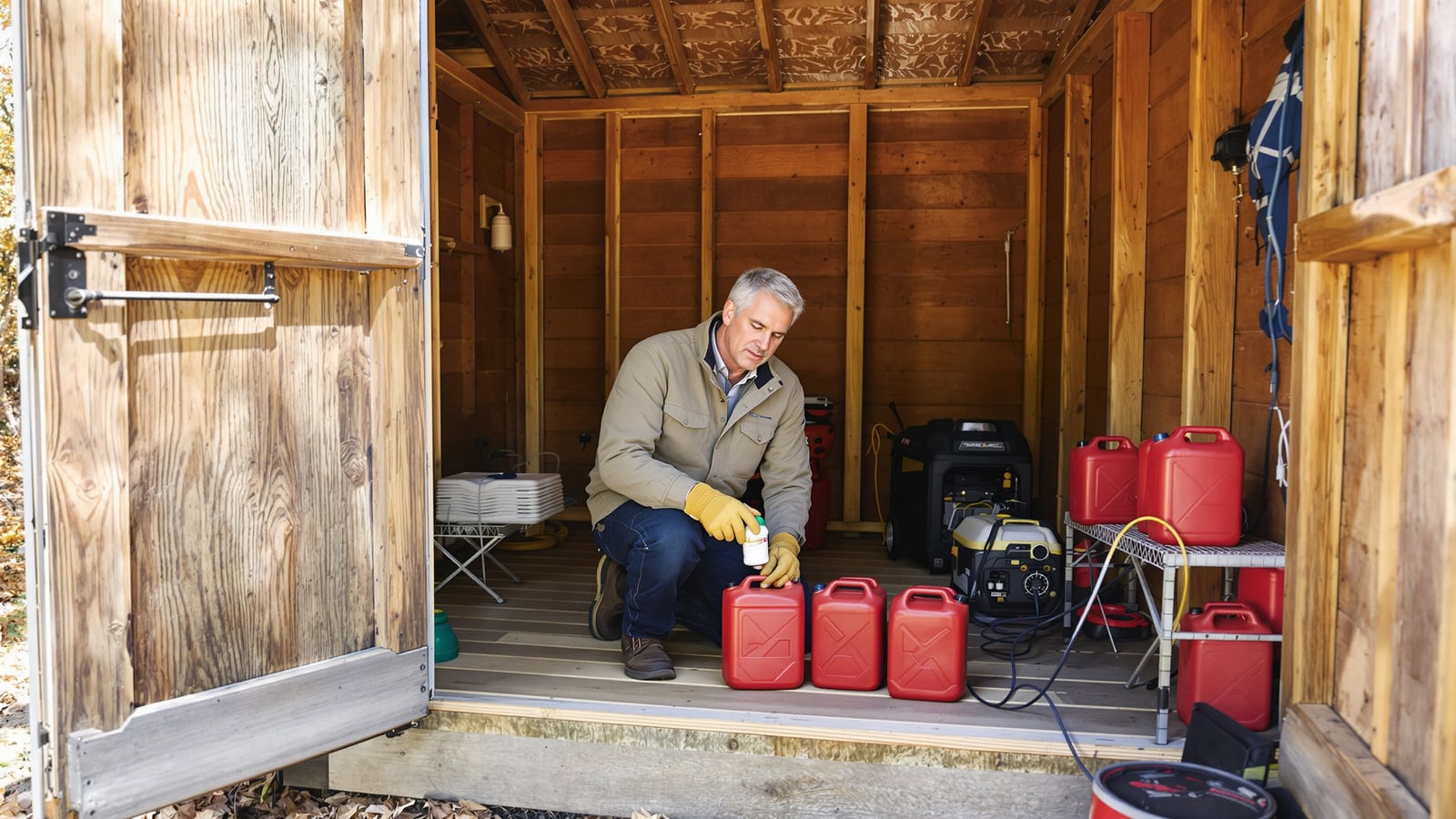
Quick answer: Store gasoline only in approved, labeled containers, in a detached shed or garage away from anything that makes a flame or spark. Add stabilizer to fresh fuel and cycle it through your truck twice a year. Do the runtime math before the storm, because the amount you can legally and safely store may not cover a week of running the generator around the clock.
Do the math before you buy a single can
Open your generator manual and find the fuel consumption at half load. Say it's 0.6 gallons an hour. That number is an example, so use your own.
Run it eight hours a day and you burn about five gallons daily. A week is 35 gallons. That's seven full five-gallon cans, and many local fire codes cap how much gasoline a household can keep. A cap near 25 gallons is common. Call your fire department's non-emergency line or check your county's fire code online to learn yours. I'm not going to guess at it.
So the shed can't be your whole plan. The plan is to burn less. Run the generator in blocks, not all day. A refrigerator and freezer that stay shut will hold their temperature for hours between runs. Cycle them: run the generator a few hours, shut it down, and let the cold coast. That can cut your fuel use by half or more. Our piece on what a week without power actually takes walks through what to power and what to let go dark.
Gas stations can't pump when the grid is down. Don't count on topping off mid-outage.
What stays good, and for how long
Gasoline. Untreated, plan on three to six months before it starts to degrade. Most pump gas in the U.S. is E10, which means up to ten percent ethanol. Ethanol pulls moisture out of the air. Enough water and the fuel can separate, and that sludge is what clogs a carburetor. With a stabilizer added to fresh gas, a year is a reasonable target. Follow the ratio on the label.
Ethanol-free gas. Some stations sell it, usually for more money. It keeps better. For a generator you'll only run a few times a year, it's worth the premium.
Diesel. Better than gas, but not forever. Six to twelve months is the usual guidance, and it grows microbes if water gets in. Treat it too.
Propane. Doesn't go stale. A 20-pound cylinder holds roughly 4.7 gallons of liquid propane. If your generator is dual fuel, a few spare cylinders are the easiest storage problem you'll ever have. Keep them outdoors and upright, never in the house, never in a basement.
Stabilizer isn't a miracle. It slows the clock on good fuel and does nothing for fuel that's already stale. Pour it in at the pump or right after you fill the can, then shake the can to mix it.
Pick the right containers
Buy cans labeled for gasoline and approved by a testing lab. Look for the marking on the can. Red is the convention for gasoline, yellow for diesel, blue for kerosene. Stick to the colors so nobody grabs the wrong one in the dark.
Skip milk jugs, soda bottles, and old paint cans. Plastic that isn't made for fuel can warp or leak. Don't pass one to a neighbor, either.
A few more habits:
- Fill to about 95 percent, not to the brim. Gas expands when it warms.
- Write the fill date on masking tape or with a paint marker. If you don't know how old it is, you don't know if it's good.
- Check the spout gasket every season. A cracked one is a slow leak you'll smell before you find.
- Keep a bag of cat litter or another absorbent nearby for spills.
The shed rules
Gasoline vapor is heavier than air. It sinks and travels along the floor until it finds a pilot light, a water heater, or a spark from a switch. That's why it doesn't belong in the house or an attached garage, and why the shed matters.
- Detached and ventilated. A shed away from the house, with vents or a gap at the bottom, lets vapor leave. If a detached shed isn't possible, check your local code for what's allowed in a garage and keep the cans as far from the water heater and furnace as you can.
- Off the ground, out of the sun. A shelf on the shaded side beats a dirt floor in direct sun. Heat builds pressure in a can.
- No ignition sources. No space heater, no grinder, no battery charger on a power strip, no smoking. Keep the generator itself out of the fuel shed.
- Gas apart from everything else. Not stacked against fertilizer, paint, or pool chemicals.
- Fire extinguisher at the door. An ABC-rated one, mounted where you can reach it without walking past the cans.
- Kids and pets out. A padlock on the shed door settles the question.
Before you add more fuel to a shed, check the rules for your property. Some homeowners' associations and insurance policies are stricter than the fire code, and a phone call to your agent costs nothing.
Fueling the generator itself
Shut it off and let it cool before you add fuel. Your manual gives the wait, and ten to fifteen minutes is common. Gas on a hot exhaust is how a bad night gets worse.
Fuel it outside, on level ground, well away from the house. Use a funnel so you aren't pouring blind in the dark. If you spill, wipe it up and let it dry before you restart.
At the pump, set the can on the ground to fill it, not in the bed of a truck or the trunk of a car. A plastic bed liner can insulate the can from the ground, and a static spark at the nozzle is a known fire risk. Keep the nozzle touching the can while you fill.
For the placement rules that keep carbon monoxide out of the house, read Twenty Feet From the House and Other Generator Rules. It matters more than anything in this piece.
The rotation routine
Twice a year, spring and fall, empty the oldest cans into your truck or car tank. Dilute it into a mostly full tank, since a modern engine handles a little aged fuel fine. Then fill the cans fresh, add stabilizer, and date them. It takes twenty minutes and your stored fuel stays young.
While you're at it, start the generator and run it for about fifteen minutes under a light load. A generator that hasn't turned over in a year is a coin flip when you need it. If you're putting it away for the season, follow the manual on stabilizer or running the carburetor dry.
Old fuel that's dark, sour-smelling, or has water at the bottom shouldn't go in any engine. Don't pour it on the ground or down a drain. Your county's household hazardous waste drop-off will take it.
Keep some cash on hand too. When the power's out, so are the card readers. Your Emergency Fund and the Cash You Can Actually Reach covers how much and where.
One last thing. If you borrow your neighbor's can during an outage, bring it back full, with a little extra in it. That's how you stay welcome the next time the lights go out.
Wes Dunbar
Country & Skills
Grew up on an acreage and never quite left. Covers trucks, trades, land, and how to do the thing yourself.

Watch
Worth an hour of your evening
More from Preparedness.
From channels we rate. Plays on YouTube.
Read next