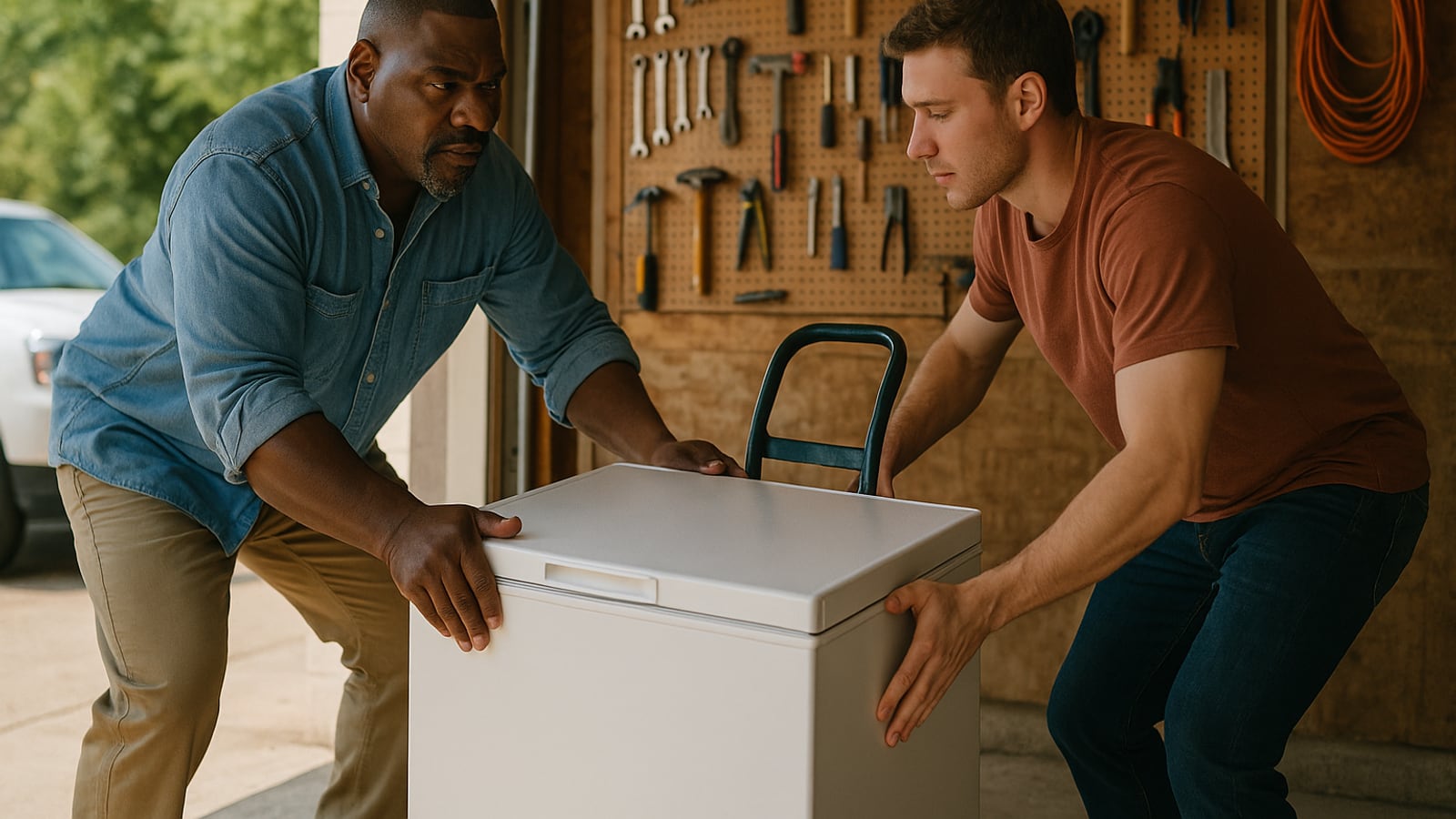
Ask him to help you with something you can't do alone.
That's the opening move. Not coffee, not "let's grab lunch and talk," not a standing invitation to come to you with his problems. A two-man job. Get the trailer hitched, move the deep freeze, pull the deck boards, load the truck for the church rummage sale. Two hours of work with one other man, and by the end of it he'll have told you more about his life than he'd have told you across a table in an hour.
Men talk sideways. Shoulder to shoulder, eyes on the work, hands busy. Face to face across a restaurant table feels like a performance review, and he's had enough of those.
Start with the task, and let the conversation find its own way
The reason this works isn't mystical. When your hands are occupied, silence stops being awkward. He can say something hard, let it sit for thirty seconds while you both wrestle a bolt, and then keep going. No eye contact required. No obligation to have a tidy conclusion.
It also puts you in a role he can accept. You're not the wise elder dispensing. You're the guy who needed help with the freezer, and he came.
Keep the tasks real. He'll know immediately if you've invented a job to manufacture a moment, and it'll embarrass you both. There's always something that genuinely needs two people. Use that.
Ask more than you tell, and mean the questions
The temptation is to answer. He mentions his boss is impossible and you've got eleven years of management behind you and you can see the whole thing from where you stand.
Don't. Ask.
"What's he like on a good day?" "What did you say back?" "What would you do if you weren't worried about the money?" Real questions, the kind you don't already know the answer to. Half the time he'll talk himself to the right conclusion, and a conclusion he reached himself will survive contact with Monday morning. One you handed him won't.
A ratio I'd aim for: three questions before one opinion. It feels slow. It's not. It's the difference between him telling you what's actually going on and him telling you the version he tells everybody.
Ask before you give the answer
When you do have something to say, ask permission first. "You want my read on this, or do you just need to say it out loud?"
He'll sometimes say the second one. Honor that. A man who's allowed to think out loud in front of you without getting a lesson every time will come back. A man who gets a lesson every time will stop telling you things, and then you're nobody's mentor, you're just an older guy he's polite to.
When he says yes, keep it short. Two minutes, not twenty. Say the thing, then stop talking. The silence after is where it lands. If you fill it with three more examples and a story about 1987, you've buried the point under your own voice.
Tell on yourself
Your successes are useless to him. He can't get inside them. You were a different man in a different decade with different rates and a different economy, and every triumph story sounds like a boast whether you meant it that way or not.
Your failures are the valuable inventory.
The job you took for the money and hated. The argument with your wife you won and shouldn't have. The friend you let drift because you were busy, and now he's gone. The year you drank more than you should have. The thing you said to your son that you'd give a lot to take back.
Those stories do something a warning can't. They tell him you've been stupid too, and survived it, and are still standing here holding one end of a freezer. That's the whole message underneath the mentoring: it's survivable. Most of it is survivable.
Be honest about the cost, though. Don't dress a failure up as a lesson you were glad to learn. Some of them just hurt.
Small and specific beats wise and general
"Be a man of integrity" gives him nothing to do on Tuesday.
"Call the client back before he has to call you twice" gives him something to do on Tuesday.
Aim low and concrete. How to ask for a raise and what to say when they stall. How much to keep in the account before you think about investing anything, and which professional to sit down with before you do. What to do when your wife is upset and you don't know why. How to write the two-line email that ends a problem instead of extending it. How to apologize without the word "but" in it.
Big principles are already in him, mostly. He heard them at church or from his mother or from a book. What he's missing is the mechanics.
Show up on a rhythm
Intensity impresses. Consistency works.
Pick something repeatable and low-stakes. First Saturday of the month, same diner, you buy. The Tuesday early service. A drive to the hardware store every couple of weeks. The point is that it happens whether or not either of you has anything to say, because the weeks when he's got nothing to say are exactly when the important thing surfaces at minute fifty.
If you can only do it quarterly, do it quarterly. Just do it on the calendar, not on the feeling.
The ways this goes wrong
- Rescuing him. If you keep solving it, he never builds the muscle. Sit on your hands more than is comfortable.
- Money. Lending it, or fixing a problem by writing a check. It changes what you're to each other, permanently, and rarely for the better.
- Running down his father. Even if the man deserves it. Especially then. Say nothing about his dad that you wouldn't say with his dad in the room.
- Making him prove he agrees with you. Politics, teams, theology, how to raise a kid. If agreement is the price of your attention, he'll pay it in public and leave.
- Repeating what he told you. Not to your wife, not as a prayer request, not as an anonymized example. Once is enough to end it.
- Making it about your own regret. He's not a second run at your twenties.
Say the hard thing once
Sometimes you'll see something he can't. He's about to marry someone who frightens you a little. He's drinking in a pattern you recognize. He's letting his marriage run on empty while he builds the business.
Say it. Plainly, kindly, once. Name the specific thing you've seen, not the character flaw you've diagnosed. Tell him you could be wrong. Tell him you'll be around either way.
Then let it go. Repeating it turns you into a nag and gives him something to push against instead of something to think about. He heard you. He'll remember it at two in the morning six weeks from now, which is when it'll do its work, and he will never tell you that's what happened.
Let him beat you at something
The relationship stays healthy when it goes both ways. Let him set up your phone. Ask him what he thinks about something you're genuinely unsure of and take the answer seriously. Tell him when he changed your mind.
A younger man who thinks he has nothing to give you is a man being condescended to, whatever words you're using.
You probably won't get thanked. Not for a decade, anyway, and maybe not to your face. What you'll get instead, if you're paying attention, is the day he tells you he's started meeting a twenty-three-year-old from work on Saturday mornings.
Sam Ortiz
Dads & Family
Father of three. Writes about presence, discipline and the long game, without pretending any of it's tidy.

Watch
Worth an hour of your evening
More from BRO Seniors.
From channels we rate. Plays on YouTube.
Read next