

Pool closings pay well until one freezes in January
Spring openings and fall closings fill a calendar fast. Here's the honest math on hours, insurance and the one mistake that eats a whole season's profit.
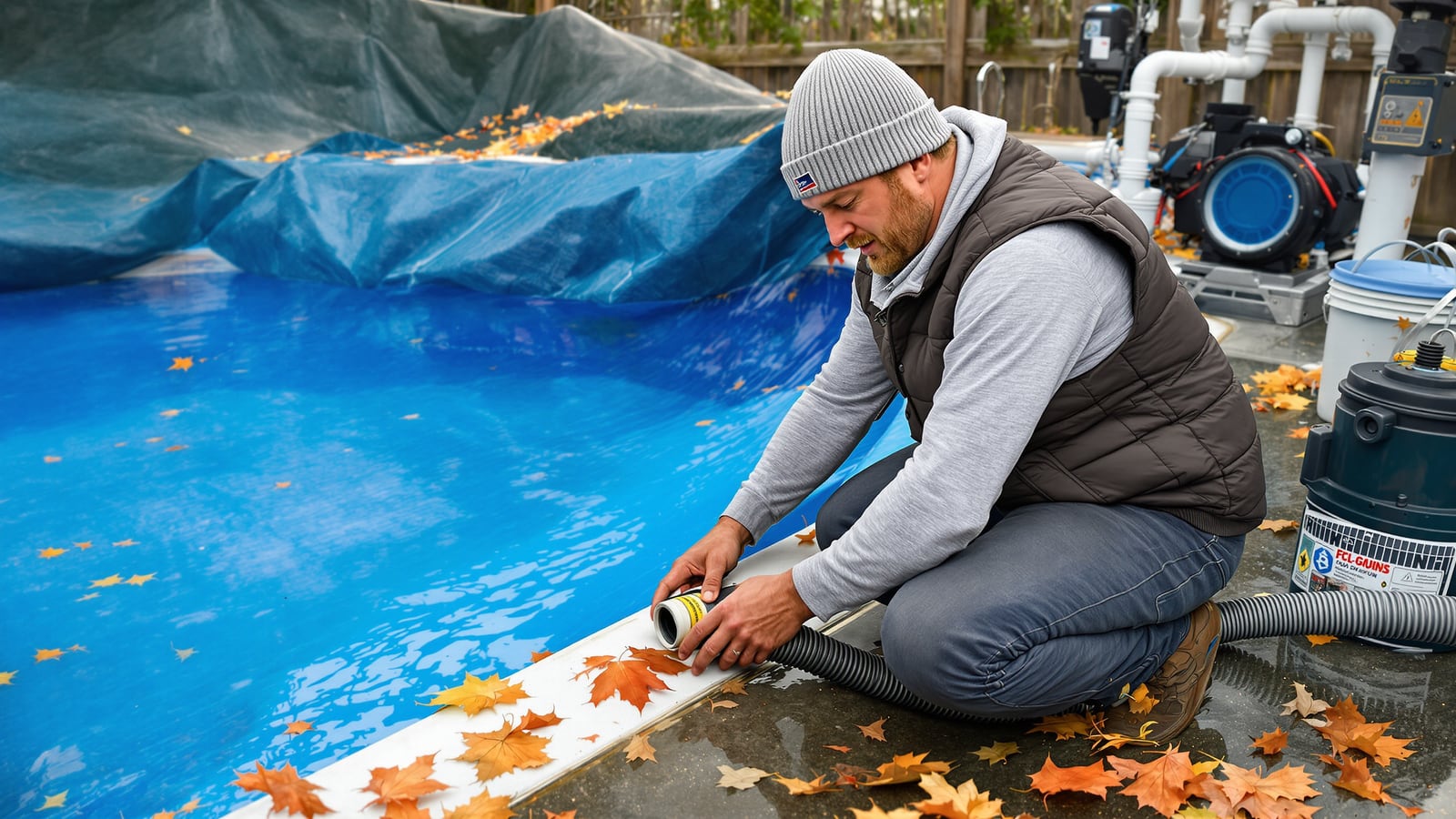
Quick answer: Pool opening and closing is real money in short bursts, mostly for a guy with a free weekend schedule and a cold-weather climate. The work is easy to learn. The risk is a closing done wrong, because the customer finds out in April, when a cracked pump or split line turns up under your name.
Why the calendar works in your favor
Pool owners don't want to do this job. They want to swim in June. Spring opening and fall closing are the two chores they put off and then panic about, which is why companies book them months ahead and why a reliable one-man operation can fill a calendar by word of mouth.
Both jobs sit inside narrow windows. Openings cluster in the weeks before the first warm holiday weekend. Closings cluster between the first cold snap and the first hard freeze. Every customer wants the same two Saturdays.
That's the first thing to understand about the business. You're not selling hours. You're selling a slot in a short season, and your capacity is a handful of weekends.
What the work actually involves
A closing, in a cold climate, runs roughly like this:
- Balance the water and shock it so it stays clear under the cover.
- Lower the water level to what the cover type and pool design call for.
- Clean the pool, remove ladders and accessories, and drain the pump, filter and heater.
- Blow out the plumbing lines, plug the returns and skimmer, and add pool-safe antifreeze where the manufacturer says to.
- Install the cover and secure it.
An opening runs backward. Pull the cover without dumping a winter's worth of leaf soup into the water, restore the equipment, remove the plugs, prime the pump, run the filter, then test and balance the water. The first look at a cover that sat all winter is something you'll remember. Sometimes it's a clear blue pool. Sometimes it's a swamp with a tarp on it.
Follow each manufacturer's instructions for the specific pump, filter and heater in front of you. Equipment differs, and "that's how my dad did it" is not a defense.
The honest numbers
These figures are placeholders, not market prices. Call three local pool companies, ask what they charge, and plug in the real ones.
Say you land 20 customers at $225 for an opening and $200 for a closing.
- Gross: 20 × $425 = $8,500 for the year.
- Supplies at an assumed $35 a visit, 40 visits: $1,400.
- Business insurance at an assumed $900 a year.
- Fuel, plugs, replacement parts and odds and ends at an assumed $400.
That leaves about $5,800 before taxes.
Now the hours. Budget about three hours per opening and two and a half per closing, counting drive time and the return trip when something wasn't ready. That's about 110 hours. Add maybe 15 more for scheduling, quotes and callbacks. Call it 125 hours, or around $46 an hour before taxes. That's a decent wage for a side job.
But look at the calendar. $5,800 a year averages under $500 a month, and in reality it's two paychecks, one in spring and one in fall. July is empty. If you need steady monthly income, this isn't it.
Taxes
Self-employment income is taxed twice over: income tax, plus self-employment tax at 15.3 percent of net earnings. On $5,800 of profit, that's a real bill. Move a chunk of every payment into a separate account the day it lands. What to Set Aside for Taxes on Side Income From Dollar One walks through how to do it, and a local CPA can tell you what your situation needs.
Keep receipts for chemicals, tools, mileage and insurance. They're deductions, and you'll want them.
Insurance is the part people skip
Your homeowner's policy and your personal auto policy probably don't cover paid work on other people's property. Ask an agent about commercial general liability, and ask directly: "What happens if I damage a customer's equipment or the pool itself?" Also ask whether your truck needs different coverage when it's hauling business gear.
Here's why. A closing is only as good as the water you got out of the lines. If a stretch of plumbing holds water, it freezes, it expands, and it splits. You won't see it in October. The customer finds it in spring, and the repair bill is not small. A pool company with a name and insurance absorbs that. You, with a truck and a good attitude, might be personally on the hook.
Your state or county may also license pool work, especially anything touching electrical equipment, heaters or plumbing. Check before your first paid job, not after.
Where beginners get hurt
Closing too early. Warm water under a cover grows algae all winter. Wait until the water temperature is reliably down.
Taking more customers than your weekends can hold. Twenty openings in the same two weeks sounds like a good problem until it rains for nine days. Cap your list at what you can finish in two Saturdays and a few evenings, with a rain buffer.
Skipping documentation. Take photos of the equipment, the water level and the plugs before you leave. Note what you did on the invoice. If something goes wrong in spring, a dated photo is worth more than your memory.
Mixing chemicals. Chlorine and acid don't share a bucket, a shelf or a storage bin. Store them separately, keep them away from kids and pets, and read each label every time. If someone gets a splash or a lungful, get medical help right away.
When it's not worth it
Skip it if you live somewhere the pool never closes. Winterizing is the bigger payday, and without it there's far less to sell.
Skip it if you can't be flexible on weekends in the two busiest windows. Customers who wait for your schedule will find someone else.
Skip it if the insurance quote makes the math fall apart, or if you're only doing it for the first five customers to "see how it goes." The first five are exactly when a mistake costs the most.
And if you already do other seasonal outdoor work, like pressure washing, a pool route can sit alongside it and share a truck, a customer list and a reputation. That's the strongest version of this hustle. If it starts to grow beyond what a few weekends can carry, read this before you call it a business.
How to start small
Do your own pool first, or a family member's, with the manual open on the tailgate. Then take on a few neighbors you know, at fair prices, and put every promise in writing. Show up on the day you said. Leave the deck cleaner than you found it, the hoses coiled and the gate latched.
Do that, and the calendar fills itself. In this business, the people who book you again in March are the same people who watched how you left their yard in October.
This is general education, not financial, tax or legal advice. A CPA and an insurance agent in your state can tell you what applies to you.
- pool opening and closing
- seasonal side hustles
- side income math
- self-employment taxes
- small business insurance
Ray Okonkwo
Money & Business
Former commercial banker turned small-business owner. Covers salary, credit, margins and the arithmetic nobody does before signing.

Watch
Worth an hour of your evening
More from Side Hustles.
From channels we rate. Plays on YouTube.
Read next