

Fix a slamming, sticking drawer in twenty minutes
Most bad drawers don't need new slides. They need a level, a screwdriver and the patience to loosen three screws before tightening them.
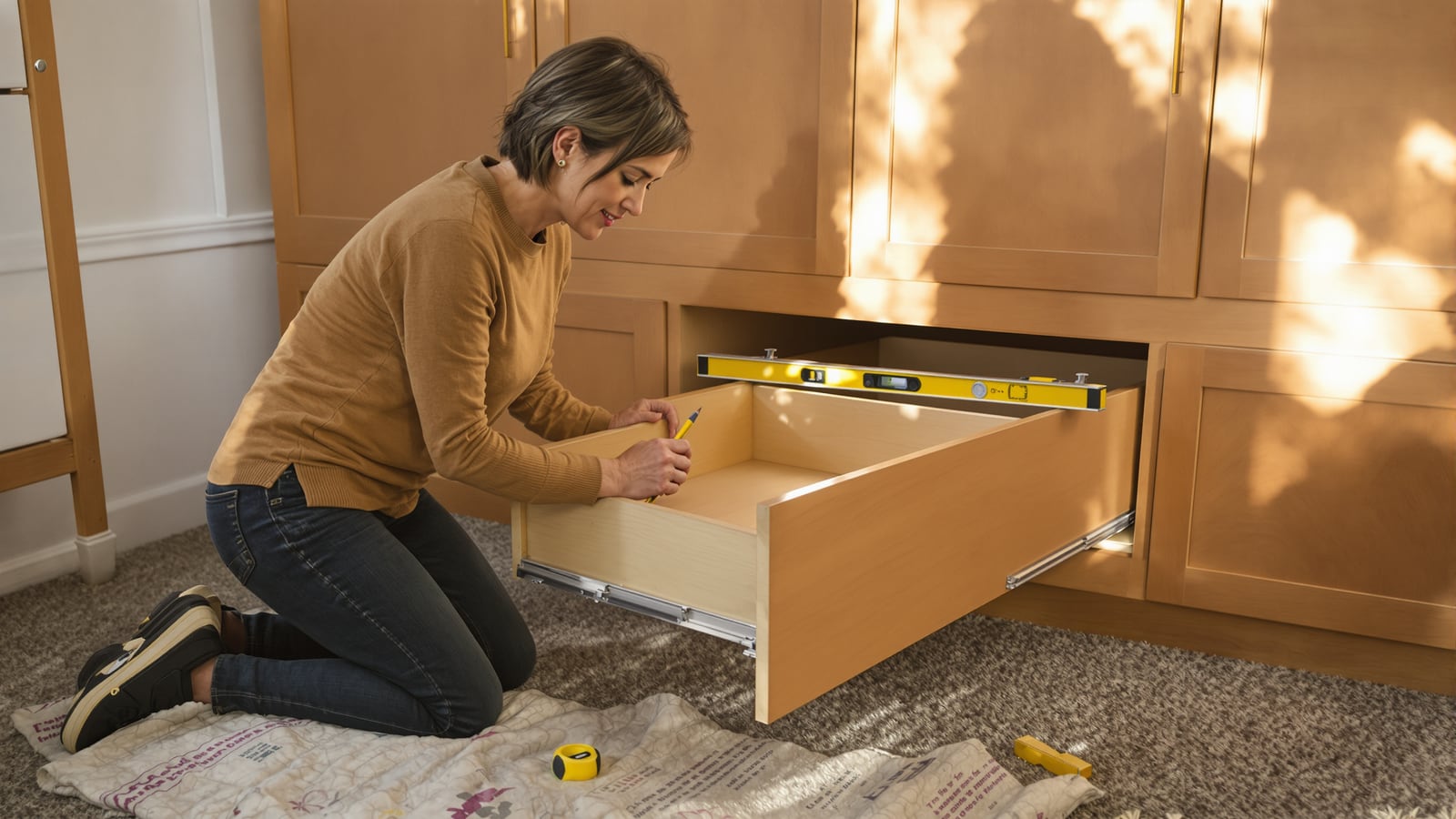
Quick answer: Empty the drawer, pull it, and check that both slides sit level and parallel. Loosen the screws through the slotted holes, nudge the slide into position, and snug them back down. Add a stick-on bumper for the final inch.
You need a #2 Phillips screwdriver (a hand one, not an impact driver), a tape measure, a small level, a pencil, and a few dollars' worth of clear silicone bumpers. That's the whole kit.
Figure out what you're dealing with
Open the drawer and look at the hardware.
Side-mount slides are metal rails running along both sides, with ball bearings inside. Most kitchen and bathroom drawers have them. The cabinet half screws to the cabinet wall. The drawer half screws to the drawer box.
Undermount slides hide beneath the drawer. You'll see small plastic clips or levers at the back or front corners. These are the ones with soft-close built in.
Wood or center-mount runners are a single track under the middle of the drawer, or wooden rails on the sides. You'll find them in older furniture.
This piece covers the first two. If you've got wood runners, skip to the wax tip near the end.
Safety first, and it's short
Take everything out of the drawer. A drawer full of plates comes off its rails faster than you expect, and a cast-iron skillet landing on your foot ends the project and starts a different one.
Keep your fingers out of the gap between drawer and cabinet while you test. Slides that slam also pinch. Wear safety glasses if you're working overhead or under a cabinet where dust and screws can drop. If the drawer is in a bathroom or by a stove, take a second to make sure nothing's plugged in nearby.
Take the drawer off
On a side-mount slide, pull the drawer all the way out until it stops. Look at each slide for a small plastic lever or tab, usually one pointing up and one pointing down. Push the left one up and the right one down, then lift or pull the drawer free. Don't yank. If it fights you, stop and look again, because there's a lever you haven't found yet.
On an undermount slide, open the drawer fully and find the release levers at the front or rear corners. Squeeze or lift them, then lift the drawer up and out. Some drawers need a slight upward tilt at the back first.
Set the drawer on a towel so you don't scratch the finish.
Look for the actual problem
Shine a flashlight into the cabinet and check three things.
- Screws. Loose ones are the most common cause of a drawer that rubs, drifts or sags. Tighten any that spin freely.
- Debris. A bottle cap, a crumb ridge or a rubber band in the track will stop a drawer cold. Vacuum it out.
- Bent rails. Look down the length of each slide. A visible bow or kink means replacement, and no amount of adjusting will fix it.
Now the part most people skip. Lay your level across the cabinet member (the half that stays in the cabinet) and check it. Then measure from the front edge of the cabinet to the slide at the front and back. The slide should sit the same distance from the cabinet front at both ends, and the left and right slides should sit at the same height.
A slide that tilts down toward the back is why a drawer drifts shut like it's on a skateboard. Even a quarter inch is enough.
Adjust the side-mount slides
The screw holes in the cabinet member are usually slotted, which is the whole point of them. You can shift the slide without drilling anything.
- Loosen the screws on the problem slide a half turn. Don't remove them.
- Slide the rail up, down, forward or back to the position you want. Check it against your level and measurements.
- Tighten the screws while holding the slide in place. Start at the middle and work outward.
- Do the same on the opposite side. Match the height and distance from the front exactly.
Most ball-bearing slides want roughly half an inch of clearance between the drawer box and the cabinet side. If one side rubs and the other has a gap, shift the cabinet slide toward the gap, not the drawer.
If a screw hole is stripped and the screw won't bite, pull the screw, push in a couple of wooden toothpicks with wood glue, break them off flush, let the glue set, and drive the screw back in. Or use the next empty hole.
Adjust undermount slides
These have built-in adjustments, and they're why people buy them. Look at the front corners of the drawer or the locking devices on the slide. You'll usually find a screw or a small cam that changes the drawer's height, another that moves it side to side, and sometimes one that tips the front face up or down.
Make one adjustment at a time. Turn the screw a quarter turn, put the drawer back and test it. If you change three things at once you won't know which one fixed it.
Some systems have a small dial or switch on the damper that sets the closing speed. Check the maker's instructions. The brand and model are often stamped on the slide itself.
Put it back and test it with weight
To reinstall a side-mount drawer, pull the inner rails fully forward, line them up with the cabinet rails, and push the drawer in until the levers click. For undermount, set the drawer down on the slides and push until you hear the locking devices catch.
Test it empty first. Then put in the weight it normally carries, because a drawer that closes beautifully with nothing in it can still slam when it's loaded with pots. Open and close it ten times. Listen for scraping and watch how it moves in the last two inches.
Stop the slam for good
If the drawer still closes harder than you like, you've got three options.
Bumpers. Stick one clear silicone bump at each top corner of the cabinet opening, where the drawer front lands. Clean the spot with rubbing alcohol first so the adhesive holds. This is the cheapest fix and it works better than it has any right to.
Add-on soft-close dampers. Retrofit kits exist for many side-mount slides. Match the kit to your slide type and measure before buying.
Replace the slides. If a rail is bent, the bearings grind or the damper has gone slack, a new pair costs less than the weekend you'll spend fighting the old one. Measure the slide's length and your drawer box before you order.
For wood runners, rub paraffin or a plain candle along the contact surfaces. For metal slides, a little dry silicone spray on the bearings beats heavy grease, which collects dust and gums up.
Leave it better than you found it
While the drawer's out, wipe down the track and the drawer box. Vacuum the crumbs. Check the drawers next to it, because the one that's a little stiff now will be the next one to slam.
Then put the screwdriver back where it came from. And the next time somebody sleeping in the house wakes up to a quiet kitchen at 6 a.m., you'll know exactly why.
Wes Dunbar
Country & Skills
Grew up on an acreage and never quite left. Covers trucks, trades, land, and how to do the thing yourself.

Watch
Worth an hour of your evening
More from Skills.
From channels we rate. Plays on YouTube.
Read next