

Why your heavy tee clings the minute you sweat
Fabric weight decides whether a shirt breathes or sticks to your back. Here's the number to look for and how to check it without a tag.
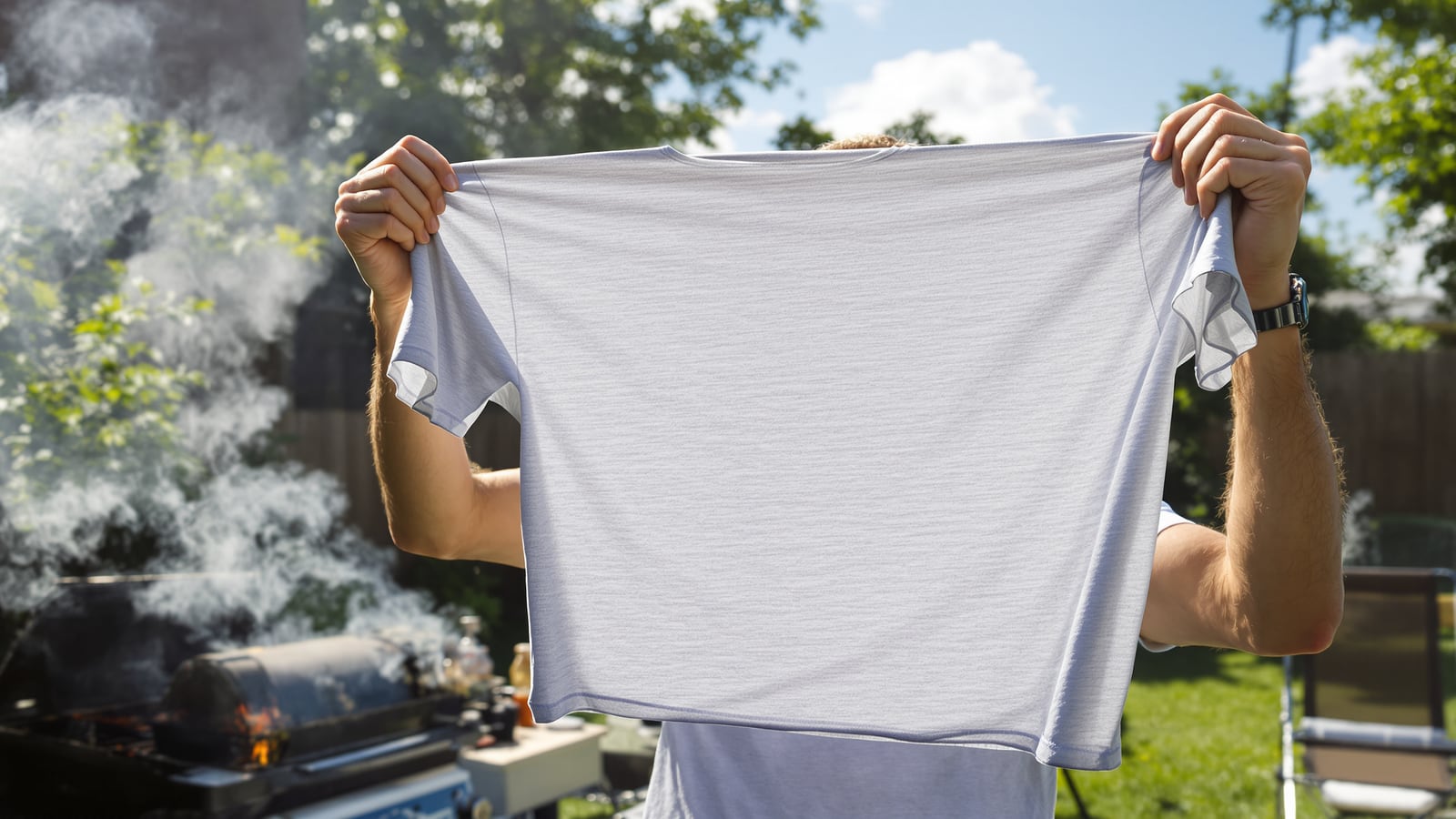
Quick answer: For hot weather, buy tees and knit shirts around 4 to 5 ounces per square yard (roughly 135 to 170 GSM), and woven shirts thin enough that your fingers show faintly through them when you hold them to a window. Go heavier and the shirt holds sweat and grabs your skin. Go too light and it turns see-through. Fit decides the rest.
The tee that felt like quality
You bought it because it felt substantial. Thick, soft, a little stiff, the kind of tee that makes you think somebody cared. In an air-conditioned store at 72 degrees, it was perfect.
Then you wore it to a cookout in July. By the second hour it had gone from shirt to wet towel, and every time you leaned back in the lawn chair it peeled off your spine like tape.
That isn't bad luck. It's weight.
Why weight matters more than the fiber name
Everybody argues about cotton versus linen versus synthetic. The number on the tag usually matters more than the word on it.
A heavier fabric puts more fiber against your skin and has more material to soak up water. Cotton takes on sweat easily and lets go of it slowly. A thick cotton tee fills up, gets heavy and sags, and then stays wet long after you've stopped moving. A thin cotton tee still gets damp, but there's less of it to hold, so it dries faster and spends more of its time off your skin.
Damp fabric clings. That's the whole problem. Less fabric means less to cling with.
The numbers worth knowing
Tags come in two units. Ounces per square yard is the older American one. GSM, grams per square meter, is the one most newer brands use. Multiply ounces by about 34 and you've got GSM.
Rough ranges for T-shirts and other jersey knits:
- Under about 4 ounces (135 GSM): very light. Cool, but thin.
- 4 to 5 ounces (135 to 170 GSM): the summer sweet spot for most men.
- 6 ounces and up (200 GSM and up): heavyweight. Great in October. A burden in August.
Woven shirts don't usually list weight, so you go by the cloth. Poplin and chambray are the lighter everyday choices. Oxford cloth is heavier and stiffer, which is why it looks so sharp and why it's the first button-down to feel like a sweater in July. Linen is the lightest of the common ones. It also wrinkles like crazy, which is the price of admission.
Test it in the store
You don't need a tag. You need about thirty seconds.
- The window test. Hold the shirt up to a light. If you can faintly see your hand behind it, it's a warm-weather weight. If you see nothing, it's a cool-weather one.
- The scrunch test. Squeeze a fistful and let go. Light fabric springs open and feels airy. Heavy fabric stays in a dense little wad.
- The sink test at home. Wet a patch the size of your palm and press it to your forearm. If it plasters on and stays there, it'll do the same on your back.
Do the sink test on a tee you already own and wear it once in the heat. You'll learn more than any product page can tell you.
Texture beats thinness
A flat, smooth, thin fabric lies right on the skin. A fabric with a little texture holds itself off the skin, and that gap is where air moves.
That's why a piqué polo, with its small raised weave, usually feels cooler than a smooth jersey polo at a similar weight. It's why seersucker was invented, and why a waffle-knit or open-weave shirt breathes better than its weight suggests. The bumps do the work.
If you sweat hard, the move is a lighter shirt with some texture. Not the thinnest shirt you can find.
The too-thin trap
Chasing lightness can backfire. A tee under about 4 ounces in a pale color goes see-through when it's wet, shows every line underneath it, and clings in a different way, because there's no body to hold it away from you.
Fixes that work:
- Pick heathered or mid-tone colors. Heather hides moisture better than a solid gray, which tells on you instantly.
- Go slightly darker or add a pattern in woven shirts. A fine stripe or a small check hides a damp back far better than a solid light blue.
- Stay in the 4 to 5 ounce range and skip the paper-thin ones.
Synthetic blends are a fair trade-off. Polyester and similar fibers don't soak up water the way cotton does, so they dry fast. The downside is that they can hold odor. They're right for a workout or a long hike. They're the wrong choice for a dinner where you'll be sitting close to people.
Fit changes everything
Even the right weight clings if the shirt is tight. A fitted tee that's fine in the mirror turns into a second skin the moment you sweat, because there's no air gap at all.
Leave room. You want fabric that skims your chest and stomach, not grips them. If you can pinch an inch or so at the side seam, you've got breathing room. The checks that tell you a garment actually fits will walk you through shoulders, chest and length so you aren't guessing.
And you can't tailor your way out of a heavy fabric. A tailor can fix the cut. They can't make the cloth lighter. If the weight is wrong, the shirt is wrong, and it goes in the fall pile.
What to do with the heavy ones you already own
Don't throw them out. A 6-ounce tee is a great layer under a flannel in October, and a good one lasts. Wear it when it's cool, and buy lighter ones for the months when you're sweating.
Mind the dryer, too. High heat shrinks cotton, and a shirt that shrinks tightens up and clings worse than it did new. The dryer is why your clothes wear out early covers how to stop doing that. Air-drying a summer tee takes about an hour in July anyway.
If you're building a warm-weather rotation from scratch, the ten garments that get you through almost any week is a sensible place to start. Pick the lighter version of each shirt on it.
Feel the fabric before you look at the label. The shirt that feels a little too thin in the store is usually the one you'll still be happy to be wearing at 4 p.m. in August.
Dean Shaw
Gear & Garage
Reads the warranty, the parts list and the long-term owner reviews before anything else. Trucks, tools, watches, and the cheap version that costs more.

Watch
Worth an hour of your evening
More from Style.
From channels we rate. Plays on YouTube.
Read next