Build the roof before you strike the match
A fire feels like rescue, but when you're wet and the wind is up, it's the wrong first move. Here's the order that actually keeps you safe.
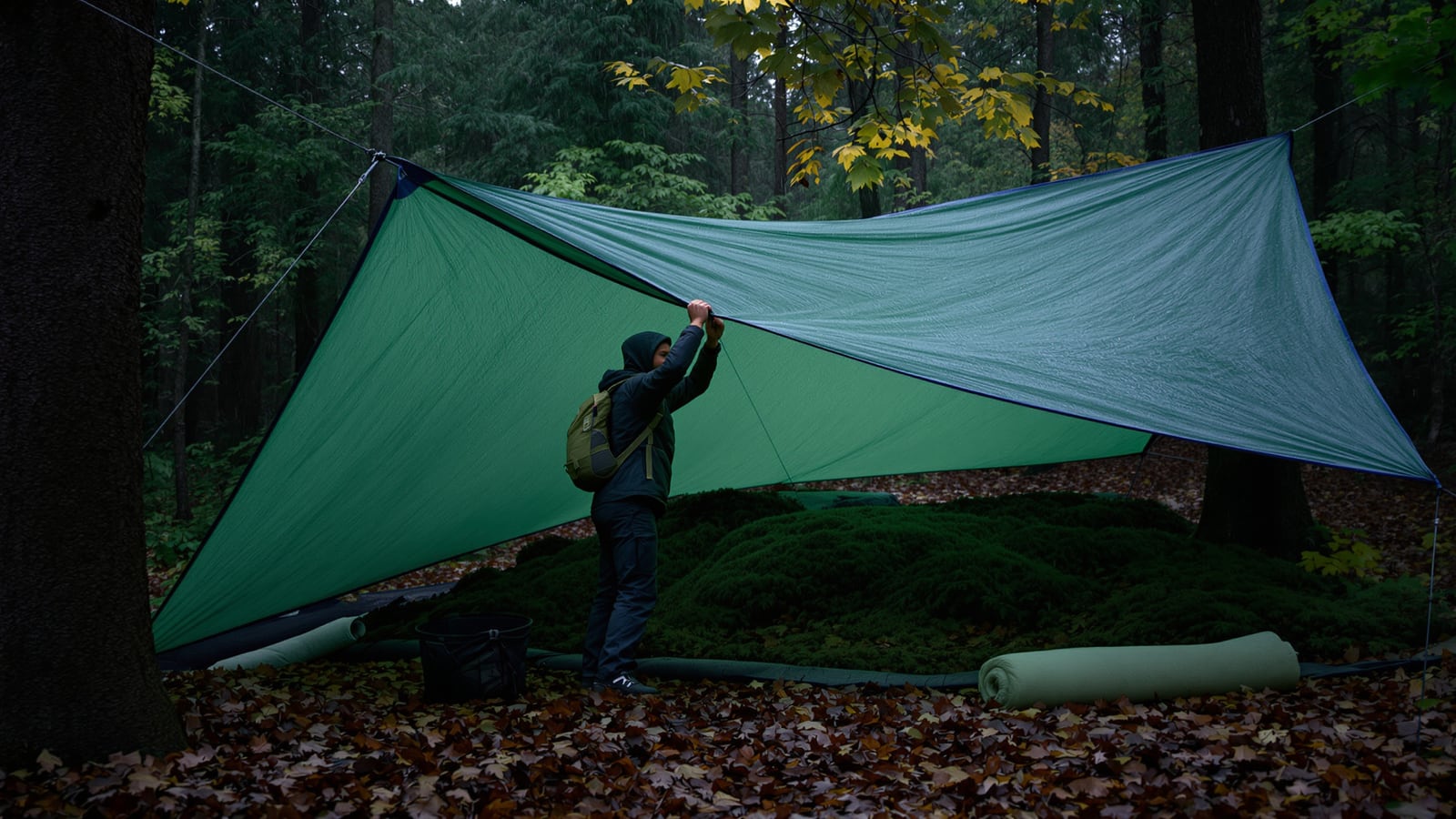
Quick answer: Get out of the wind and rain first. Get off the cold ground second. Make fire third, if at all. A dry person can get through a fireless night. A soaked person standing next to a fire is still in trouble.
Forty-five degrees and falling
It's 4:30 on an October afternoon. Rain has been steady for two hours. Your jacket stopped shedding it an hour ago, and sundown is at 6:15. You took the wrong fork, and you're not getting back before dark.
Every instinct says fire. Every movie says fire. Ignore both for the next twenty minutes.
Hypothermia doesn't need freezing weather. Cool, wet and windy is enough, and a forty-five-degree rain does it fine. Water pulls heat off your body much faster than air at the same temperature. Soaked clothing loses most of its insulation. Wind strips what's left.
A fire warms your front. It does nothing for the wet jacket on your back or the ground under you. It also takes longer than you think. In rain, finding dry tinder, sheltering a flame and feeding it can easily eat an hour. Your fingers go clumsy first, and clumsy fingers can't work a lighter.
The order it's actually done
1. Stop sweating before you stop moving. Sweat is wet that starts inside your clothes. On the walk, vent your jacket and shed a layer before you overheat. When you stop, put the dry layer on right away, before you feel cold.
2. Pick the spot in two minutes. Look for a slight rise, out of the wind. Skip low draws where water runs. Don't set up under a dead limb or a leaning dead tree, because they fall in wind without any warning. Don't set up beside a lone tall tree either.
3. Get off the ground. Lying on cold ground drains heat faster than the air around you does. Pile a foot of leaves or evergreen boughs and put your pack under your feet. Do this before the roof.
4. Build the roof and one wall. Run a cord between two trees at about waist height and drape a tarp over it. Pitch one side low to the ground on the windward side. A tarp pitched high and loose lets the rain blow straight in.
5. Then fire, if conditions allow. Check for fire restrictions first. Build it on bare dirt, a few feet from the open side of your shelter, never inside it. A fire in an enclosed space is a carbon monoxide risk.
6. Eat something and drink water. Your body is the furnace. A snack and some water do more for you than any flame.
What to carry, and what it costs
None of this is exotic.
- Tarp, 8 by 10 feet: $30 to $80. Silnylon or coated polyester, with grommets.
- Paracord, 50 feet: about $8 to $12.
- Heavy contractor bags, 3 mil: a box runs about $20. Carry two. They work as a poncho, a pack liner or a wind shell over your legs.
- Closed-cell foam pad: $25 to $50. It insulates from the ground and doesn't care if it gets wet.
- Reflective emergency bivy: $15 to $30. It's better than nothing and noisy, and it collects condensation. A proper bivy sack or bag costs more and works better.
- Lighter and ferro rod: around $15 together. Carry both.
- Wool or synthetic mid-layer: you probably own one already.
That's roughly $100 to $200, depending on how much you already own, and a few pounds in the pack. It's cheap against what it covers.
What goes wrong
Cotton. A cotton hoodie soaks up water and holds it. It's the most common mistake on a day hike.
Waiting for dark. You build shelter at the end of the light with cold hands. Start while you can still see and still feel your fingers.
A sagging tarp. If it's flapping, the rain is coming in sideways. Pull it tight and lower the windward edge.
Shelter under a dead branch. It looks perfect and it isn't. Look up before you commit to a spot.
Fire first, because it feels productive. It does feel productive, which is why people do it. It's also why they end up wet, cold and out of daylight.
There are fair exceptions. If it's dry, deep cold and you have plenty of dry fuel, fire can come earlier. If someone's already chilled and you've got a fire going, you use it. The order is for the common case, which is wet, windy and getting dark.
Stay put, and tell somebody before you go
If you're truly lost, the usual rule is to stay where you are once you've made yourself safe. The first hour matters most, and What to do in the first hour you're lost in the woods covers it step by step.
Better still, don't be lost. Tell someone your route and your return time before you leave. Then stick to it, because that person only helps you if they know when to worry.
If anyone in your group starts shivering hard, then stumbling, fumbling with zippers or slurring words, that's a medical emergency. Call 911 if you have a signal. Hypothermia gets worse quickly.
This piece is general education. It isn't medical advice, and reading about a tarp isn't the same as pitching one in the rain. A wilderness first aid course from a qualified instructor, usually a weekend and a couple hundred dollars, is the best money you'll spend on any of this. Also check local rules on fires and camping before you go. They vary by park, forest, state and province, and nothing here's legal advice.
Do it once in your backyard
On the next rainy night, pitch the tarp in the yard and spend two hours under it. Time yourself from the first cord to the first dry minute. If you're not comfortable with that, you'll know exactly what to fix.
A dry man on a cold night has an inconvenience. A wet man next to a good fire still has a problem.
Wes Dunbar
Country & Skills
Grew up on an acreage and never quite left. Covers trucks, trades, land, and how to do the thing yourself.

Watch
Watch how it's done
Picked for this article.
From channels we rate. Plays on YouTube.
TA Outdoors
20 Bushcraft Tips: Heavy Rain & Wet Weather Conditions
Paul Messner
Storm Shelter Tarp Setup in Grim Weather
Read next