Buy Your First Handgun After You Shoot It, Not Before
Trigger reach, slide technique and a rental counter will teach you more in one afternoon than a month of scrolling reviews.
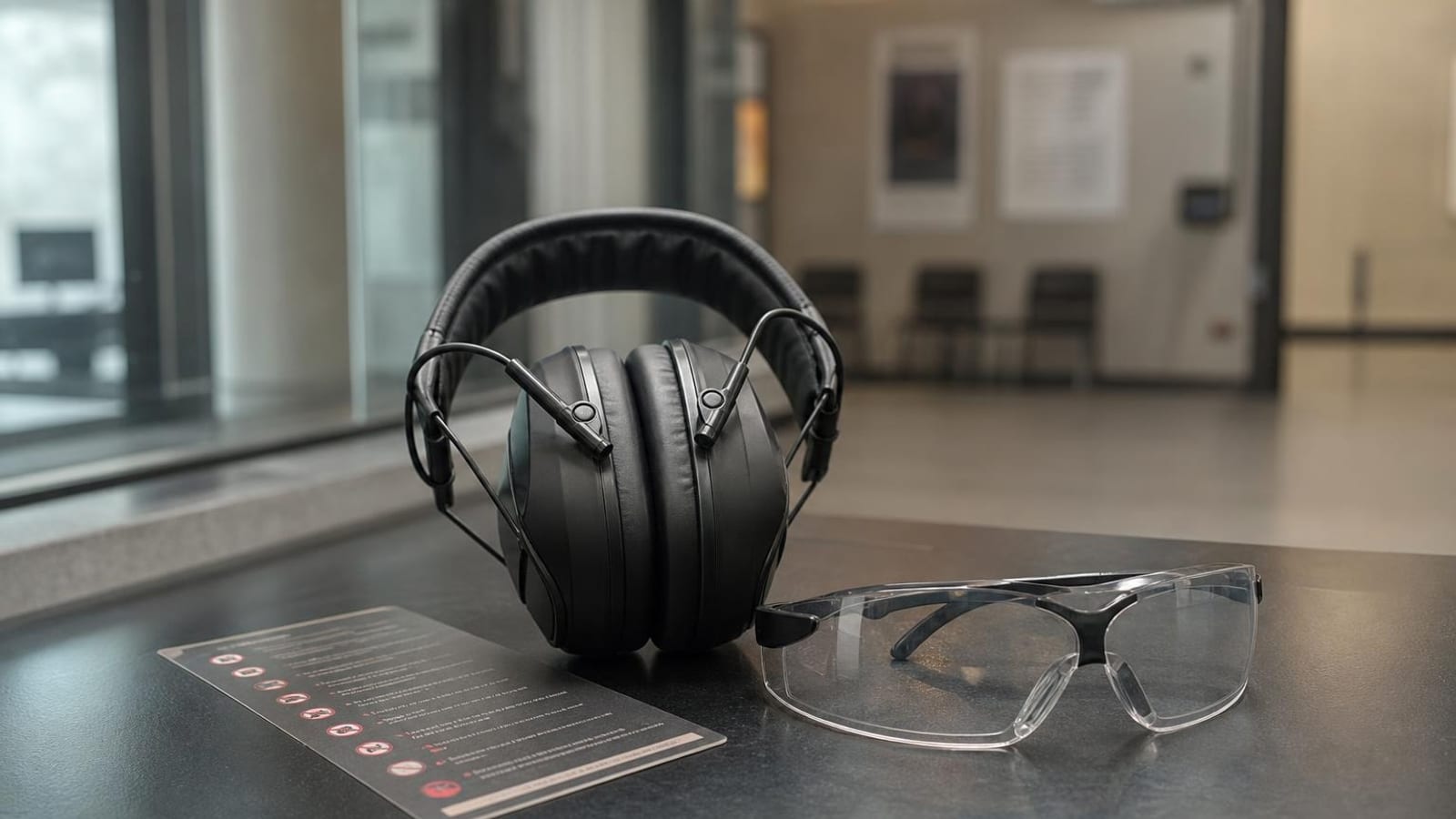
The worst gun advice in the country gets handed across a glass counter, usually by someone who means well. "Get her a snub-nose .38. Simple. Can't go wrong." That little revolver has a double-action trigger pull somewhere around 10 to 12 pounds, sights the size of a grain of rice, and a grip so short that a 158-grain load feels like slamming your palm in a car door. It's a gun for an expert who wants something tiny, not for a beginner who wants something easy.
If you're buying your first handgun, the order of operations is fit, then function, then purchase. Not the other way around. And fit isn't about how the gun looks in your hand at the counter. It's measurable.
Fit means trigger reach, not gun size
Pick up any striker-fired pistol and put your strong-hand grip on it: web of the hand as high into the tang as it'll go, three fingers wrapped, thumb along the frame. Now look at where the pad of your index finger lands on the trigger face.
You want the center of the pad, the whorl of the fingerprint, sitting on the middle of the trigger. If you can only reach the trigger with the tip of your finger, the frame is too big for you. What happens next is predictable: to get any leverage you'll rotate your whole hand around the grip, and every shot will land off to one side. Right-handed shooters push left. Left-handed shooters push right. Then somebody tells you you're flinching, and you're not. The gun doesn't fit.
If your finger goes in past the first joint, the gun is too small, and you'll drag your shots the other way.
This measurement is called trigger reach, and it varies a lot between models that look identical on a shelf. A Glock 19 and a Glock 43X feel worlds apart in the hand. A SIG P365 has a noticeably shorter reach than a full-size M&P. Several pistols ship with two or three interchangeable backstraps in the box, which can buy you a few millimeters in either direction. Walther builds an F-Series version of the PDP specifically with a shorter trigger reach and a reduced grip circumference. That's not marketing fluff, it's a real dimensional change.
The slide is technique long before it's strength
Most women who tell me they "can't rack a slide" are doing the pinch. Thumb and forefinger on the back of the slide, squeezing, pulling straight back with arm strength. Nobody can do that well, including men with strong hands.
Do this instead. Support hand goes over the top of the slide, palm down, fingers gripping the far side, heel of the hand on the near side. Bring the gun in close to your chest at about sternum height. Now push the frame forward with your strong hand while the support hand holds the slide still. You're not pulling the slide back. You're punching the gun out of your own hand. Whole-body leverage instead of finger pinch.
That one change solves it for most people. If it still doesn't, you have options. Smith & Wesson's M&P Shield EZ line in 9mm and .380 uses a lighter recoil spring and a grip safety specifically so the slide runs easy, and it goes for somewhere around $500 depending on the day. Some shops will swap a lighter recoil spring into other models. A revolver skips the problem entirely, at the cost of five or six rounds and a heavy trigger.
Grip strength is still worth building. A $20 hand gripper by the TV works. So does carrying the groceries in one trip, which you were going to do anyway.
Rent four guns. Fifty rounds each.
This is the whole article, honestly. Find a range with a rental counter. Most charge around $15 to $25 per gun rental, plus lane time and ammo. Bring a friend to split lane fees.
Shoot four candidates, fifty rounds apiece, back to back on the same afternoon. Write down what you notice before you leave the parking lot, because by Thursday every gun feels the same in your memory.
A reasonable rental list for a first-time buyer: a compact 9mm like a Glock 19 or M&P 2.0 Compact, a slim single-stack-ish carry gun like a P365 or 43X, a Shield EZ, and a small revolver so you can feel for yourself what that trigger is actually like. Total damage for the day, including two boxes of range ammo at roughly $15 to $18 a box, lands somewhere near $150.
Compare that to buying a $600 pistol you end up hating and selling back to the shop for $400.
What actually goes wrong
The gift gun. A husband or a father buys it as a surprise. His hands aren't her hands. That gun lives in a drawer.
Too small, too soon. Micro pistols are easy to carry and hard to shoot. A pocket .380 like an LCP MAX runs around $400 and disappears in a waistband, but the grip is short, the sights are minimal, and recoil is sharp. Plenty of experienced shooters carry one. Almost nobody should learn on one.
The gun you won't carry. A pistol in a safe at home doesn't do anything for you in a parking garage. Budget for the rest of the system. A stiff leather or reinforced nylon gun belt runs $70 to $100 and matters more than people expect. A kydex holster that covers the trigger guard completely, around $60 to $90. Off-body purse carry creates real problems, starting with the purse being the thing a thief grabs.
Nobody taught the grip. Two hands, thumbs forward, support hand filling the gap on the grip, both wrists locked. A weak grip causes malfunctions that get blamed on the gun.
The four rules, and the lock
These never change, and they're the entire reason lawful ownership is a responsibility and not just a right.
- Treat every gun as loaded.
- Never point the muzzle at anything you're not willing to destroy.
- Finger off the trigger and outside the guard until your sights are on target.
- Know your target and what's behind it.
Storage is the other half. A pistol not on your body goes in a locked container, away from children, every time. A quick-access box like a Vaultek or a Fort Knox pistol box runs $200 to $300 and opens in about a second. A basic cable lock is better than nothing and usually comes free in the case. Kids find everything. Assume yours will.
Dry practice at home is free and it's how you actually get good. Unload the gun, take the ammunition out of the room entirely, check the chamber twice with your eyes and your finger, use snap caps at about $15 for a set, and aim at something that would stop a bullet.
Pay an instructor before you pay for a gun
A basic pistol course, usually four to eight hours, runs somewhere in the $100 to $250 range in most parts of the country. Many ranges will let you shoot a variety of guns during it. Ask whether the instructor is NRA-certified or USCCA-affiliated, ask how many students per coach, and ask whether they'll work with you one-on-one for an hour. Private instruction at $75 to $100 an hour is the best money in this entire sport.
And take the defensive class after you've had the gun a while. Different skill, different day.
One more thing, and it matters as much as anything above: carrying a firearm means your job is to avoid trouble, not meet it. You leave early. You take the other exit. You give up the parking space. Force is the last thing on a long list, and everything on that list is cheaper.
Laws on purchase, transport, carry and storage vary enormously by state, province and city, and they change. Canada's handgun rules are a different world from Texas or Arizona. Nothing here's legal advice. Before you carry anywhere, read your own state statutes and talk to a qualified firearms attorney or a local instructor who teaches your jurisdiction's law.
Now go book the lane. Bring a notebook, not a shopping list.
Nina Castellan
BRO for Her
Runs the women-facing desk. Same standard, same tools, written for a different reader — not a softer one.

Watch
Watch how it's done
Picked for this article.
From channels we rate. Plays on YouTube.
GBGuns
How To Rack Any Handgun Slide
Tessah Booth
HOW TO EASILY RACK AND LOCK BACK YOUR SLIDE
Read next