
Commentary.
In 2008, in District of Columbia v. Heller, the Supreme Court said what most American households already understood. The Second Amendment protects an individual right to keep and bear arms. The Court also named the place that right matters most: the home, "where the need for defense of self, family, and property is most acute."
Read that list again. Family is right there in the middle.
That's the case for the right, and it's a strong one. It's also where most people stop thinking about it. They buy a pistol, put it on a closet shelf, and consider the matter handled. The right is real. But a right you exercise badly protects nobody. Your family deserves the version where you did the work.
Nobody else is required to come
This isn't a knock on police. The officers I know are good people who'd run toward trouble for a stranger. But they aren't your bodyguard, and the law says so.
In Castle Rock v. Gonzales (2005), the Supreme Court held that a woman had no constitutional entitlement to police enforcement of a restraining order against her estranged husband. The Court didn't say police shouldn't help. It said the Constitution doesn't guarantee they will.
Add the plain physics of distance. Even a fast response takes minutes. In a rural county, it can take a lot of minutes. Whatever happens in your hallway in that stretch of time happens with the people already in the house.
So the right to bear arms isn't an abstraction for gun collectors. It's the recognition that the first responder to a threat against your kids is you. The founders didn't invent that idea. They wrote down something that was already true and told the government not to take it away.
A gun in a shoebox isn't a plan
Picture the version most people actually have.
It's 2 a.m. There's a noise downstairs. The pistol is on the top shelf of the bedroom closet, in the box it came in, under a sweater. The magazine is in a drawer somewhere. You've fired it twice, both times at a range three years ago. Your wife doesn't know how to open the box. Your fourteen-year-old knows exactly where it is, because fourteen-year-olds know where everything is.
That household owns a gun. It doesn't have home defense.
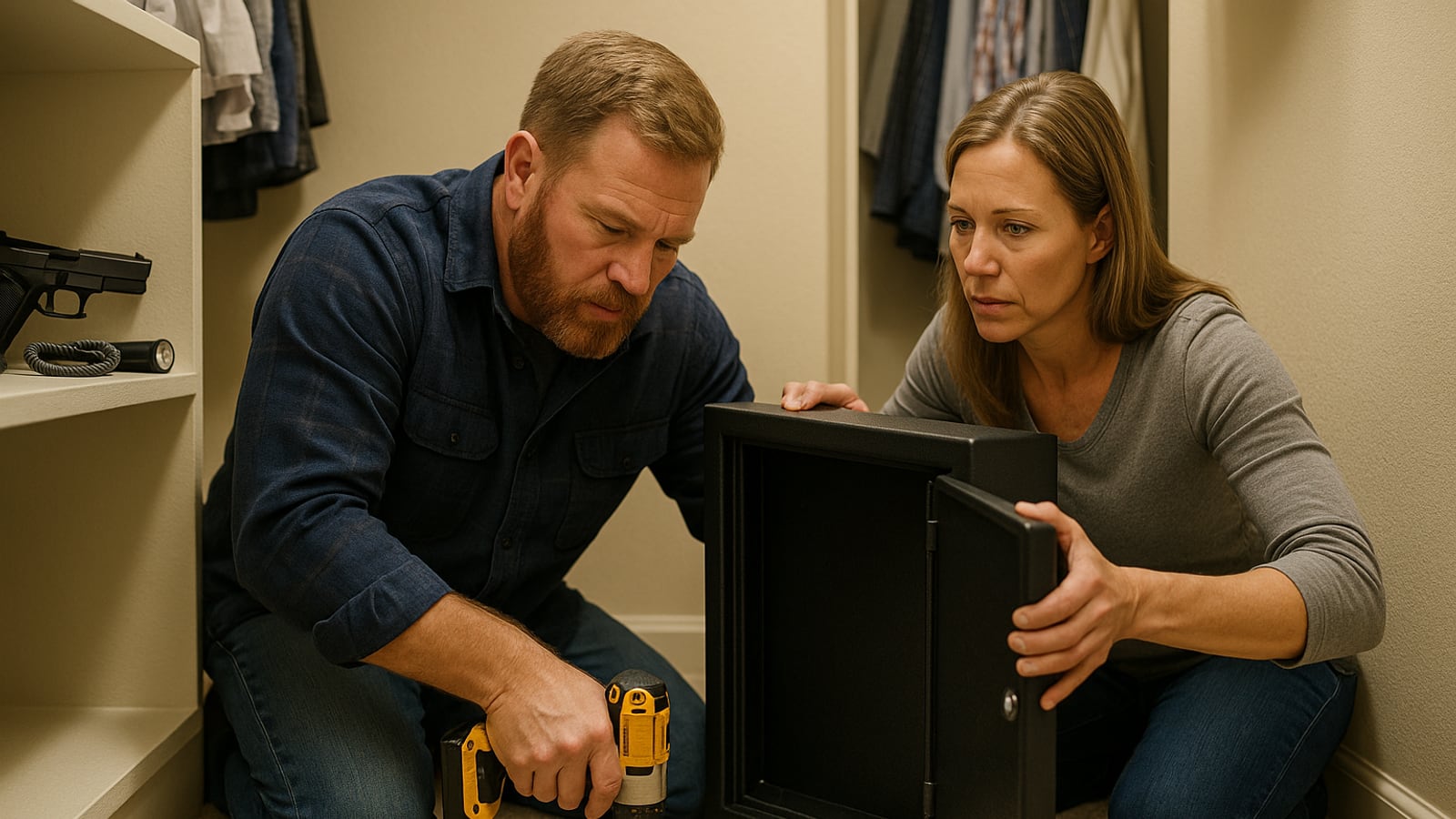
Now the other version. The pistol sits in a quick-access safe bolted to the bed frame or the nightstand. It opens by fingerprint or keypad in a couple of seconds, in the dark. Both adults can open it and both have trained with it. Everyone knows the plan: the kids stay in their rooms, one parent goes to them, one calls 911, and nobody goes looking for the noise. We've laid out the room-by-room version of that in Who Goes Where If Someone Breaks In At 2 A.M..
Same right. Same gun. Completely different family.
What doing it right actually costs
Less than people think. More effort than people want.
- A quick-access handgun safe. Roughly $100 to $300. Vaultek, Hornady RAPiD and Fort Knox all make them. Bolt it down. A small safe you can carry off is just a gift box for a burglar.
- A full safe for everything else. Figure $600 to $2,000 and up, depending on size and fire rating. Long guns and anything you're not staging for defense live here.
- Cable or trigger locks. Often free with a new gun. Many police departments hand them out through Project ChildSafe. They're a floor, not a ceiling.
- A real class from a qualified instructor. An intro handgun course usually runs $100 to $250. If you're nervous about it, read Your First Firearms Class Isn't a Test You Can Fail. Then keep going. One class is a starting point.
- Practice ammo and range time. Budget for it monthly, or the skill goes away.
Then the rules. Every adult in the house who touches a firearm should know these without thinking:
- Treat every gun as if it's loaded.
- Never point the muzzle at anything you aren't willing to destroy.
- Keep your finger off the trigger until your sights are on target and you've decided to shoot.
- Know your target and what's beyond it.
That fourth one matters more at home than anywhere. Drywall stops almost nothing. Know which walls your kids sleep behind.
And teach the kids. A locked safe does most of the work, but kids visit other houses where the parents weren't so careful. Your Kid Should Know What To Do When They Find A Gun covers the conversation. Have it early and have it more than once.
Where the argument doesn't hold
I'll concede three things, because they're true.
First, this is an argument about the American constitutional right. Canadian readers live under very different law, where self-defense generally isn't an accepted reason to own a firearm, and handguns face a national freeze on new sales and transfers. If that's you, the protection principles still apply, but the gun specifics don't. Follow your local law.
Second, not every household should have a gun in it right now. If someone at home is going through a mental health crisis, the responsible move can be to store your firearms somewhere else for a while, with a trusted friend or a licensed dealer, where your state's transfer laws allow it. That isn't giving up the right. That's exactly the judgment the right assumes you have.
Third, if you won't train, you should think hard before you buy. An untrained gun owner isn't a villain. He's just someone who hasn't finished the job yet.
The law, said plainly
Self-defense law, carry rules, storage requirements and transport rules vary by state, province and even city. Some states have child-access prevention laws with real penalties. Some require locks sold with every gun. Nothing in this piece is legal advice. Check your local law, and talk to a qualified attorney or a certified instructor who teaches your state's use-of-force law.
And keep the order straight. Avoidance comes first. Locks, lights, a dog, a good door, a family that doesn't open up to strangers at midnight. De-escalation comes next. Getting away counts as winning. Force is the last option, reserved for when there's genuinely no other way to keep your people safe. Every good instructor teaches it in that order, and every serious gun owner I know lives it that way. If you ever do have to use it, What the law actually asks after you defend yourself is worth reading before that day, not after.
The part the Constitution can't do for you
The Second Amendment is a promise from the country to you. It says the government won't take away your ability to protect the people you love.
Owning a gun is you making a promise back. It says the gun will be locked when it should be locked, ready when it should be ready, and held by someone who took the time to learn how.
The Court protected the right in 2008. Whether your family is protected is up to you, and it gets decided on some quiet Saturday at the range, long before anything happens at 2 a.m.
Dean Shaw
Gear & Garage
Reads the warranty, the parts list and the long-term owner reviews before anything else. Trucks, tools, watches, and the cheap version that costs more.

Watch
Worth an hour of your evening
More from Survival & Self-Defense.
From channels we rate. Plays on YouTube.
Read next