The loose hook on your tape measure isn't broken
A tape, a speed square and a pencil decide whether the cut fits. Here's what to buy, what the cheap ones miss, and the habits that matter more.
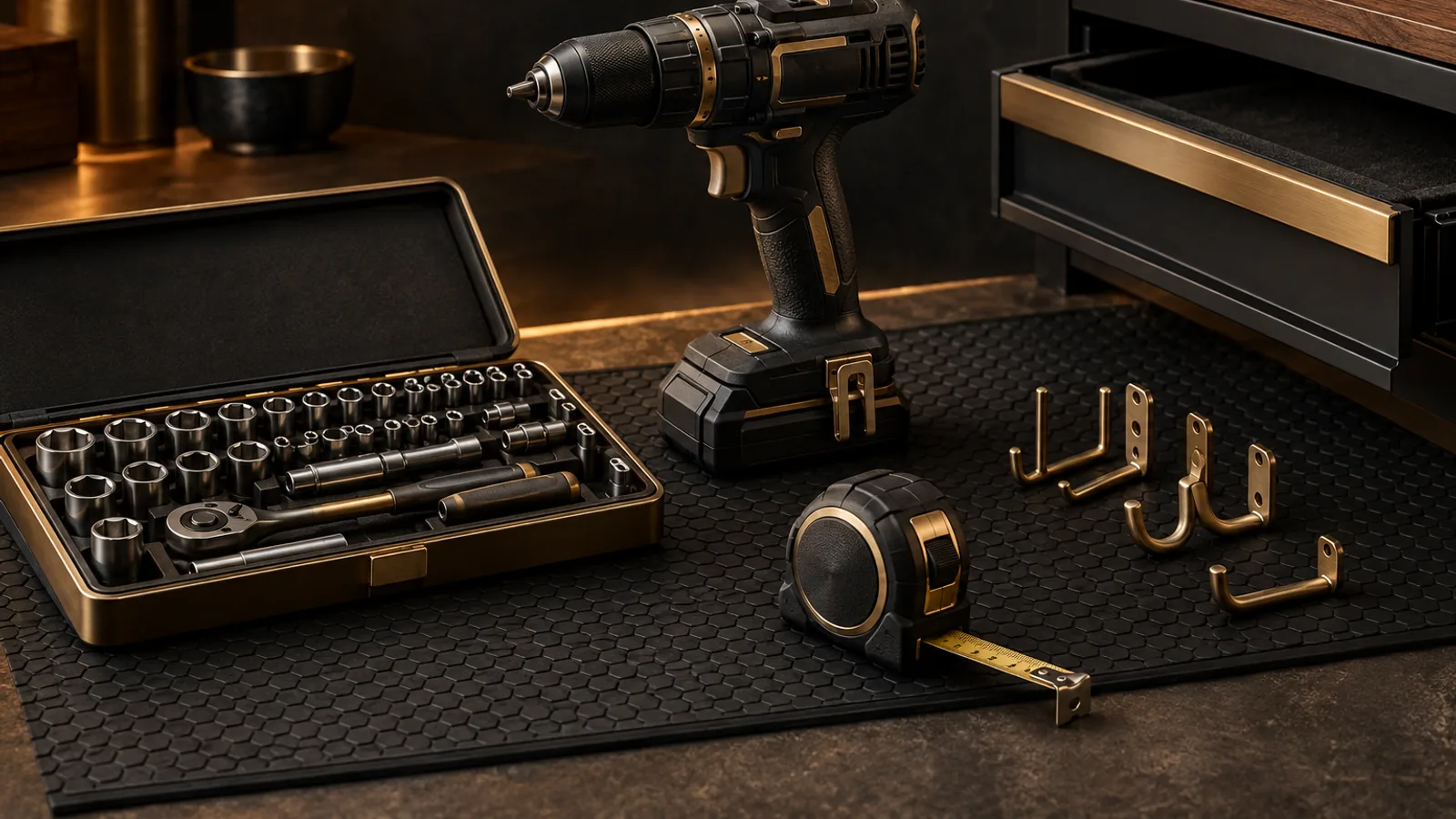
Quick answer: Buy a 25-foot tape with a wide blade, a 7-inch aluminum speed square, and a flat carpenter pencil. Together that's roughly thirty to forty dollars. Then use the same tape for the whole job, cut on the waste side of the line, and check your square once. That last part costs nothing.
The hook is supposed to wiggle
Every new guy pulls out a tape, sees the metal hook at the end slide back and forth, and decides the tape is defective. It isn't. The hook moves by exactly its own thickness, which is about a sixteenth of an inch.
Push the tape against a board and the hook slides in, so you get a true reading. Hook it over the end and pull, and the hook slides out by the same amount. Either way, zero lands where the wood starts. A rigid hook would be off by a sixteenth on half your measurements.
If the hook is bent, or the rivets have worked loose and it flops around, that's a different story. Replace the tape. A fifteen-dollar tape isn't worth arguing with.
One tape per job
Lay three tapes side by side at the 10-foot mark and you'll often find they don't agree. A sixteenth here, an eighth there. Nobody builds a house with that kind of error, but it'll wreck a bookcase.
So pick one tape and use it for the whole project. Measure with it, mark with it, and check the cut piece with it. Never take a measurement from your tape and then verify it with your buddy's. The mistake in woodworking is almost never a bad tape. It's two good tapes that disagree.
What to buy
Tape measure. A 25-foot tape with a wide blade, in the neighborhood of fifteen to twenty-five dollars. Stanley FatMax and Milwaukee's wide-blade compacts are the usual answers, and both earn it. The wide blade stands out about ten feet before it folds, which means you can measure a ceiling or a long board alone without it buckling. Pass on the 12-footer unless you're measuring trim. You'll miss the length the first time you need it.
What the cheap tape gets right: it measures. A ten-dollar tape from the hardware store counter does the job on a weekend deck.
What it gets wrong: a thin blade that folds at four feet, a hook that's soft and bends, and numbers that wear off. Printing that rubs away in a year is the most common complaint, and it's why the coated blades cost more.
Speed square. A 7-inch Swanson Speed Square runs about ten to fifteen dollars. It's the tool that's been on every framing site since Albert Swanson introduced it in the 1920s, and it's still the one to buy. Get aluminum, not plastic. Plastic ones are fine for a kid's birdhouse and nothing else.
Pencil. A flat carpenter pencil, a few dollars for a pack. The flat lead doesn't roll off a sawhorse, and you can sharpen it with a knife to a chisel edge.
The speed square does five jobs
Most guys use it as a 90-degree guide and stop. Learn these.
- Square a cut. Hold the fence tight against the board edge, slide the square along it, and draw the line. Cut it straight across.
- Mark 45 degrees. Pivot from the same edge and the diagonal side gives you a perfect miter.
- Guide a saw. Clamp it down, and the saw rides the edge of the square for a true crosscut. Faster than a miter box.
- Mark angles by degree. Put the pivot corner on the board edge, rotate until the degree you want crosses the edge, and mark. It handles stair stringers and angled braces.
- Check for square. Fit it into any corner, a door frame or a cabinet, and see whether the gap shows light.
Test your square before you trust it
Don't assume a new one is true. Take a board with a factory-straight edge, hold the square's fence against it, and draw a line along the square's perpendicular edge. Flip the square over, keeping the fence against the same edge, and draw a second line. Do the lines overlap? Good. If they split in a V, the square is off and you should return it.
Cheap squares are the ones that fail this test. A sixteenth off at six inches turns into half an inch off at four feet, and that's how a deck frame goes out of square.
The pencil matters more than you think
A standard number-two pencil leaves a line about a sixty-fourth of an inch wide. A carpenter pencil with a dull tip leaves one three or four times that. A sixteenth of an inch is a long way when the fit is tight.
Two habits fix it:
- Sharpen the pencil to a chisel edge and mark with the thin edge against the tape or square. A mechanical pencil with a hard lead, or a marking knife, is better still for fine work like cabinet joinery. A knife line gives you something for the saw tooth to catch.
- Mark a V for the measurement, not a dot. Place the point of the V on the number, and the V points exactly where you measured. A dot hides an eighth of error.
Which side of the line
The line has width. You have to decide where the cut goes in relation to it, every time, and say it to yourself out loud if you have to. The saw blade, called the kerf, removes about an eighth of an inch of wood. Cut on the waste side of the line and leave the line on the piece you're keeping. Cut through the line and you've shortened the piece by half the line's width, plus the blade's.
Mark the waste with an X. It takes one second and it's saved more boards than any gadget.
When to rent, when to skip
You don't rent a tape. But a long layout job, like a patio, a fence line or a foundation corner, is a case for renting a rotary laser level for a day. It gives you a flat plane across a whole yard, and a string line can't match that. For a standard weekend project, a four-foot level and a chalk line do the job.
For any other measuring, buy a laser distance measurer if you're doing a lot of rooms. It's good for flooring and drywall estimates. It's no replacement for the tape on a cut.
What I'd buy, what I'd skip
Buy: a wide-blade 25-foot tape, a 7-inch aluminum speed square, flat carpenter pencils by the pack, and a cheap utility knife for marking. Put the knife and the square in the same apron pocket every time, as laid out in where every tool goes and why you'll actually put it back.
Skip: the 100-piece measuring kit, the plastic squares, and the novelty tapes with the fraction chart on the case. You'll never look at the chart.
If you're building out the rest of your set, the 20 tools every homeowner needs and what to pay for each is the next stop, and the three saws a home shop needs covers the cutting half of this conversation.
Measure twice, cut once. The old line is right, and almost nobody does the second part. Do it. Then cut.
Dean Shaw
Gear & Garage
Reads the warranty, the parts list and the long-term owner reviews before anything else. Trucks, tools, watches, and the cheap version that costs more.

Watch
Worth an hour of your evening
More from Tools & Organizing.
From channels we rate. Plays on YouTube.
Read next