The back pain red flags that need a hospital today
Most back pain gets better with time and a little movement. A short list of symptoms doesn't, and waiting until Monday is how people lose function permanently.
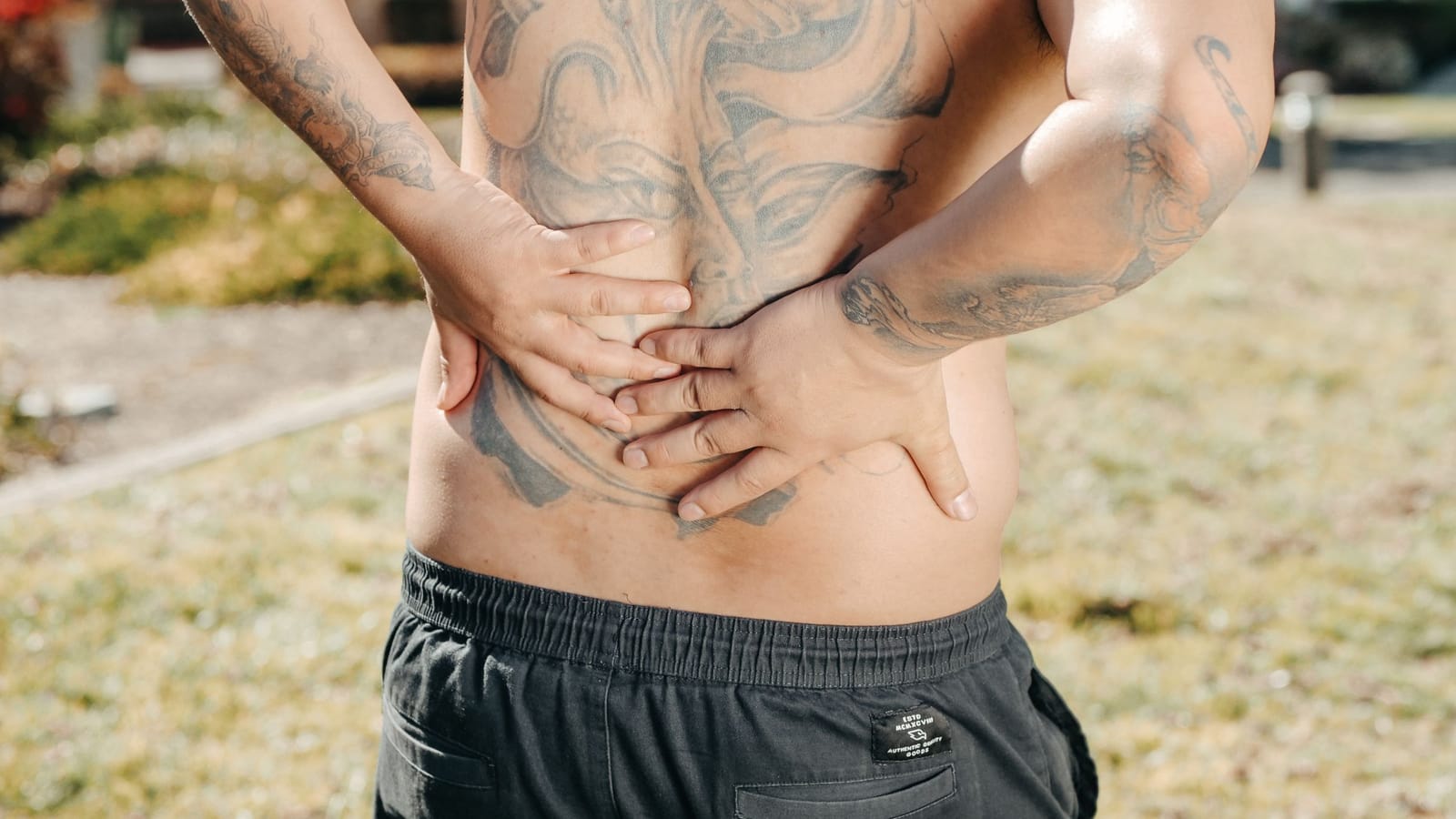
Ask yourself one question before you do anything else: can you still tell when your bladder is full?
That's the question. Not how much it hurts. Pain is a terrible triage tool, because a strained erector spinae can drop a grown man to the garage floor while a spinal tumor sits there aching like a bad mattress. The nerve stuff is what sorts an ordinary bad back from a drive-to-the-ER back.
Most low back pain is mechanical, boring, and improves whether or not you do anything clever about it. You tweaked something loading the car. You slept wrong on a hotel bed. You did eight sets of Romanian deadlifts after three weeks off because your buddy talked you into it. That back hurts, it stiffens up overnight, it eases when you walk, and in a couple of weeks it's a story instead of a problem.
Then there's the other kind. Here's how to tell them apart, and what to say when you get there.
Saddle numbness plus anything bladder
Cauda equina syndrome is the one that makes emergency physicians move fast. The nerve roots at the bottom of the spinal canal get compressed, usually by a big disc herniation, and the symptoms are specific.
Numbness in the area that touches a bicycle seat. Inner thighs, the region between the legs, around the back passage. People describe it as their skin feeling like it's been to the dentist.
Trouble starting a urine stream, or dribbling, or not feeling the urge until you're suddenly desperate. Not being able to tell when you're passing gas. New incontinence of either kind.
Weakness in both legs, or numbness running down both legs rather than one.
Any one of those, with back pain, means you go to the emergency department now. Not a chiropractor. Not a walk-in clinic with no MRI. Not tomorrow, when your wife can get off work to drive you. Surgical decompression for cauda equina is measured in hours, and the function you lose while you're waiting for a good time is often the function you don't get back. Bladder control doesn't have a great track record of returning once it's gone.
If you're wavering because it's 11 p.m. and you feel like an idiot: being sent home from the ER with a normal exam is the cheapest good news you'll ever buy.
Weakness that's getting worse, not pain that's getting worse
Sciatica hurts like fire and usually isn't dangerous. A weak leg is a different animal.
Test it honestly. Stand on one leg and rise up on the ball of your foot ten times. Then the other side. Walk twenty feet on your heels. If one foot slaps the floor, or the toes won't clear, that's a foot drop, and it's a nerve signal, not a pain signal.
A stable foot drop that's been there since Tuesday needs an urgent call to your doctor. A foot drop that's clearly worse today than yesterday, or weakness spreading to the other leg, goes to the hospital.
The pattern that matters is progression. Numbness climbing from the toes toward the knee over hours. Grip on the stairs going from awkward to unsafe. Write down what you can do at 8 a.m. and check it at noon. If the list is shorter, go.
Fever with back pain
Back pain plus a temperature isn't the flu with a stiff back. Spinal infections, including epidural abscess, present exactly this way, and they present vaguely enough that they get missed on the first visit all the time.
The risk goes up sharply if you've had a spinal injection or surgery in the last few months, if you're on immunosuppressants, if you've had a recent bloodstream infection or a bad skin infection, if you're diabetic with poor control, or if you inject drugs.
Tell the triage nurse about the procedure or the immunosuppressant in the first sentence. Those words change what gets ordered.
Night pain is in the same family. Not "it hurts when I roll over." Pain that wakes you at 3 a.m. and doesn't care what position you find, night after night, along with unexplained weight loss or a history of cancer, gets imaged. Prostate, breast, lung, kidney and thyroid cancers all like bone, and the spine is the most common place they land.
Trauma, and the trauma that doesn't look like trauma
A car wreck, a fall off a ladder, a hard landing on the ice. That's obvious. Go.
The less obvious version: a minor fall that wouldn't have bothered you at thirty. If you're over 65, or on long-term prednisone, or you've had a bone density scan you didn't love, tripping on the porch step is enough to compress a vertebra. Sudden sharp pain in the mid-back after a small fall, especially with a new stoop or a loss of height, needs an x-ray this week.
If you're on a blood thinner and you fall on your back, don't tough it out. Bleeding into the spinal canal is rare and it's fast.
And one that isn't spinal at all: a man over 60, usually a current or former smoker, with sudden severe pain in the back or flank that feels like tearing, maybe with a pulsing sensation in the belly or a leg that's gone pale and cold. That's an ambulance call, not a drive. Aortic problems refer pain to the back and they kill people who assumed it was a muscle.
What to say when you get there
Triage runs on keywords. Lead with the nerve symptoms, not the pain score.
"I have new numbness between my legs and I can't feel when my bladder is full."
"My right foot is dropping and it's worse than this morning."
"I had a spinal injection six weeks ago and now I have back pain and a fever of 101."
Bring the list of your medications, including the blood thinner and the steroid. Mention any cancer, ever, even the skin thing they took off your shoulder in 2011. Say when the symptom started, in hours. "Since about 4 o'clock" beats "a little while."
If they bladder-scan you and you've got a lot of urine sitting there you couldn't feel, that's a real finding. Ask what it was.
The things that aren't emergencies
Sharp pain down one leg to the calf, with normal strength, normal bladder, and no fever. Miserable. Not urgent.
A back that seizes up so hard you can't stand upright, but loosens over ten minutes of shuffling around the kitchen.
Stiffness that's worst for the first half hour of the morning.
Pain that's clearly tied to a specific movement and clearly absent in others.
Those get the unglamorous plan. Keep moving, short walks several times a day rather than one long one, back to easy training as soon as it's tolerable rather than waiting for zero pain. Bed rest past a day or two makes it worse. Call your regular doctor if it hasn't clearly improved in about six weeks, or sooner if you want help with it.
Going back to the bar
When you're cleared and the scary stuff is off the table, resist the urge to make up for lost time. The second injury usually happens in week three, when the pain's gone and the ego's back.
Start at half your working weight with full range of motion. Add load only on days where yesterday's session left you the same or better. Goblet squats, half-kneeling presses, sled pushes and carries all load the trunk without asking your spine for a personal best.
A forty-year-old with two kids and a job doesn't need an optimal program. He needs one he can run for eleven months a year without a reset.
This is general information, not a diagnosis, and it doesn't know anything about your particular back. If you're reading this at midnight, weighing whether the numbness counts, the answer is that you've already spent longer deliberating than the drive takes.
Cal Brennan
Fitness
Strength coach. Trains fathers, tradesmen and desk workers, which means programs that survive a bad week.

Watch
Watch how it's done
Picked for this article.
From channels we rate. Plays on YouTube.
Fix Your Back Pain- Spine Surgeon Explains
Severe Back Pain? Red Flag Symptoms You Must Not Ignore | When to Go to the ER
Read next