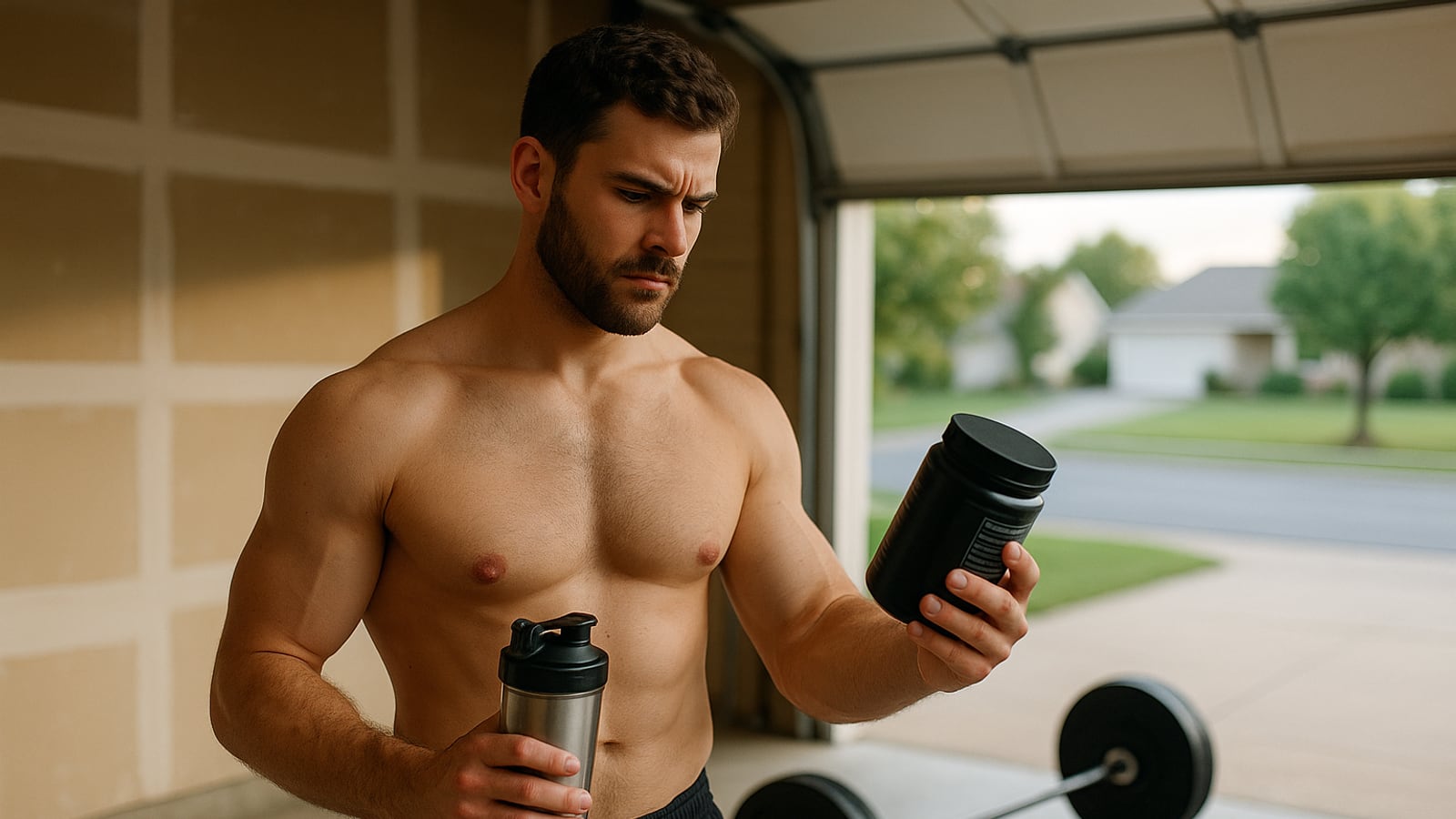
If your pre-workout has stopped doing much, the fix isn't a stronger one. It's less of the one you've got, for about two weeks.
That's the whole answer. The rest of this is why, and how to do it without wrecking the only training window you have.
The scoop is bigger than you think
Most pre-workout formulas are built around caffeine. Everything else in there — the citrulline for blood flow, the beta-alanine that makes your face tingle, the electrolytes, the flavoring — is supporting cast. Caffeine is the act you paid for.
Look at the label. A single serving in a mainstream product usually lands somewhere between 150 and 400 mg of caffeine. A strong cup of coffee is a fraction of the top end. So when you take a scoop and a half because one stopped hitting, you may be taking more caffeine in one shaker than most people drink in a day.
Then check whether the label lists caffeine by the milligram or hides it inside a "proprietary blend." If it's a blend, you don't know your dose. That alone is a reason to switch products. You can't manage a number you can't see.
Two other things worth spotting. Some formulas stack caffeine with other stimulants, which means the label's caffeine figure understates the total load. And some list caffeine anhydrous plus a second, slower-release form, which stretches the effect further into your evening than you'd expect.
U.S. regulators have long used 400 mg a day as a figure not generally associated with harmful effects in healthy adults. That's a population-level guide, not a personal prescription. Plenty of people feel awful well below it. If you're on medication, pregnant, or managing blood pressure or a heart condition, the number to work from is the one your doctor or pharmacist gives you, not the one on a tub.
Tolerance is the reason the scoop kept growing
Caffeine works mostly by blocking adenosine, the molecule that builds up across the day and makes you feel like sitting down. Block the signal and you feel sharper. You haven't added energy. You've muted the message.
Take that away every day and the body adjusts. It adds receptors. Now the same dose blocks a smaller share of a bigger system, and you need more to get the same lift. That's tolerance, and it builds fast — weeks, not years.
The tell is specific. You're not getting the buzz anymore, but you absolutely notice when you skip it. That's the signature of a habit that's moved from performance to maintenance. You're no longer training better. You're just avoiding feeling worse.
The crash is three things wearing one coat
People describe "the pre-workout crash" like it's a single event. It's usually a pile-up.
Adenosine catching up. The signal didn't stop while you were blocking it. It kept accumulating. When the caffeine clears, all of it arrives at once. That's the 3 p.m. wall that feels heavier than plain tiredness.
Sugar, if your product has it. A lot of the sweeter, cheaper formulas carry real carbohydrate. Fast up, fast down, especially on an empty stomach at 5 a.m.
Not eating. This is the big one for parents. You got up early, took the scoop, trained, showered, handled the school run, and by the time anyone fed you it was half past nine. The crash you blamed on the supplement was partly a four-hour fast with a workout in the middle of it.
Dehydration piles on top. Caffeine is mildly diuretic, you sweated, and you probably drank less than you think.
The half-life problem, and the 4 p.m. trap
Caffeine's half-life in most healthy adults is often cited as around five hours, with a wide spread between individuals — genetics, liver enzymes, some medications, and pregnancy all move it substantially.
Do the arithmetic on a 300 mg scoop at 4 p.m. Around 150 mg is still circulating at 9 p.m. Roughly 75 mg at 2 a.m. That's a coffee's worth of caffeine sitting in your system while you're trying to get the deep sleep that makes yesterday's training count for anything.
And here's the trap. You sleep badly, so you're wrecked the next afternoon, so you take the scoop again to get through the session, which wrecks the next night. Three weeks in you're training on fumes and calling it discipline.
If you train in the evening and you have kids, the evening scoop is the first thing to cut. Not negotiate — cut.
How to reset without losing the habit
Two options. Both work.
The taper. Halve your dose for four or five days. Halve it again. Then go to none for about a week. Slower, far fewer headaches, and easier to hold together when you can't afford three bad days at work.
The cold stop. Two weeks, nothing. Expect a headache on days one through three, a foggy patch around day two, and genuinely better sleep by the end of week one. Do it starting on a Friday if your job has any give in it.
During the reset, don't stop training. Drop the load, keep the schedule. Two or three sessions a week at seventy percent of your usual weights, full reps, no grinding. The point is to prove to yourself that the session happens without the scoop. It does. It's just less exciting.
When you come back, come back at half a serving, and treat it as equipment rather than breakfast. Twice a week, on the two sessions that matter most. Nothing after lunch if you value your sleep at all.
What to do on the other days
The unglamorous stuff outperforms the tub, which is exactly why nobody sells it.
- Eat something first. A banana and a handful of nuts beats an empty stomach and 300 mg of caffeine. If you train fasted and like it, eat immediately after, not two hours later.
- Drink 400 to 500 ml of water before you start. Most morning "no energy" is mild dehydration after seven hours without a drink.
- Warm up long enough to change your mind. Five to eight minutes of easy movement and two light sets produces most of what people credit to stimulants. Motivation tends to arrive after you start, not before.
- Move the session, not the dose. If 5:30 a.m. genuinely isn't working, a twenty-five minute lunchtime session you actually do beats an hour you keep missing.
- Guard sleep like it's a training variable. Because it's. Everything gets harder on six hours, and caffeine hides that fact without fixing it.
The line worth holding
Caffeine is a real, legitimate performance tool. It's cheap, it's well understood, and used properly it makes hard sessions feel manageable. There's nothing virtuous about refusing it.
What you want to avoid is the slide from tool to crutch to cost. The tool makes a good session better. The crutch props up a schedule that's already broken. The cost is your sleep, your afternoon patience, and the tone you use with your kids at six o'clock when the adenosine lands.
Check the label tonight. Find the milligram number. If you can't find one, that's your first decision made.
If you've got a heart condition, high blood pressure, an anxiety disorder, or you're taking prescription medication, run the caffeine question past your doctor or pharmacist before you change anything. It interacts with more things than most people realize.
The scoop was never the reason you showed up. You were.
Cal Brennan
Fitness
Strength coach. Trains fathers, tradesmen and desk workers, which means programmes that survive a bad week.

Watch
Worth an hour of your evening
More from Fitness.
From channels we rate. Plays on YouTube.
Read next