

A damp hose fitting is the warning you get for free
A power steering hose rarely bursts without notice. It sweats at the fitting for months first, and a flashlight and a paper towel will catch it.
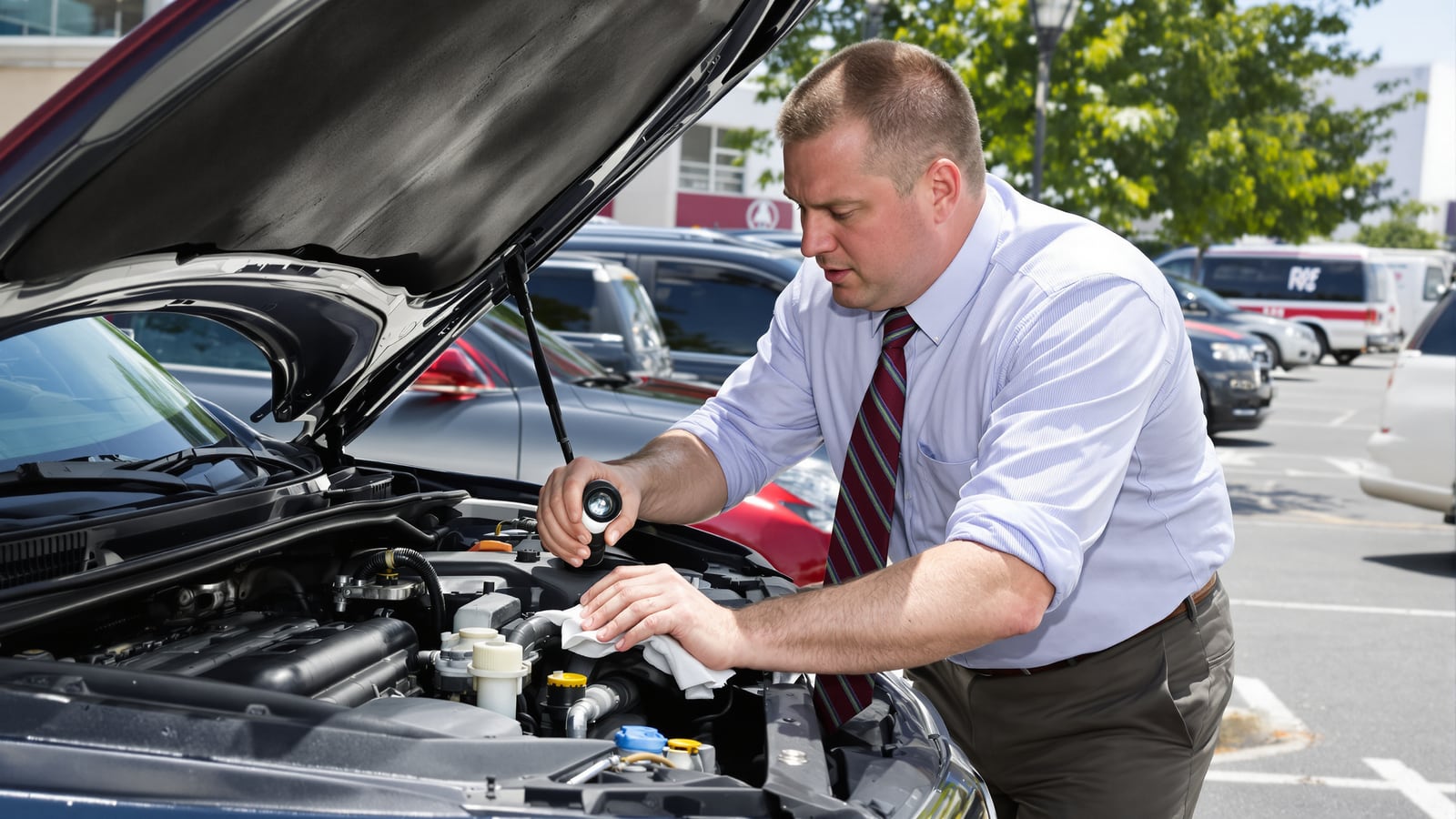
Quick answer: Wipe the ends of your power steering hoses with a paper towel. If one comes away wet, or the metal collar is caked in dark, dusty grime, replace that hose now. Don't just top off the fluid and hope.
What the leak looks like
It's never dramatic. You won't see a puddle. You'll see a hose end that looks a little greasier than the one next to it, with a crust of road dust stuck to it like felt.
That crust is the tell. Power steering fluid seeps out slowly, and dust sticks to it. Over a few months the seep builds a dark, tacky rim around the crimped metal collar where the rubber meets the fitting. That collar is the weak point on almost every hose. Rubber ages from the inside, the crimp loosens a hair, and the high-pressure side pushes fluid past it a drop at a time.
The pressure hose runs from the pump to the steering rack or gearbox, and the pressure inside it's often well over a thousand psi. A weep at that end is a hose telling you its grip is going. When it lets go, it doesn't leak. It sprays.
Check it in five minutes
Do this cold, with the engine off, on level ground. Pop the hood and grab a flashlight and a clean paper towel.
- Find the reservoir. It's a small plastic or metal tank near the pump, usually with a cap marked with a steering wheel symbol or the words "power steering." Two hoses run from the pump area. One is thick and stiff with a metal fitting. That's the pressure line. The other is softer and usually held by clamps. That's the return.
- Wipe, don't just look. Run the towel around each hose end and fitting. Dry means good. Damp, or a dark smear, means the hose is seeping.
- Look underneath. Slide a piece of cardboard under the front of the car overnight. A drip pattern near the pump or the rack tells you which end to chase.
- Read the fluid. Check the level against the hot and cold marks on the cap or tank. Fluid should be clean and fairly clear, depending on type. Dark brown, burnt-smelling or foamy fluid means air is getting in or the system is overdue for service.
- Listen on a cold start. Turn the wheel lock to lock with the car parked. A groan or whine, especially in the morning, means the pump is starving.
A newer car may not have any of this. Many current models use electric power steering, with no hoses, no fluid and no pump. Your owner's manual will say in one line. If there's no reservoir under the hood, skip this piece and keep your oil changes on schedule.
Why topping off is a trap
It's tempting. The level's a little low, so you add half a bottle, the whine goes away and life goes on. And on a car with a slow, old seep from a low-pressure return line, a quart in the trunk really can buy you some weeks.
But the pump is the expensive part of this system, and it lives on that fluid. Run it low and it chews itself up. It also overheats the fluid that's left. You're trading a modest hose for a pump, and sometimes a rack.
Use the right fluid too. Some systems want dedicated power steering fluid, some call for a specific automatic transmission fluid, and some Honda and European systems want their own spec. Guessing is how seals get ruined. The cap or the owner's manual tells you which. Read it before you pour.
What happens when one goes on the highway
Say you're doing seventy and the pressure hose splits. You'll hear a hiss or a bang, then feel the wheel go heavy in your hands. The steering still works. You've lost the assist, not the connection, and that's the part people panic over.
- Grip with both hands. It'll take real arm to hold a lane. Don't let go.
- Ease off the gas. Don't stab the brake. Let the car slow itself and keep the nose pointed straight.
- Signal and drift to the shoulder. Wide, gentle turns. A tight corner at speed is hard work with no assist.
- Shut the engine off once you've stopped. The pump has no fluid, and fluid sprayed onto a hot exhaust manifold can smoke and, in the worst case, catch.
- Don't drive it further. Not even to the next exit. Get it towed.
You can handle all of that. You'd rather never have to.
The fix, and what it costs you
A hose end that's weeping can't be repaired. The crimp is factory-pressed, and no clamp will save it. The hose gets replaced, and on the pressure side that usually means a complete assembly with the right fittings for your car.
The return line is a friendlier job. It's low-pressure rubber hose on barbed fittings with clamps, and if you own basic hand tools it's an afternoon. The pressure line is doable too, but it takes more patience. The fittings are tight, there are crush washers or O-rings to replace, and the system needs bleeding afterward so you're not running air through the pump.
If that's more than you want to take on, any competent independent shop does it routinely. The labor isn't heavy. The part and the fluid are the main cost, and both are small next to a pump. Get a quote for the hose and a fluid flush together, since fluid that's been seeping for a year is usually tired anyway.
Whatever you do:
- Replace the O-rings or crush washers that come with the new hose. Don't reuse the old ones.
- Bleed the system per your manual. Usually that's turning the wheel lock to lock with the engine off, then running it and repeating.
- Recheck the level after the first drive and again a week later.
- Take the old fluid to an auto parts store. Most take used fluid for free. Don't pour it on the ground or down a drain.
Wipe it again in a month
After the new hose is on, wipe the ends again in a few weeks. A fresh hose that weeps usually means a fitting wasn't seated or a washer was skipped. Better to find that in your driveway than at mile marker 211.
Make this part of a routine, not a one-off. It fits in the same twenty minutes as the engine-off checks that tell you most of what you need to know. It also belongs on the list of servicing that can't wait, because a few dollars of rubber is cheap next to what it protects. And it's the kind of unglamorous habit behind every car that reaches 250,000 miles.
A hose that's damp today is a tow truck waiting for a better day. Pay for the hose while it's still your idea.
Dean Shaw
Gear & Garage
Reads the warranty, the parts list and the long-term owner reviews before anything else. Trucks, tools, watches, and the cheap version that costs more.

Watch
Watch how it's done
Picked for this article.
From channels we rate. Plays on YouTube.
1A Auto: Repair Tips & Secrets Only Mechanics Know
Smelly Puddle Under My Car or Truck? How to Diagnose Power Steering Leak
Scotty Kilmer
How to Find Power Steering Leak in Your Car (Hose Replacement)
Read next