

The oil spot on your driveway is a bill with a due date
A few drops overnight feels harmless. Here's how to read the stain, check the one thing that matters, and decide what's worth fixing.
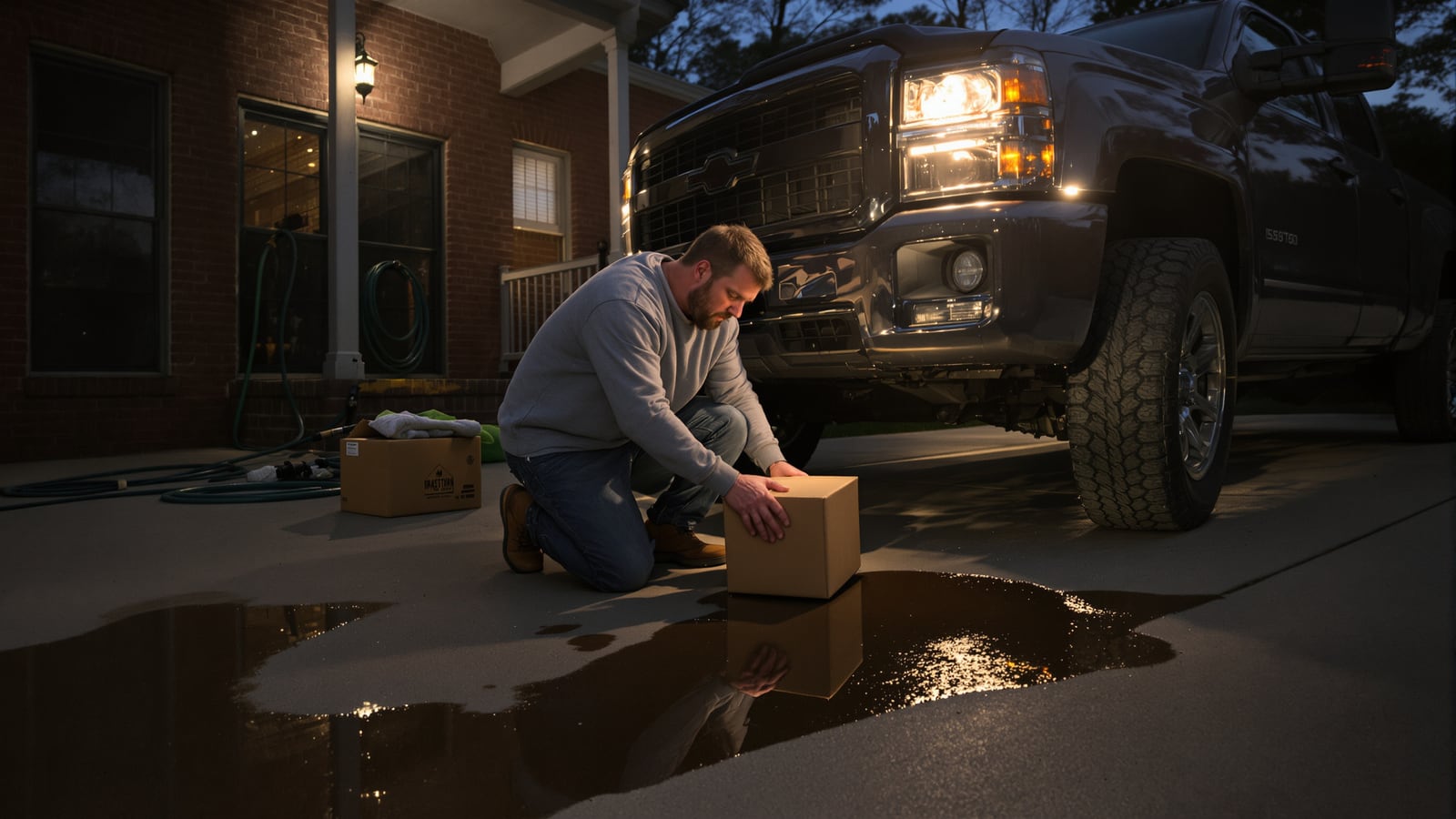
Quick answer: The leak isn't what kills the engine. Running low on oil is. Slide a piece of cardboard under the car tonight, check the dipstick tomorrow, and you'll know whether you have a Saturday project or a tow truck waiting to happen.
The stain is a message
Most people see a spot, feel a small pang of guilt, and park somewhere else. That's the expensive response.
Engine oil on a driveway is brown to black and slick, and it doesn't evaporate. Fresh oil is amber. Old oil is the color of strong coffee. Before you blame the engine, rule out the look-alikes:
- Red or pink and thin: transmission or power steering fluid.
- Green, orange or sweet-smelling: coolant.
- Clear and watery under the front passenger side: air conditioning condensation. Normal.
- Brown, thick, and smelling like a garage: engine oil.
Where it lands tells you where to look. A spot under the front of the engine points toward the front seal, the oil pan or the valve cover. A spot in the middle often means the oil filter, the drain plug or the pan gasket. A drip between the engine and the transmission is the one you don't want, and I'll get to why.
Do the cardboard test
Slide a flattened box under the engine overnight. In the morning you've got a map.
Measure the spot. A dime-sized mark means a slow seep. A saucer-sized one means a drip. If you find a puddle or a trail, you have a leak that needs attention this week, not this season.
Also look at the pattern. Fresh, wet drops under the car mean it's leaking now. A dull, dusty film on the engine itself means it's been weeping for a while and collecting dirt. Both are information.
Check the level, not the spot
Here's where most people get it backwards. The size of the stain tells you very little about how much oil you're losing. The dipstick tells you everything.
Park on level ground. Shut the engine off and give it five minutes so the oil drains back to the pan. Pull the dipstick, wipe it on a clean rag, push it all the way in, and pull it again. The oil should sit between the two marks. Most engines hold four to six quarts, and the gap between those marks is usually about a quart.
If you're at the low mark, add a quart now. Don't overfill, since too much oil causes its own trouble. Then check it again in a week.
A car that loses a quart every few thousand miles is a car you can live with, as long as you actually check. A car that loses a quart every few hundred is bleeding. And a car whose owner never opens the hood is gambling.
What running low actually does
Oil is a film between metal parts moving at thousands of revolutions a minute. Take enough of it away and that film thins out, the parts touch, and the damage is permanent. Bearings wear. Heat climbs. On a bad day the engine seizes and you're shopping for a replacement.
If the oil pressure light comes on, don't finish the drive. Pull over where it's safe, shut the engine off, and get the car checked or towed. That light isn't a suggestion.
An engine usually dies from the slow version of this: a leak nobody measured, a level nobody checked, a trip that ran a quart too long. It doesn't have to go that way.
The damage the oil does outside the engine
Oil doesn't stay where it falls. It runs down onto things that weren't built for it.
Rubber hoses and engine mounts soften and swell when they sit in oil. A drive belt coated in it slips and wears out early. Oil dripping onto a hot exhaust manifold smokes, smells, and in the worst case can catch fire. That's rare, but it's the reason a leak onto the exhaust deserves attention sooner than a leak onto the pan.
And it's hard on the people around you. Oil soaks into concrete and asphalt, and it gets tracked into the house on shoes. If it's your landlord's driveway, your neighbor's curb or a friend's garage, it's on you to clean it up.
What it costs to fix, and why the price swings
I won't quote you a number, because it depends on the engine and the shop. But the pattern holds.
The part is almost never the expensive piece. The labor is. A valve cover gasket sits on top of the engine where you can reach it, so it's often a cheap fix, and a patient owner with basic tools can do it. An oil filter that was installed badly, or a drain plug with a worn washer, costs next to nothing and takes ten minutes.
Then there's the rear main seal, down at the back of the engine where it meets the transmission. The seal itself is cheap. Getting to it means pulling the transmission, and that's where the bill climbs. Don't fix it on a hunch, and don't pay for it until a mechanic you trust has confirmed it's the source.
Get a written estimate. Ask which gasket or seal, and ask what else they'd replace while they're in there. A good shop will tell you plainly whether it's worth doing on a car with this many miles. If you're trying to stretch a car a long way, the 250,000-mile piece covers where oil work sits in the order of things.
Which leaks can wait, and which can't
Not every leak deserves a weekend. A sensible way to sort them:
- Wait and watch: a seep that leaves the engine damp and dusty, with a dipstick that stays in range between oil changes. Check it every other fill-up.
- Schedule soon: a steady drip, a quart gone between changes, or oil that shows up on the belt or the hoses.
- Stop driving: a puddle, a low-oil warning, a burning smell, smoke from under the hood, or any oil pressure light.
That middle category matters. If you're juggling repairs, the guide to servicing that can't wait will help you rank this one against everything else on the list.
If you're the one buying
A fresh puddle is easy to spot. A hidden leak is the one that costs you. Sellers know it, and some will steam-clean an engine before you arrive. A spotless engine on a car with high miles should make you suspicious, not happy.
Look underneath for fresh wetness. Check the dipstick and the oil's color. Look for oil residue on the bottom of the engine and on the belts. The pre-purchase checklist walks through the full list, and an hour with a mechanic before you hand over cash is cheaper than inheriting somebody else's seal job.
Clean it up like you'd want it left for you
Whatever you decide about the repair, handle the stain. Cover a fresh spot with cat litter and let it sit for a few hours. Sweep it up and dispose of it as the label directs. Scrub what's left with dish soap and a stiff brush. Old oil that's already soaked in will take several rounds. Don't hose it into the street or down a storm drain.
Leave the pavement cleaner than you found it. It's the same rule you follow when you return a borrowed truck with a full tank.
Then go put the cardboard down.
Dean Shaw
Gear & Garage
Reads the warranty, the parts list and the long-term owner reviews before anything else. Trucks, tools, watches, and the cheap version that costs more.

Watch
Worth an hour of your evening
More from Cars.
From channels we rate. Plays on YouTube.
Read next