

A block heater earns its cord below about 10 degrees
Plug it in for the wrong reasons and you're just paying the power company. Here's where a block heater saves your engine, and where it doesn't.
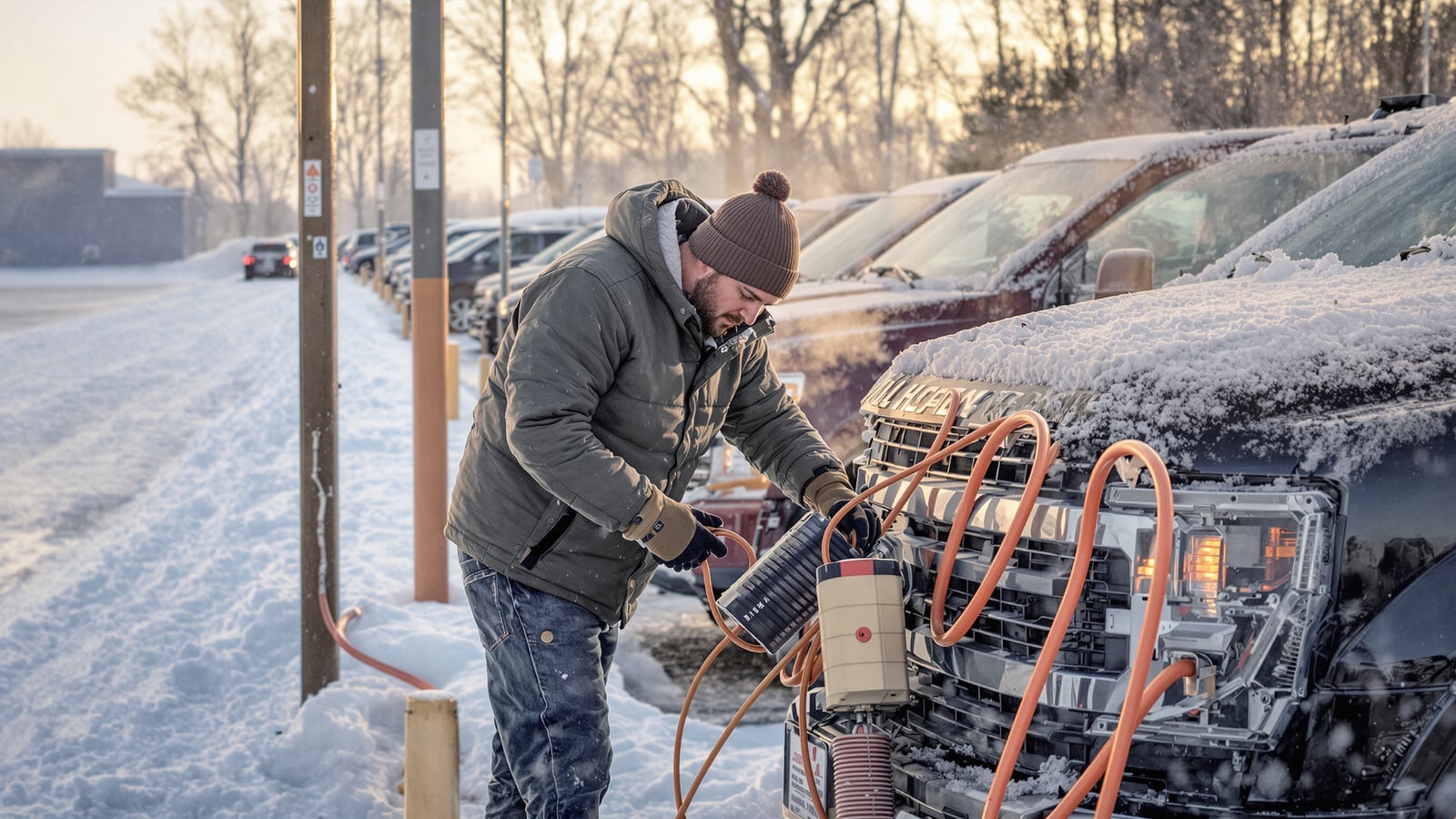
Quick answer: If your winter mornings sit above 20°F, skip it. Between 20°F and 0°F it's a comfort and a small fuel saver. Below about 10°F, and anywhere near zero with a diesel, it's cheap protection. Put it on a timer either way.
What a block heater does
It's a small electric heating element, usually sitting in the engine block where a freeze plug would be, and it warms the coolant. That's all. Most draw somewhere between 400 and 1,500 watts, and your owner's manual lists yours.
It doesn't heat the oil directly. Warm coolant soaks into the block and heads, and the oil warms with it. The engine starts at something closer to a mild fall day than a January night.
Where the wear happens
Cold-start wear comes from the first few seconds. Oil is thick and slow to reach the top of the engine. The computer also runs the mixture rich on a cold start, and the extra fuel can wash oil off the cylinder walls just when they need it most.
A warm block thins the oil sooner and lets the mixture lean out sooner. Less fuel washes the walls, and the starter doesn't have to drag cold, stiff internals around.
That's the real case. It's also why the benefit is lopsided. At 35°F a modern engine on the right oil barely notices. At minus 10°F it notices a great deal.
Your climate, in three bands
Treat these as rough guides. Your manual's number wins. Some manufacturers name a temperature to start plugging in, and it's commonly somewhere between 0°F and 20°F.
Above 20°F. Leave the cord coiled. A gas engine with fresh, correct-grade synthetic oil and a healthy battery starts fine. Spending electricity here buys you almost nothing.
20°F down to about 5°F. This is the gray zone, and it's honestly a comfort call. You'll get heat out of the vents faster and burn less fuel idling at the curb. Wear savings exist but they're modest on a modern gas engine. Plug in on the coldest nights and skip the rest.
Below about 5°F, or any sustained cold snap. Use it. This is where oil gets stiff, batteries lose a lot of their punch, and a cold engine labors through its first minute. If you drive a diesel, move every one of those numbers up. Diesels are harder to start cold, and fuel can start to gel in deep cold. A block heater helps with the first problem. Winter-blend fuel handles the second.
What it costs to run
Do the math yourself. A 1,000-watt heater running four hours uses 4 kilowatt-hours. At 15 cents a kilowatt-hour, that's 60 cents a night. Check your own rate on your bill.
The mistake is plugging in at dusk and leaving it all night, every night. After about two to four hours the block is mostly as warm as it's going to get. The extra hours cost money and add almost nothing. A $10 outdoor timer set to switch on two or three hours before you leave fixes that. If you leave at 6:30 a.m., set it for 4:00.
Remote start is not the same thing
Remote start warms the cabin, not the engine, and it does it by running the engine cold, rich and idling. An engine at idle warms slowly, and the cold-start conditions you were trying to avoid drag on for minutes. Plenty of people feel they've done right by the truck because they started it ten minutes early. They've mostly spent gas.
The two work well together. Block heater first, remote start second. Then the engine is already warm when it fires, and the heater has something real to blow.
The cord is where people get hurt
Four things go wrong more than anything else.
- Driving off while plugged in. It's an easy way to rip out a socket or damage the cord. Hang the cord over the mirror or lay it across the steering wheel when you plug in. You can't leave without handling it.
- The wrong extension cord. Use a heavy-gauge outdoor-rated cord, as short as you can manage. A 16-gauge lamp cord running a 1,000-watt heater is asking for trouble. Don't daisy-chain two together.
- A cracked or frayed cord. Look at it before the first cold snap, not during. Replace it if the jacket is split or the prongs are bent.
- The outlet. Use a grounded outdoor outlet with a GFCI. If the breaker trips, don't keep resetting it. Figure out why.
One more from the garage floor. Mice like the warm engine bay, and they like chewing wiring. When you unplug, coil the cord and tuck it away from the grille.
What it won't fix
A block heater won't rescue a weak battery. Cold cuts battery capacity, and an old one that barely gets by in October will quit in January. Have it tested before the cold arrives. Most parts stores do it free.
It won't fix the wrong oil either. Check the manual for the winter grade. Most newer engines call for something thin like 0W-20 or 5W-30, which flows far better cold than a heavy grade would.
And it won't do anything for a car that's already sluggish because it's overdue for service. The servicing that can't wait matters more than any accessory. If you're after the long game, what it takes to reach 250,000 miles is mostly the boring stuff, and cold-start care is part of it.
Installing one
Many trucks, and plenty of cars sold in cold states, already have a factory cord tucked behind the grille. Look before you buy anything. Check the front bumper and grille for a plug end, and ask the dealer or look up your VIN if it isn't obvious.
If you don't have one, a shop can install an aftermarket block heater. It's usually a straightforward job, though it varies by engine, and you'll want a quote. Some engines don't suit a freeze-plug heater and use an in-hose or oil-pan unit instead. Pay a mechanic who has done your engine before.
If you'd rather not open the engine up, a battery blanket or an oil-pan heater helps a little, and those pad-on options are easy to fit. They don't warm the whole engine the way a block heater does.
The rule to carry into winter
Know your manual's number, put the cord on a timer, and buy a good outdoor extension cord once. Then leave that truck in a driveway at five below, hear it catch on the first turn, and drive off with the heat already coming. A winter kit in the trunk is the other half of the deal, and this list covers it.
Neighbors who plug in at 9 p.m. and leave it until noon are donating money. Be the one who plugs in at 4 a.m. on a timer and keeps the dollar.
Dean Shaw
Gear & Garage
Reads the warranty, the parts list and the long-term owner reviews before anything else. Trucks, tools, watches, and the cheap version that costs more.

Watch
Worth an hour of your evening
More from Cars.
From channels we rate. Plays on YouTube.
Read next