

The squeeze test that catches a bad radiator hose early
A radiator hose gives you warning before it fails. Five minutes with a cold engine and your bare hands will tell you whether it's time.
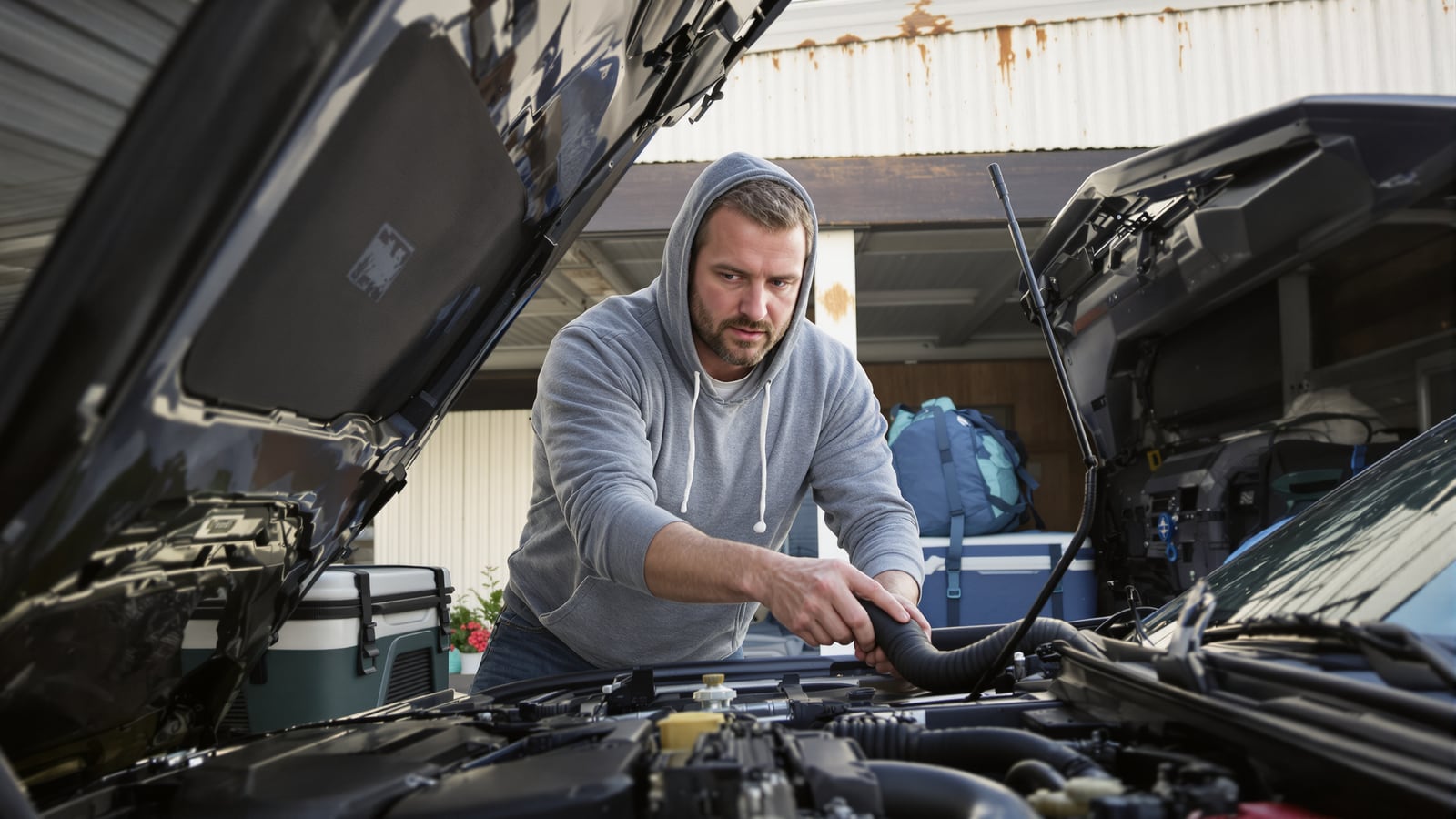
Quick answer: With the engine cold, squeeze the big upper and lower radiator hoses. They should feel firm but give a little. If one is mushy, rock hard, cracked, bulging or crusty at the ends, replace it this week, not this summer.
A radiator hose doesn't pick a convenient time. It picks 75 mph in the left lane, a hot July afternoon, or a boat ramp line with the trailer behind you. Steam rolls out from under the hood. The temperature needle slams to the red. Within a minute or two, a cheap rubber part has become an engine problem.
The good news is that hoses almost always telegraph it. You just have to put your hands on them.
Why a hose gives out
The hose carries coolant that runs hot, under pressure, for years. Heat bakes the rubber from the outside. Coolant works on it from the inside. Engine vibration and the flex of every start and stop wear on it at the ends.
Here's the annoying part. A hose can look perfect and still be failing. Rubber hoses can break down from the inside out, with the damage hidden under a smooth surface. That's why you can't just glance at one and call it good. You have to feel it.
The cold squeeze test
Do this with the engine completely cold. Not "off for ten minutes." Overnight cold. Pressurized coolant at operating temperature can scald you badly, and the radiator cap is not something to touch on a warm engine.
Pop the hood and find the two fat hoses on the radiator. One runs from the top of the radiator to the engine. The other runs from the bottom. Squeeze each one in the middle, then near both ends.
A healthy hose feels firm and springy. It gives under your grip and pushes back.
A weakening hose feels wrong in one of these ways:
- Soft or spongy. It collapses easily and feels like it's lost its structure. The rubber is breaking down inside.
- Hard and crunchy. It feels like a dried-out garden hose, or you hear a faint crackle when you squeeze. It's baked and brittle.
- Swollen. A bulge or balloon, usually near an end, means the inner layers are failing and the outer skin is all that's holding.
- Cracked. Look for fine cracks on the surface, especially on the bends where the rubber flexes most.
Then check the lower hose with an extra step. Some lower hoses have a coil of wire inside to keep them from collapsing under suction. If the hose looks pinched or flattened when the engine is running, that's a problem a cold squeeze can miss.
Read the ends
Most leaks start where the hose meets the fitting, not in the middle. Shine a flashlight at both clamps on each hose.
You're looking for a crust. Dried coolant leaves a residue, usually white, green, pink or orange depending on what's in your system, and it gathers around a slow seep. A damp ring at the clamp, a stain on the radiator tank, or drips on the ground under the front of the car all say the same thing. The hose or its connection is leaking now, just slowly.
Also check the clamps themselves. A rusted or loose clamp is its own warning. If a hose end can twist freely on its fitting, it won't hold when pressure builds.
Don't forget the smaller heater hoses running to the firewall. They're easy to overlook and they fail the same way.
Signs you'll notice while driving
Sometimes the car tells you before you look.
- A sweet, syrupy smell after you park. That's coolant, and it's hitting something hot.
- The coolant reservoir needing a top-off more than once. Coolant doesn't evaporate in a closed system. It's going somewhere.
- A temperature gauge that creeps higher than normal in traffic or on a hill.
- A heater that blows cool air when it should be hot.
Any one of those deserves a look under the hood the same day. If you've got a low-coolant warning light, treat it as a real warning, not a suggestion.
If one blows on the road
Don't try to limp it home. Driving on a failed hose can destroy an engine fast, and a hose is a small bill next to a warped cylinder head.
- Turn on the heater full blast as you pull over. It's an old trick that pulls a bit of heat off the engine while you find a safe spot.
- Get off the road completely. Put it in park, set the brake and shut it off.
- Get everyone out and away from traffic if you're on a busy shoulder.
- Don't open the hood right away and never open the radiator cap. Steam and scalding coolant can come out hard. Give it a good half hour or more to cool.
- Call a tow. A roadside plan on your insurance or through a membership pays for itself on a day like this.
Coolant also tastes sweet and is dangerous to pets and kids. If a puddle forms, keep animals away from it and rinse it down when you can.
Replacing one without making it worse
A hose swap is one of the more doable jobs for a guy with basic tools and a free Saturday morning. You drain some coolant, loosen the clamps, pull the old hose, fit the new one and refill. The part usually costs far less than the tow.
A few notes that save grief:
- Replace the pair. If the upper hose is tired, the lower one is the same age and has done the same work.
- Replace the clamps while you're in there, especially if they're rusty.
- Use the coolant your owner's manual calls for. Mixing types is how you end up with gunk in the system.
- Bleed the air out afterward as the manual directs. Trapped air causes overheating that makes you think you did it wrong.
- Catch the old coolant in a pan and take it to a recycling center or an auto parts store that accepts it. Don't pour it in the yard or down a drain.
If any of that sounds like too much, hand it to a shop. Ask them to look at the hoses at your next oil change. It's a short look, and a good mechanic will tell you honestly if they're fine. It's the same kind of job that sits on the list in the car servicing that can't wait.
Make it a habit
Put a cold squeeze on your calendar twice a year, before summer heat and before winter. It takes five minutes and it's easy to pair with the other checks in twenty minutes with the engine off. It's also exactly the kind of small, boring attention that separates cars that die at 120,000 from cars that make it past 250,000.
And if you're borrowing a truck from a friend, or lending yours, give the hoses a squeeze before the keys change hands. Better to find out in the driveway than on the shoulder.
Dean Shaw
Gear & Garage
Reads the warranty, the parts list and the long-term owner reviews before anything else. Trucks, tools, watches, and the cheap version that costs more.

Watch
Worth an hour of your evening
More from Cars.
From channels we rate. Plays on YouTube.
Read next