

The thirty-second dipstick check that saves an engine
Most people check oil wrong, on a slope, at the wrong time, reading the wrong mark. Here's how to do it right, and what to do when the level's low.
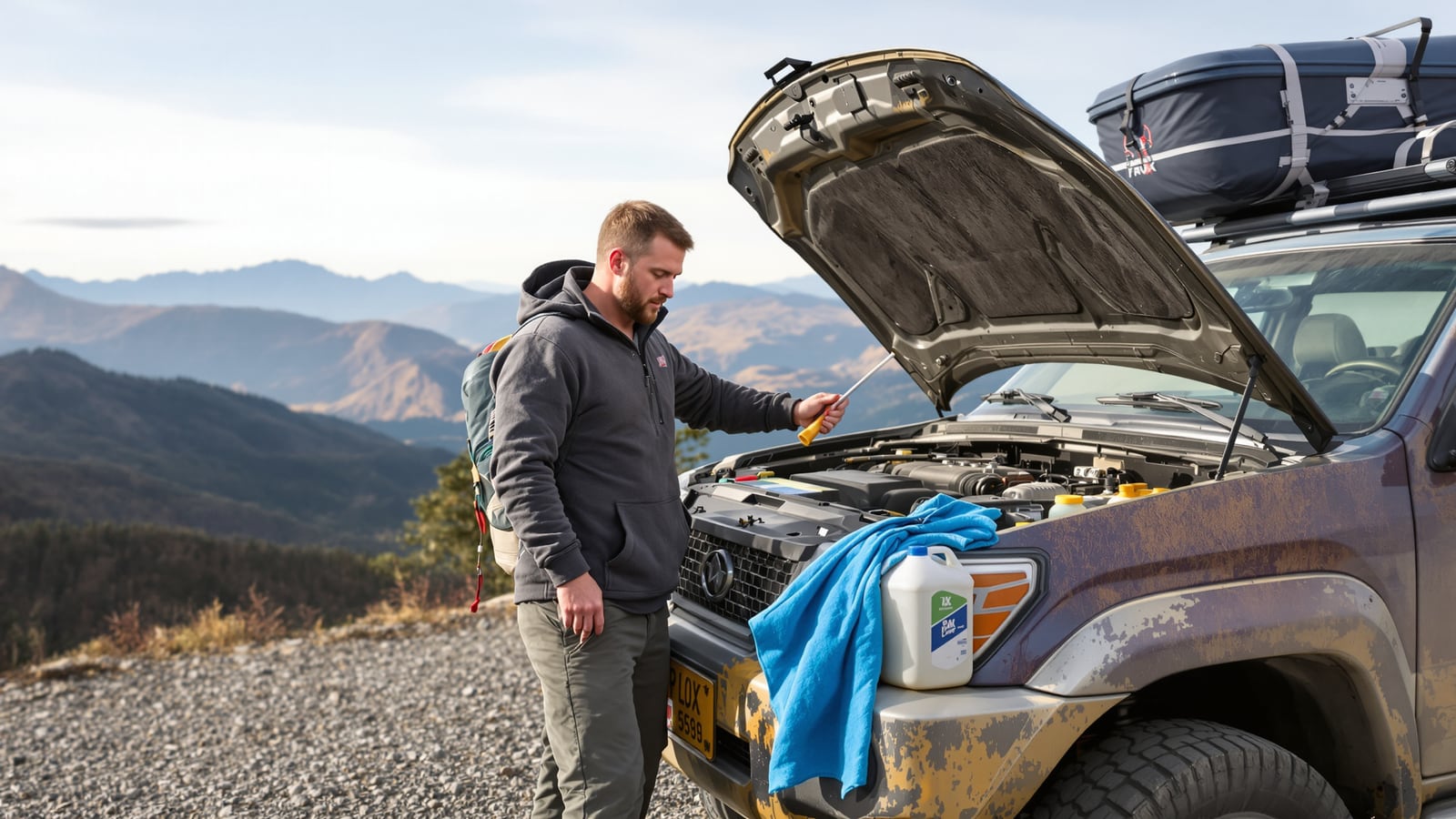
Quick answer: Park on level ground, let the engine sit a few minutes after it's been running, wipe the dipstick, push it all the way in, pull it, and read it. Be at or near the top mark, never below the bottom one. Do it every other fill-up and before any long drive.
Your oil light isn't a gauge. People treat it like one, and that's how engines die.
That light is a pressure warning. By the time it comes on, the oil is already low enough that the pump is struggling to move it. Rod and main bearings ride on a thin film of pressurized oil, and the metal never touches the metal. Lose that film for even a short stretch and the bearing starts to wear. Drive on it and it spins or seizes. You'll hear a deep knock from the bottom of the engine, and that's a repair bill that usually costs more than the car's worth.
A dipstick check takes thirty seconds and catches it weeks earlier.
Why a low level is so dangerous
The oil pan holds a fixed amount, and the pump pulls from a pickup tube near the bottom. When the level drops far enough, hard braking, a steep downhill or a tight corner can slosh the oil away from the pickup. The pump grabs air for a moment, pressure collapses, and the bearings run dry. You might never see a light flicker. You'd just have a bearing that's a little more worn than it was yesterday.
Do that enough times and one day it finishes the job.
Engines that burn oil between changes are the most exposed. Plenty of healthy, high-mileage engines use a quart every thousand miles or so. That's not a disaster. It becomes one when the owner doesn't know and trusts the sticker on the windshield. If you've got a few years on your odometer, this check matters more for you than for the guy with a new car.
How to read it right
Most bad readings come from sloppy habits, not a bad dipstick.
- Level ground. A driveway with a slope can shift the reading by a visible amount. Use a flat spot.
- Wait a few minutes. Oil needs time to drain back into the pan after the engine shuts off. Pull the stick right away and you'll see a falsely low level. Five to ten minutes is the usual advice for a warm engine. A few makers specify a cold engine instead, so check your owner's manual for yours.
- Wipe, reinsert, then read. The first pull is only there to clean the stick. Wipe it with a clean rag or paper towel, push it in until it seats fully, pull it again and read it.
- Read both sides. Oil can cling to one face and look different from the other. Take the lower of the two readings.
- Hold it level. Tilt it and the oil runs along the stick and fools you.
On most engines the space between the two marks is about a quart, but it isn't universal, so check your own manual instead of assuming. If the oil sits at the bottom mark, you're about a quart down. If it's below the stick altogether, don't start the engine. Add oil first.
Look at the oil, not just the level
Rub a drop between your fingers while you're at it.
Fresh oil is amber. Dark is normal for oil that's been working, and dark alone isn't a reason to panic. A few things are.
- Milky or foamy, like chocolate milk. Coolant is getting in, often from a failing head gasket. Stop driving and get it looked at.
- Gritty. That's contamination, and grit scrapes bearings the way sandpaper scrapes wood.
- A fuel smell. Gasoline is thinning the oil. A shop should look at it.
- Shiny metallic flecks. Parts are wearing. That's a mechanic's job, today.
Too much oil is a problem too
Fill past the top mark and the spinning crankshaft can whip the oil into foam. Foamy oil doesn't lubricate well and the pump has trouble with it. The fix is simple. If you overfilled, have the extra drained rather than hoping it burns off.
This is also why you add oil in small amounts. Pour in half a quart, wait a minute or two, then check again. Repeat until you're near the top mark. It's a patient job, and it keeps you from overshooting.
What to buy and what to carry
Use the viscosity grade and specification printed in your manual and on the filler cap, something like 5W-30. If you don't know what your engine takes, look it up before you buy. Don't guess in the aisle.
Keep one quart of that exact oil in the trunk, along with a clean rag and a small funnel. It costs almost nothing and it has saved more road trips than most people would believe. A quart in the trunk beats a ruined engine on a Sunday evening with every shop closed.
If the level's dropping fast between checks, the oil is going somewhere. A drip spot on the driveway, blue smoke from the tailpipe or a damp underside all point to a leak or a burn. Don't just keep topping it off for months. Have someone find the cause. The car servicing that can't wait is mostly the list of things like this, and there's a plain breakdown of which is which.
Some cars have no dipstick
A number of newer vehicles, especially some European ones, swap the stick for an electronic sensor and a menu on the dash. If that's yours, learn the procedure in the manual. It often needs the engine at temperature and the car level for a set time before the reading appears. Don't ignore it because it's buried in a submenu. It's the same check.
Make it a habit
Pick a trigger and stick to it. Every other time you fill the tank works. So does the first Saturday of the month. Before any trip over a couple hundred miles, check it every time.
When you borrow a vehicle, check the oil before you hand it back. If it's down, top it off. Same as returning it with a full tank and a wash. The owner may never know you did it, which is rather the point.
And if you've got a son or daughter learning to drive, make them do it with you once. Hand them the rag and let them find the marks themselves. A teenager who checks the oil on their own at sixteen has a head start on half the adults on the road. It's the same discipline that gets a car past a long odometer, which is covered in what it really takes to get a car past 250,000 miles, and it begins with a rag and a stick.
If you're shopping for a used car, pull the dipstick before you do anything else. A bone-dry stick on a car that's supposed to be "well cared for" tells you how the previous owner treated everything else. Twenty minutes with the engine off covers the rest of what to look at.
Go check yours now. It's thirty seconds, and you've got the rag in the garage.
Dean Shaw
Gear & Garage
Reads the warranty, the parts list and the long-term owner reviews before anything else. Trucks, tools, watches, and the cheap version that costs more.

Watch
Watch how it's done
Picked for this article.
From channels we rate. Plays on YouTube.
Backyard Chevy
How to Check Your Oil Level & Read Your Dipstick
Read next