

Check the transmission dipstick before you pay for a flush
A paper towel, a flashlight and ten minutes in the driveway will tell you whether the shop's transmission quote is honest, or at least worth a second opinion.
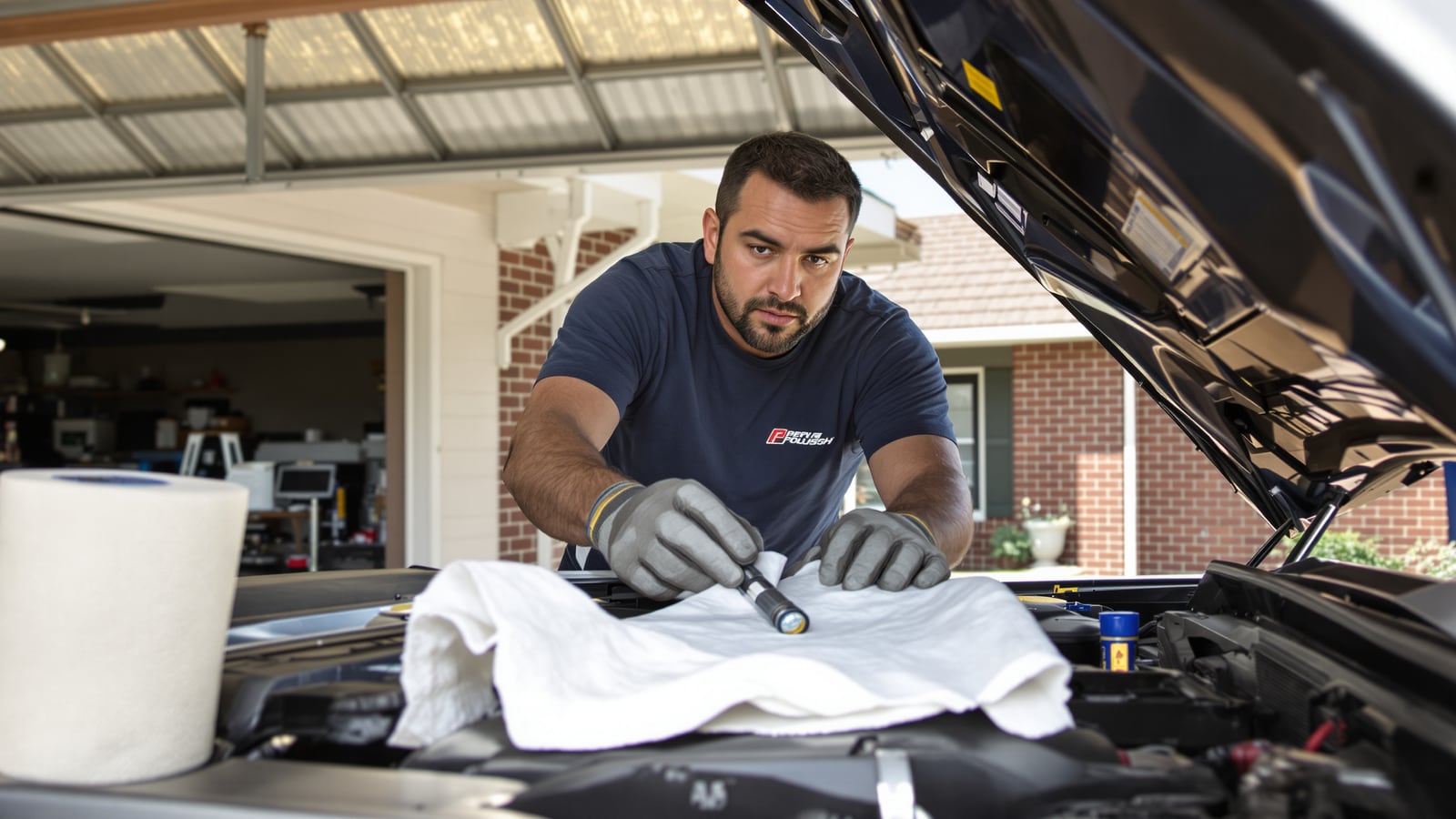
Quick answer: Warm the engine, park on level ground, pull the transmission dipstick and wipe it on a white paper towel. Bright red or pink fluid that doesn't smell is healthy. Dark brown with a burnt smell means it's overdue for service. Metal glitter or a milky look means stop and get it looked at properly.
A shop tells you the transmission needs a flush. Or it's "starting to go" and you're looking at a rebuild. You nod, because you can't see inside a transmission and the guy in the clean shirt can.
But on many cars you can see a good deal of it. The dipstick is a free second opinion, and it costs you a paper towel.
First, find out if you even have one
Plenty of newer cars don't. Automakers have sealed a lot of transmissions, and there's no dipstick, just a fill plug underneath the car. Check the owner's manual before you go hunting. If yours is sealed, the check is a shop job with a specific temperature procedure, and what follows below won't apply directly.
If you do have one, it's usually a red, orange or yellow handle toward the back of the engine bay. Rear-wheel-drive trucks and older sedans tend to make it easy. Some front-wheel-drive cars bury it behind other parts.
Do it right or the reading means nothing
Most of the bad information about this check comes from doing it wrong. Run through this first.
- Drive the car for ten to fifteen minutes. Fluid reads differently cold than at operating temperature.
- Park on level ground. A driveway with a slope will lie to you.
- Follow your manual on gear. Most cars want Park with the engine running. A few call for Neutral. Don't guess, because it's printed right there.
- Keep your hands and sleeves away from belts and the fan. The engine is running and hot.
- Pull the stick, wipe it clean, push it all the way back in, pull it again. The first pull is just a smeared mess.
Do that, then read it in daylight or under a flashlight.
Read the level, then the color
Most dipsticks have a hot range with a crosshatch or two marks. The fluid should sit inside it. Low usually means a leak somewhere, and that matters more than any flush. Look under the car where you park. A reddish spot on the pavement tells you something.
Too high is a problem too. Overfilled fluid can foam, and foamy fluid doesn't do its job. If somebody topped it off carelessly, that can be the whole story behind a rough shift.
Now the color. Wipe the dipstick across a white paper towel and give it a minute to spread.
Bright red or pink, clear, and mild smelling. This is what you want. A shop that says you need a rebuild with fluid like this had better have a real reason, like a shifting problem they can describe.
Light brown or amber. It's aging. That's normal at mileage and it's a decent time for a fluid service, but not an emergency.
Dark brown, opaque, with a burnt smell. Think burnt toast. The fluid has been cooked, and it's been working hard or overheating. A service is overdue. Whether it helps or whether the damage is already done is something nobody can tell from the driveway.
Milky or pink like a strawberry milkshake. Coolant is getting in, usually through the cooler inside the radiator. This is a real mechanical problem and the transmission can be ruined if it keeps running that way. Get it to a shop soon, and don't drive it far.
Glitter, metal flecks or a gray paste. Fine metallic shimmer means parts are wearing. Paste or sludge on the towel is often clutch material. A little fine dust is common over a long life. Visible chunks or a lot of glitter isn't.
The flush argument, and what to ask
Here's the part that surprises people. Mechanics honestly disagree about flushing a transmission that's never been serviced and is deep into high mileage. Some say fresh fluid on a neglected unit is just fine. Others have seen a transmission start slipping right after a service, and they blame the new fluid loosening debris. I don't think anybody has settled it, so don't let a shop tell you it's settled.
What you can do is ask questions. Is this a drain-and-fill or a machine flush? Which exact fluid goes in? Your manual specifies a type, and the wrong one is a real way to wreck shifting. How much of the fluid gets replaced? A drain-and-fill typically swaps out only part of it, so some shops do it more than once.
Ask what they saw that led to the recommendation. A good service advisor will say "the fluid's dark and smells burnt" or "the car shifts hard into second." A bad one says "it's just time."
When the dipstick looks fine and the car still acts up
Clean fluid doesn't clear the transmission. Watch for these:
- The engine revs but the car doesn't accelerate to match, a slipping feel
- A hard clunk when you shift into Drive or Reverse
- Delayed engagement, where you wait a second before the car moves
- Shuddering at steady highway speed
- A warning light on the dash
Any of those with good-looking fluid points away from a simple service and toward something that needs a proper diagnosis. That might be a solenoid, a sensor or a software issue, which is a lot cheaper than a rebuild. A rebuild is a multi-thousand-dollar job. Before agreeing to one, ask the shop to scan for codes and tell you what they found.
Hold your ground, politely
You don't have to be rude to be nobody's pushover. Tell the shop you'll think it over. Say you'd like the fluid condition shown to you, and ask for the recommendation in writing with the reasoning. Then go get a second quote from a shop that isn't the one selling the job. A decent shop welcomes that. A pushy one gets pushier, and that tells you what you needed to know.
If the dipstick is clean and the shop is still pitching a rebuild, you have your answer. If it's black and burnt, you now know the quote deserves a serious look, and you'll go in less scared.
Leave it better than you found it
Wipe the dipstick before you put it back and seat it fully. A loose stick lets dirt in. Toss the paper towel, and if you noticed a leak or a bad smell, write the date and what you saw somewhere you'll find it. That note is worth real money to the next shop, or the next buyer.
The rest of the pre-visit routine is in Twenty minutes with the engine off tells you most of it. And if you want to know which jobs deserve your money now versus later, The car servicing that can't wait, and the kind that can sorts it out. Fluid care is also a big piece of what it really takes to get a car past 250,000 miles.
Ten minutes with the dipstick won't make you a transmission tech. It will make you someone the shop can't just talk past.
Dean Shaw
Gear & Garage
Reads the warranty, the parts list and the long-term owner reviews before anything else. Trucks, tools, watches, and the cheap version that costs more.

Watch
Worth an hour of your evening
More from Cars.
From channels we rate. Plays on YouTube.
Read next