

Pick the truck by the door jamb sticker, not the tow rating
A half-ton that says it tows 11,000 pounds will still be illegally overloaded by a 7,800-pound travel trailer. The math is in the door.
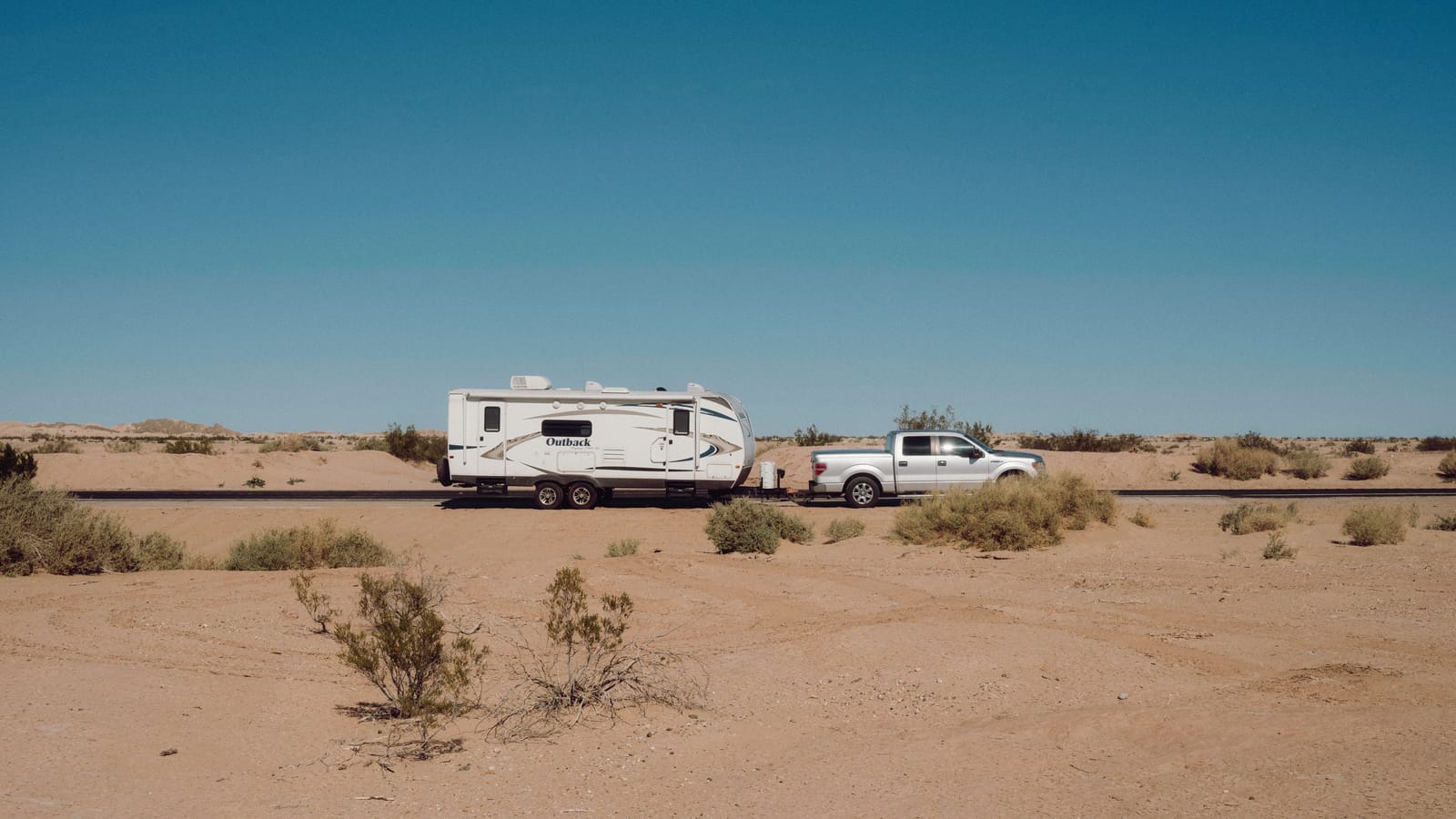
A salesman will tell you the truck tows 11,000 pounds. Your camper weighs 7,800 loaded. Sounds like three thousand pounds of breathing room, and it's not. You'll be over the truck's legal limit before your wife sits down.
The number that stops you isn't the tow rating. It's payload, and it's printed on a sticker inside the driver's door jamb of every truck sold in this country. Yellow or white, usually near the tire pressures, and it reads: The combined weight of occupants and cargo should never exceed XXX lbs. That number was calculated for the exact truck you're standing next to, with its exact options. Believe it over the brochure, over the website, over the guy with the lanyard.
Why the tow rating lies to you
Tow ratings get published for the lightest, cheapest version of a truck. Regular cab, two-wheel drive, no sunroof, no moonroof, no power running boards, a driver assumed to weigh 150 pounds and nobody else in the cab. Nobody buys that truck. You're buying the crew cab 4x4 with leather, and every one of those options came out of payload.
So a crew-cab four-wheel-drive half-ton often lands somewhere between 1,300 and 1,700 pounds of payload. Some are lower. Go look at the sticker on the one in your driveway right now, because it's probably less than you'd guess.
Now spend it.
A conventional travel trailer puts 12 to 15 percent of its loaded weight down on the ball. On a 7,800-pound trailer that's roughly 950 to 1,170 pounds, sitting on the back of your truck. A weight distribution hitch, which you need, adds another 80 to 100 pounds of steel. Add yourself at 200, your wife at 140, three kids at 300 together. Add the dog. Add the generator, the firewood, the cooler, the bikes on the tailgate rack.
You just spent 2,000 pounds of a 1,500-pound allowance. The truck will still pull the trailer down the interstate. It will pull it right up until the moment you need it to do something else, like stop, or hold a line in a crosswind on I-80 through Wyoming.
Use the loaded weight, not the dry weight
The camper brochure lists a dry weight. That's the trailer as it left the factory with no propane, no battery, no water, no fifth of the garage packed into the pass-through.
Use the trailer's GVWR instead. It's on the trailer's own sticker, it's the most the trailer is allowed to weigh, and it's the honest planning number. Two full 30-pound propane tanks, a pair of batteries, and forty gallons of fresh water will add over 400 pounds before you've loaded a single sleeping bag. Water alone runs about 8.3 pounds per gallon, which is the fact that surprises people.
Then take 13 percent of that GVWR and call it tongue weight. If your payload can't absorb that number plus everybody who's coming, you need a different truck or a smaller camper.
Where the half-ton actually stops
There's a real line, and it isn't snobbery.
Up to about 5,000 pounds loaded trailer. A properly equipped half-ton with the factory tow package is genuinely fine. Pop-ups, small single-axle trailers, most boats. Don't let anybody talk you into a three-quarter ton for this. It rides like a buckboard when the bed's empty, and you'll drive it empty 340 days a year.
5,000 to 8,000 pounds. Gray zone. A half-ton can do it if the cab is light and the family is small. Run the payload math honestly, and if you're within 200 pounds of the sticker, step up.
Anything with a fifth wheel. Three-quarter ton minimum, full stop. Fifth-wheel pin weight runs 15 to 25 percent of loaded trailer weight. A 12,000-pound fifth wheel can put 2,400 pounds in your bed. No half-ton made has that payload.
Big fifth wheels, toy haulers, horse trailers. One-ton, and at the top end a dually. The second set of rear tires isn't for pulling. It's for carrying the pin weight and for keeping you pointed straight when a semi passes you at 70.
The two ratings nobody checks
Rear gross axle weight rating. Printed on the same sticker. A fifth wheel loads the rear axle almost exclusively, and it's common to blow past RGAWR while still under GVWR. If you're going fifth wheel, this is the number that actually governs.
GCWR, the gross combined weight rating. Truck plus trailer plus everything in both. This is the one that matters on a grade. A gas three-quarter ton will haul 9,000 pounds across Kansas all day and then make you very aware of itself climbing out of Denver in August.
Which brings up the diesel. It buys you torque, an exhaust brake that saves your service brakes on a long descent, and a much calmer truck at 65 with a big trailer. It costs close to ten thousand dollars new, adds 700-plus pounds over the front axle, and the maintenance bills on a used one are serious money. If you tow 4,000 miles a year through flat country, gas is the smarter buy and you should spend the difference on the camper. If you live in the mountains or tow 12,000 pounds, the diesel isn't a luxury.
Details that decide whether towing is pleasant
- The factory tow package. Not the aftermarket receiver somebody bolted on. You want the transmission cooler, the axle ratio, the wiring, and an integrated brake controller. A 7-pin round connector is the tell.
- Axle ratio. 3.73 or 4.10 over 3.21. You'll lose a mile or two per gallon unloaded and get it all back towing.
- Wheelbase. Longer is calmer. A crew cab short bed is the most popular truck in America and the twitchiest one behind a tall trailer. Bearable with a good weight distribution hitch and honest tongue weight. For a fifth wheel, a short bed means you need a slider hitch or you'll fold the cab in a tight turn.
- Mirrors. Factory tow mirrors that extend. Try backing a 30-foot trailer into a site at dusk with stock mirrors once. You won't do it twice.
Buying used without guessing
Two schools here, and both are defensible. Buy the truck that towed its whole life and check the evidence, or buy the one that never did and accept the mileage.
If it towed: pull the hitch and look at the receiver for cracks and elongated pin holes. Look at the rear leaf springs for a sag or a mismatched replacement. Check the transmission fluid color and ask whether the cooler lines were ever serviced. On a diesel, ask directly about the emissions hardware, because that repair costs real money and the seller knows it.
If it didn't: expect brakes and suspension that never got worked, and a truck whose transmission has never been asked a hard question.
Either way, the door sticker is still the first thing you read. Second thing: hook up the camper you already own, drive to a CAT scale at a truck stop, and pay the twelve or fourteen dollars to get weighed. Front axle, rear axle, trailer, all separate. It takes fifteen minutes and it ends every argument you've had with yourself about whether the truck is enough.
Most guys discover they're heavier than they thought. Better to find that out standing still.
Dean Shaw
Gear & Garage
Reads the warranty, the parts list and the long-term owner reviews before anything else. Trucks, tools, watches, and the cheap version that costs more.

Watch
Watch how it's done
Picked for this article.
From channels we rate. Plays on YouTube.
Dick's 4x4 Garage
How to Tow Safely with a 1/2 Ton Truck: Payload Explained
All About Trailers
#GVWR - What Is It? Vehicle Weight Ratings Explained (GVWR, GCWR) w/All About Trailers
Read next