A city can regulate your rally. It can't regulate your message.
Your town can require a permit and pick the hour. It can't pick the viewpoint. Here's the test courts use and how to read your own ordinance with it.
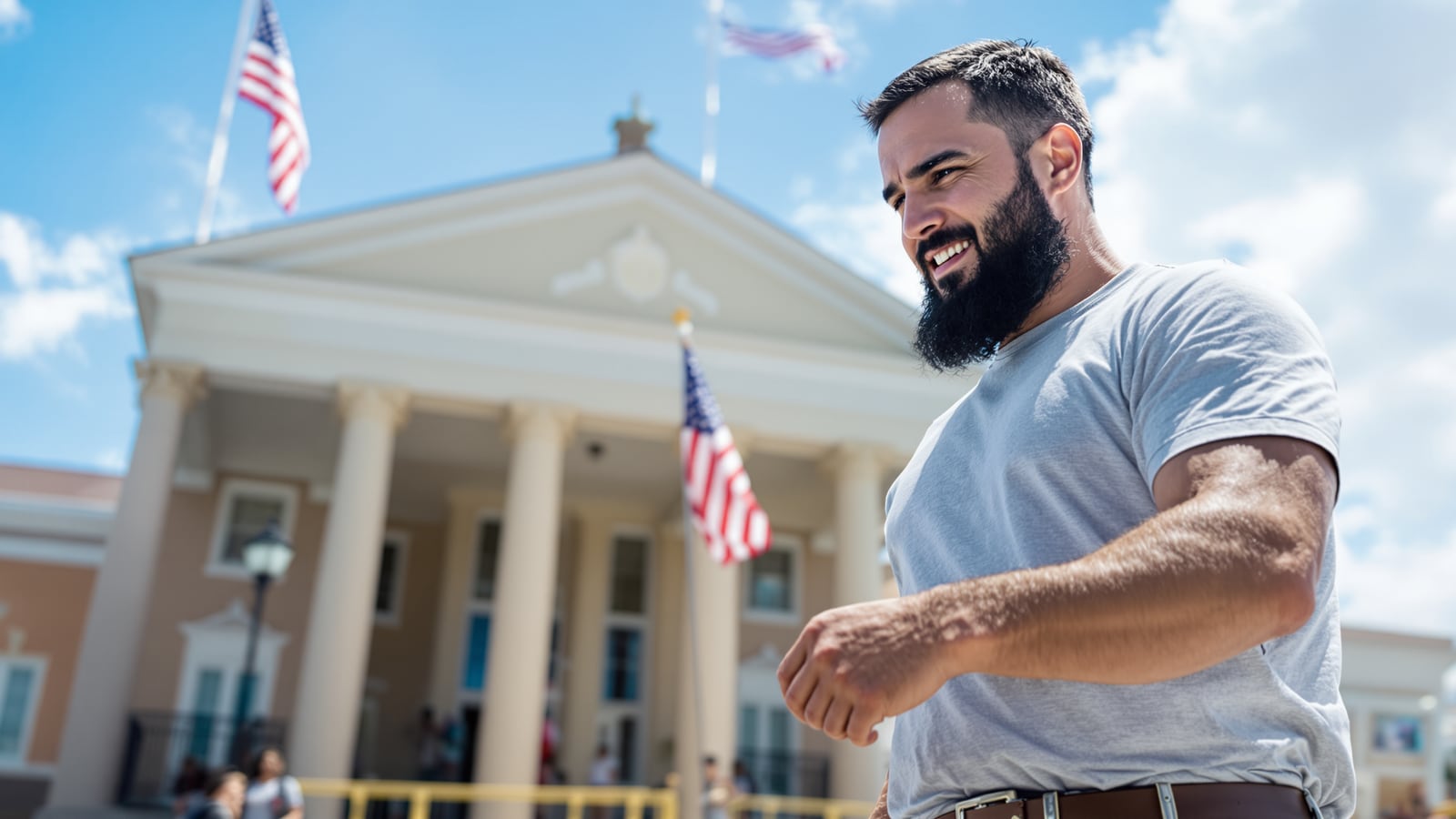
Quick answer: A city can set neutral rules about when, where and how loudly you speak. It can't turn those rules against what you're saying, and it can't hand an official the power to approve the speakers he likes. If you're planning a rally, a sign campaign or a turn at the microphone, learn that one distinction. It decides almost every case.
Why a city council is bound at all
The First Amendment opens with "Congress shall make no law." Your city council isn't Congress. But since the 1920s and 30s the Supreme Court has held that the Fourteenth Amendment carries those limits down to the states and to the cities, counties and school boards the states create. The right to assemble and petition came along too.
So the mayor, the council, the parks department and the police chief all answer to the same text. Your state constitution probably has its own speech clause as well, sometimes broader. For the wider picture, see what the First Amendment actually protects, and what it doesn't.
The test every restriction has to pass
Public streets, sidewalks and parks are what courts call traditional public forums. The Court said as far back as Hague v. CIO (1939) that these have been held in trust for public discussion. Government can regulate speech there, but only if the rule meets the test from Ward v. Rock Against Racism (1989):
- Content-neutral. It applies no matter what the speaker says.
- Narrowly tailored to serve a significant government interest, such as traffic, safety or noise.
- Ample alternatives. You still have other realistic ways to reach your audience.
Concede the obvious: this is a real test, but not a brutal one. Under Ward the city doesn't have to pick the least restrictive option. That's why a lot of ordinary rules survive. The question to ask of any ordinance is simple. Would it apply the same way if the speaker were saying the opposite?
Where cities cross the line
A permit that runs on one official's judgment. In Shuttlesworth v. Birmingham (1969), the Court struck down a parade ordinance that let officials deny permits based on vague standards like the public welfare and good order. A permit scheme needs clear, objective criteria. "We'll know it when we see it" isn't one.
A fee that tracks how much people dislike you. In Forsyth County v. Nationalist Movement (1992), a Georgia county let an administrator set parade fees up to $1,000 a day, partly to cover security against hostile crowds. The Court said no. If the price goes up because onlookers are angry, the city is taxing unpopular opinions. The group in that case was one most Americans wanted nothing to do with. That's the point. The rule that protects the speaker you can't stand is the same rule that protects you when your side is the unpopular one.
A permit to knock on doors. In Watchtower Bible v. Village of Stratton (2002), the Court struck down an Ohio village ordinance requiring a permit from the mayor's office before going door to door to promote any cause. That covers political canvassing and petitioning too. Asking a government for permission to talk to your neighbor doesn't survive.
Sign codes that rank messages. Gilbert, Arizona treated signs differently depending on what they said. Political signs got the most room and a small local church's temporary signs announcing its services got the least. In Reed v. Town of Gilbert (2015), the Court held that a rule that depends on the topic of the sign is content-based and gets the toughest scrutiny. The code failed.
Where cities win
Don't walk in thinking you can ignore every rule. The city wins plenty.
- Permits for parades and big events. Cox v. New Hampshire (1941) upheld licensing that only manages time, place and manner. Closing a street takes planning, and the city can ask for notice.
- Volume and equipment. Noise limits are routine. In Ward itself, the Court upheld New York's requirement that performers at the Central Park bandshell use the city's sound system and technician.
- Targeted picketing at a home. Frisby v. Schultz (1988) upheld a Wisconsin town's ban on picketing aimed at a single residence. You can march through the neighborhood. You can't park outside one family's door.
- Rules about location. Blocking an entrance, a lane of traffic or a fire exit isn't protected just because you're holding a flag.
- Incitement and true threats. Speech aimed at producing imminent lawless action and likely to do so isn't protected (Brandenburg v. Ohio, 1969). Neither are genuine threats. Disagreement doesn't qualify, however heated.
A sign code can also still separate on-premises from off-premises signs. The Court said so in City of Austin v. Reagan National Advertising (2022), because that line depends on location, not message. Lines like that are why you read the ordinance before you assume anything.
The council meeting is a different kind of room
A city council or school board meeting is usually a limited public forum. The board doesn't have to open the floor at all unless state law, often your state's open meetings act, says so. Once it does, the rules shift.
It can:
- set a time limit, usually three minutes
- require sign-up
- limit comment to agenda items or topics within the board's business
- remove someone who actually disrupts the meeting
It can't:
- pick who speaks by viewpoint
- let praise through and cut off criticism
- bar you from criticizing a member by name because the criticism is sharp
Courts treat that last move as viewpoint discrimination. Government officials get to run a meeting. They don't get to run an audience's opinion of them.
Opinion: This is where conservative parents, small-business owners and taxpayers should dig in. When a board changes its comment rules right after a heated meeting, ask what changed and why, and ask it politely and in public. Most boards that overreach do it out of irritation, not malice, and a calm, well-sourced citizen reading the actual policy back to them fixes it more often than a shouting match does. And if it doesn't, the First Amendment is on your side. Hit the policy, not the person who wrote it.
If you're organizing something
- Get the ordinance in writing. Call the city clerk and ask what permits apply to a rally, a march, amplified sound or signs. Read it before you plan.
- Apply early. Many cities want ten to thirty days' notice. Many also exempt small or spontaneous gatherings. Ask.
- Ask who decides. If one person has open discretion and no stated standard, note it.
- Get any denial in writing, with the reason and the appeal process. A verbal "no" is almost impossible to challenge.
- Offer an alternative. If they won't give you Main Street at noon, a reasonable counteroffer shows the "ample alternatives" half of the test is being tested.
- Know your forum. The sidewalk outside city hall is open ground. The lobby inside isn't.
- Call a lawyer if it goes sideways. Groups that take on First Amendment cases will often look at a clear denial. Nothing here's legal advice for your situation, and a local attorney who knows your state's law is the right call.
A rule that treats every speaker the same is government doing its job. A rule that depends on who's speaking is government picking winners. Read yours with that in mind, bring a copy to the next meeting, and use the three minutes you get. The same Bill of Rights that limits the council gives you the standing to hold it to the text. For the bigger picture, start with why we have a Bill of Rights and what each one says, then see how much of your life is decided closer to home in your state legislature runs more of your life than Congress does.
Marcus Vale
Editor-in-Chief
Twenty years in magazines, most of it deciding what to cut. Writes about work, discipline and the decisions that compound.

Watch
Worth an hour of your evening
More from Civics.
From channels we rate. Plays on YouTube.
Read next