

Size the generator for the second your pump kicks on
A well pump asks for three times its running power for about one second. Buy the generator for that second, and a long outage gets a lot cheaper.
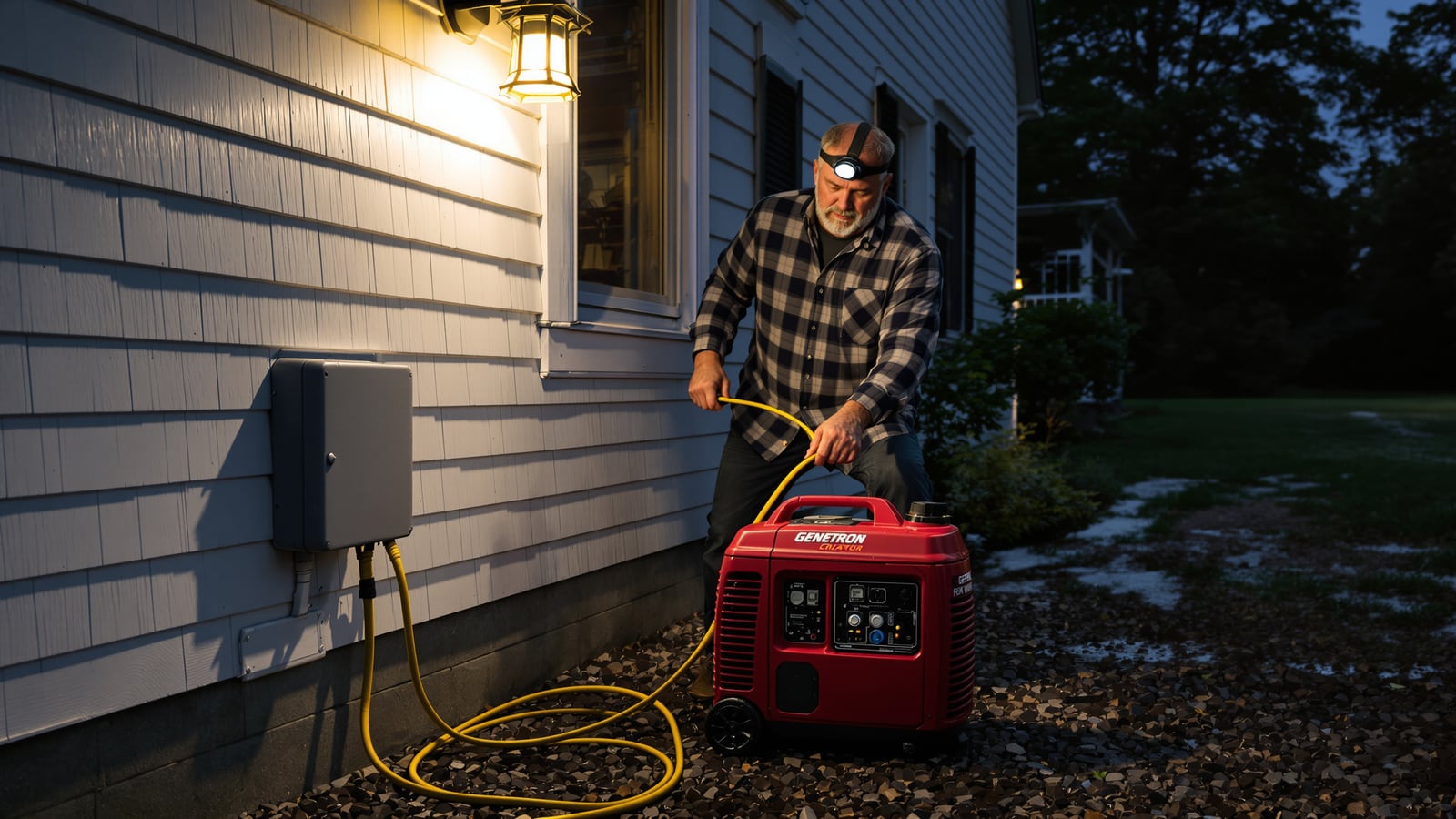
Quick answer: Read the pump's nameplate, find the amps and volts, and multiply them to get running watts. Then plan on roughly three times that for startup. Wire the generator in through a proper transfer switch or interlock, run it outside, and run it only long enough to refill the pressure tank.
The label on the generator is lying to you, politely
Most generators are sold by one big number on the box. That's the running watts. A well pump doesn't care about it.
A pump motor spends its whole life loafing along at a modest draw. But at the instant it starts, it has to get a column of water and a heavy rotor moving from a dead stop. For a second or two, it pulls several times what it needs to keep going. A half-horsepower submersible might run on a little over a thousand watts and ask for three times that to get off the line.
Buy a 3,000-watt generator because the pump "only uses a thousand," and you'll find out about starting surge at the worst time. The generator bogs, the breaker trips or the engine hunts, and the pump hums without turning.
So start with the nameplate. It's on the pump's control box if you've got a three-wire submersible, or on the motor itself with a jet pump. You'll find volts, amps and sometimes a "locked rotor" figure. Volts times running amps gives you running watts. If the locked rotor amps are listed, multiply those by the volts for a truer startup number. If they're not, three times running watts is the rule of thumb most pump installers use.
Then look at the generator's surge or starting rating, not just its running rating. That's the number your pump meets.
Your pump is probably 240 volts
Plenty of rural wells run a 240-volt pump. A generator that only offers standard 120-volt outlets can't feed it. You want one with a 240-volt output, usually on a 30-amp or 50-amp locking receptacle.
Check the pump's wiring before you shop. A jet pump in a basement is often 120 volts and easy. A deep submersible is usually 240 and wants a bigger machine.
Open-frame conventional generators often handle motor surges well for the money. Inverter models are quieter and sip fuel, but you pay more per surge watt. Either works if the surge rating clears your pump with room to spare. Leave a cushion, because you may want the refrigerator running at the same moment.
How it gets from the generator to the pump
Don't run an extension cord to the pump. It's hardwired, and it should stay that way.
Have a licensed electrician install a manual transfer switch or a generator interlock at the panel, plus an inlet box on the outside wall. This isolates your house from the grid while the generator is feeding it.
Skip the "male-to-male" cord trick that some old-timer swears by, the one that backfeeds the house through a dryer outlet. It energizes the lines outside, and a lineman working to restore your power can be killed by it. The transfer switch costs a few hundred dollars and an afternoon. It's worth it for that reason alone.
Run the circuits you want on the generator, not the whole house. Pump, refrigerator, a freezer, a few lights, the furnace blower in winter. You don't need the electric range and the dryer fighting the pump for watts.
Run it to fill the tank, then shut it off
This is the part that saves you fuel and wear. The pressure tank holds a reserve. Every time you turn on a tap, the tank drains a bit, and the pump only kicks on to refill it when the pressure drops.
So you don't have to run the generator all day. Start it, let the pump fill the tank to its cutoff, and shut the generator down. Do that two or three times a day for dishes, a shower and the toilet. You'll burn a fraction of the fuel compared with leaving it idling.
A few habits help:
- If a storm or ice is in the forecast, fill the bathtub and a few buckets first. That's your flush water, and it takes pressure off the whole system.
- Keep a couple of gallon jugs of drinking water in the pantry anyway.
- Let the tank fill before you start the dishwasher or laundry.
- Running livestock off the same well? Figure their daily water first, because horses and cattle drink more than you'd guess. What a Well and a Septic Really Cost to Keep Running covers what the system costs on an ordinary day, which is a good baseline for an outage.
In freezing weather, there's another reason to keep water moving and heat on. What Freezes First on a Property and How to Stop It is worth reading before the first hard cold snap.
Put the generator outside and keep it there
Carbon monoxide kills people every winter in exactly this situation. A cold, dark house, a generator pushed into the garage or onto the porch "just for a minute," and the exhaust drifts in.
Set the generator outdoors, a good twenty feet from the house, with the exhaust pointed away from every window, door and vent. An open garage door doesn't make a garage safe. Put battery-powered CO detectors inside, and check the batteries in the fall.
If anyone in the house gets a headache, feels dizzy or nauseated while the generator's running, get them into fresh air at once and get medical help right away. Don't tough it out.
Fuel is another danger. Let the engine cool before you refill it. Gas spilled on a hot muffler is how a bad night turns worse. Keep fuel in approved cans, away from the house.
Test it on a calm Tuesday
The worst time to learn your generator won't start the pump is two in the morning in an ice storm.
Pick a mild day. Switch your well circuit over, start the generator, and run it under real load for fifteen to twenty minutes. Watch the pump start. Listen for the engine lugging. Open a tap and make sure pressure builds.
Do it every month or two. Gas goes stale, carburetors gum up, and a pull cord that worked in March sticks by December. Use a fuel stabilizer, and rotate your stored gas into the truck before it's old. Check the oil. Keep a spare spark plug taped to the generator itself, where you'll find it.
If it fails the test, you've lost nothing. You've bought yourself the afternoon to fix it.
If the neighbor's well is dry too
In a long outage, somebody down the road will be without water, and you'll be the one with the generator. Run a hose, fill their jugs, or let them fill the tub. That's how the country works. If they borrow your generator or your can of gas, they bring it back full and clean. If you borrow theirs, you do the same, and you replace the oil. The unwritten rules of having neighbors in the country goes through that code in more detail.
Water isn't a luxury when the power goes out. It's the one thing you can't go without for long, and it's the one most people never planned for. Read the nameplate this weekend. It takes five minutes.
Wes Dunbar
Country & Skills
Grew up on an acreage and never quite left. Covers trucks, trades, land, and how to do the thing yourself.

Watch
Worth an hour of your evening
More from Country Bro.
From channels we rate. Plays on YouTube.
Read next